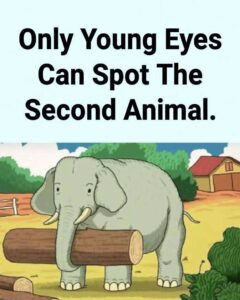
At first glance, this peaceful countryside illustration looks like an ordinary, cheerful picture. A large elephant stands on a patch of green grass, holding a wooden log with its trunk. Nearby, a small red barn, leafy bushes, and a simple fence complete the charming rural scene.
Everything appears easy to understand, and there seems to be nothing unusual about the picture.
But look a little closer.
Hidden somewhere within the illustration is a second animal, cleverly disguised among the shapes and details surrounding the elephant. Your challenge is to find it without looking at the answer first.
It sounds simple, but many people find themselves staring at the image longer than expected. The elephant naturally attracts most of the attention because it is the largest and most noticeable object in the scene. As a result, smaller details can easily escape notice.
This is what makes visual puzzles so entertaining. Sometimes, the hardest thing to see is the detail that has been sitting right in front of you all along.
Are you ready to test your observation skills? Take a moment, examine the picture carefully, and see whether you can discover the hidden creature before reading the hints below.
Can You Find the Second Animal Without a Hint?
Before reading any further, take a few moments to examine the entire picture.
Start by looking at the elephant’s outline. Notice how its legs, body, and trunk connect to the surrounding scenery. Then shift your attention to the grass, bushes, and spaces between the different shapes.
Try not to focus exclusively on the center of the illustration. Hidden-object puzzles often work by directing your attention toward one obvious subject while disguising another object within less noticeable details.
You might find it helpful to look at the picture from a slightly different perspective. Instead of asking yourself what each shape represents individually, consider whether two or more outlines could combine to form the silhouette of another animal.
Pay attention to unusual curves, dark patches, and gaps between objects. Sometimes, the outline of a hidden creature becomes clearer when you stop concentrating on the main subject.
There is no need to rush. The challenge is about careful observation rather than speed.
And remember, the title’s reference to sharp young eyes is part of the fun. People of different ages can be good at visual puzzles, and solving this one is not a scientific test of eyesight or intelligence.
Why Is This Optical Illusion So Tricky?
The secret behind many hidden-animal puzzles is the way our brains process visual information.
When we look at a picture, we tend to identify its main subject first. Once we recognize an elephant, our brains organize the surrounding shapes into a scene that makes sense: grass beneath its feet, bushes behind it, and a barn in the background.
That automatic interpretation can make it harder to notice shapes that serve a second purpose.
This tendency is related to visual attention and pattern recognition. Our brains constantly prioritize some details over others, allowing us to understand complicated scenes quickly. However, that efficiency can sometimes cause us to overlook something unusual.
A hidden animal may share its outline with a leg, a shadow, a bush, or another part of the illustration. Until you notice the alternative shape, the image may appear completely ordinary.
Once the hidden creature becomes visible, however, it can be difficult to understand how you missed it in the first place.
That moment of discovery is part of what makes these puzzles so satisfying. You are not necessarily seeing something new; you are interpreting familiar shapes in a different way.
A Small Hint Before You Reveal the Answer
Still searching?
Take another look at the lower part of the illustration, particularly around the elephant’s back leg and the bushes nearby.
Pay attention to the outlines rather than the colors alone. Try to identify a shape that does not quite fit your first interpretation of the scene.
You may find that moving your gaze away from the elephant’s face and trunk makes the smaller details easier to notice.
Here are three simple strategies to try:
- Look at the negative space: Examine the empty areas between the elephant and nearby objects. The shape of an animal can sometimes emerge from the space around it.
- Follow the outlines: Trace the edges of the bushes, legs, and other objects slowly. A single continuous curve may resemble part of another creature.
- Change your focus: Look away briefly, then return to the image and scan it from the bottom upward. A fresh look can help you notice details you previously ignored.
Give yourself a few more seconds before continuing. If you have already spotted something unusual, try to identify the animal’s head, body, or legs before deciding on your answer.
Why Do People Enjoy Hidden-Animal Challenges?
Picture puzzles have remained popular because they combine simplicity with a satisfying mental challenge.
Unlike complicated mathematical problems or lengthy quizzes, a hidden-animal puzzle requires only a picture and a little patience. Almost anyone can participate, making these challenges suitable for family gatherings, classrooms, social media posts, and relaxing breaks during the day.
They also encourage people to slow down and observe details they might normally ignore.
Children may enjoy identifying familiar animals, while adults might appreciate the clever use of overlapping shapes and visual misdirection. Friends can compare answers, share hints, and challenge one another to solve the puzzle without assistance.
These activities can encourage attention to detail and provide an opportunity to practise visual observation. However, solving one puzzle does not measure overall intelligence, and there is no need to feel discouraged if the hidden animal proves difficult to find.
Sometimes, the image itself is simply more ambiguous than expected.
The most enjoyable puzzles offer a fair challenge: the answer should make sense once it is revealed, and the viewer should be able to understand how the artist created the illusion.
The Big Reveal: What Is the Hidden Animal?
Before revealing the solution, there is one important detail to remember: the exact answer depends on the specific illustration.
Without seeing the actual picture, it would be misleading to name a particular animal or claim that it is hidden in the elephant’s back leg or nearby bushes. The location suggested in the hint is a place to inspect, not confirmation of the solution.
If the image clearly shows the second animal once its outlines are traced, look for the features that distinguish it from the surrounding scenery. Does it have a recognizable head, ears, tail, or legs? Can you follow its shape without combining unrelated parts of the illustration?
Those clues can help confirm whether you have found the intended creature rather than an accidental resemblance.
If you have already identified the animal, congratulations! You have taken the time to look beyond the most obvious subject and consider another interpretation of the scene.
If you are still searching, don’t worry. Sometimes a small change in perspective is all it takes to make the answer appear.
Challenge Your Friends and Family
Once you solve the puzzle, share it with someone else and see how long it takes them to find the hidden animal.
Resist the temptation to reveal the answer immediately. Give them a chance to examine the elephant, study the surrounding shapes, and discover the solution themselves.
You can offer the same lower-area hint if they get stuck, but let them decide when they are ready for more help.
You may be surprised by how differently people interpret the same picture. One person might immediately notice a shape near the elephant’s legs, while another concentrates on the bushes or the outline of the trunk.
That difference is part of the fun.
Final Thoughts: Did You Spot It?
At first glance, the illustration seems straightforward: an elephant, a wooden log, green grass, a red barn, and a peaceful countryside setting.
Yet the possibility of a hidden second animal encourages us to examine familiar objects more carefully and question our first impressions.
That is the appeal of a good visual puzzle. It reminds us that what we notice first is not always everything there is to see.
Now it’s your turn: Did you find the hidden animal on your own, or did you need a hint? Share your answer and challenge your friends to see whether they can solve the mystery, too.