My wife and I left town for a long weekend, expecting to return to the same peaceful neighborhood we had called home for years. We had no idea that while we were away, our neighbor, Priscilla, would make a decision that would change our relationship with her forever.
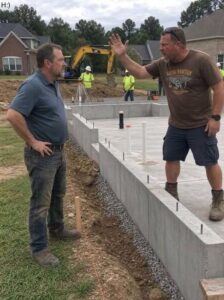
When we returned, I noticed construction equipment parked next door, piles of dirt scattered across the yard, and a fresh concrete foundation where there had previously been nothing but grass. Priscilla had been planning an addition to her home for months, so the construction itself wasn’t surprising. What caught my attention was how close the foundation sat to our property line.
At first, I assumed the builders had simply worked within the approved boundaries. Then I walked closer and noticed something that made my stomach tighten.
Part of the concrete appeared to extend onto our land.
I stood there staring at it, trying to convince myself that I was mistaken. Perhaps the angle was misleading. Maybe the foundation had been poured right up to the boundary, making it look as though it crossed over. I wanted to believe there was a reasonable explanation because the alternative meant dealing with a neighbor who had apparently taken a serious liberty while we were away.
Unfortunately, the more I looked, the less comfortable I became.
The Missing Property Markers
That evening, after my wife and I had unpacked, I retrieved our property survey from the filing cabinet in my office. We had purchased the house years earlier, and I had kept the documents carefully organized. The survey clearly identified our boundaries, including the section of land where Priscilla’s new foundation now stood.
The following morning, I walked along the edge of our property with the survey in hand.
Several boundary markers that I remembered seeing before our trip were missing. I searched the grass and the disturbed soil near the construction area, hoping they had merely been covered during excavation. I couldn’t locate them.
That discovery changed my perspective.
A missing marker doesn’t automatically prove wrongdoing, and I knew I needed professional confirmation before making accusations. Still, the combination of the missing pins and the position of the concrete was difficult to ignore.
I took photographs from several angles, documenting the foundation, the disturbed ground, and the apparent overlap. I also saved copies of the construction plans Priscilla had previously discussed with us. Those drawings appeared to show the addition staying within her property.
What I was seeing now looked different.
Rather than confronting the builders or attempting to measure the boundary myself, I decided to hire a licensed land surveyor. I wanted an independent assessment that would stand up to scrutiny if the disagreement became a legal matter.
What the Surveyor Discovered
The surveyor arrived a few days later carrying professional equipment and copies of the relevant property records. He reviewed our deed, examined the existing boundary information, and began taking measurements around the affected area.
For several hours, he worked methodically, checking reference points and comparing the recorded boundaries with the new construction.
I watched from a distance, growing increasingly anxious as the afternoon passed.
Finally, he approached me with his notes.
His findings confirmed my concern: part of Priscilla’s newly poured foundation extended beyond her property boundary and onto our land.
The exact consequences would depend on the applicable property laws and the circumstances surrounding the construction, but the physical encroachment was no longer merely my suspicion.
I asked the surveyor whether the missing markers had affected his work. He explained that he had used reliable reference information and appropriate surveying methods to establish the boundary. The absence of the visible pins did not prevent him from determining where the property line belonged.
I thanked him and requested a written report, along with a clear drawing showing the location of the foundation relative to the legal boundary.
That document became one of the most important pieces of evidence I had.
Priscilla Refused to Listen
I decided to speak with Priscilla that evening.
I approached her house calmly, carrying a copy of the surveyor’s preliminary findings. I hoped that once she understood the measurements, she would recognize the problem and work with us to find a solution.
Instead, she became defensive almost immediately.
She insisted that the land belonged to her and claimed that the construction crew had followed the plans provided to them. When I explained that an independent survey placed part of the foundation on our property, she dismissed my concerns.
Then she said something I couldn’t forget.
“You have no right to interfere with my construction.”
I stared at her, struggling to understand how she could be so certain while refusing to consider the evidence. I explained that I wasn’t trying to interfere with legitimate construction on her land. I simply wanted the portion occupying our property addressed properly.
She crossed her arms and told me she had already spent too much money on the project to stop now.
That was when I realized a friendly conversation probably wouldn’t resolve the situation.
I returned home and told my wife everything. She was upset, particularly because the work had progressed while we were away and because our attempts to discuss the matter had been rejected.
Neither of us wanted a prolonged neighborhood dispute. We valued our home, our privacy, and the quiet life we had built there. But avoiding conflict could not mean surrendering land we legally owned.
We needed professional legal advice.
My Attorney Examined Every Document
The following morning, I contacted our attorney, Martha Kline, and arranged a meeting. I brought our deed, the original survey, the surveyor’s report, photographs of the construction, and the plans Priscilla had previously shared.
Martha reviewed everything carefully.
She paid particular attention to the recorded property description, the surveyor’s measurements, the timing of the construction, and the differences between the earlier plans and the foundation that had actually been poured.
I explained that we had been away when the concrete work took place. I also described the missing boundary markers and Priscilla’s refusal to acknowledge the survey findings.
Martha listened without interrupting. When I finished, she placed the documents on her desk and looked directly at me.
“Don’t touch that foundation yet,” she said. “Let me see what we can do.”
Her advice surprised me. I had been so frustrated that I had considered demanding that the construction crew remove the concrete immediately. Martha explained that taking matters into our own hands could create additional legal problems.
We shouldn’t damage the foundation, enter the neighboring property without permission, or interfere physically with the construction. Instead, we needed to preserve the evidence and pursue the matter through the appropriate legal channels.
Depending on the applicable law, potential remedies could include a negotiated agreement, compensation, an easement, removal of the encroaching structure, or a court order. None was automatic, and the right approach would depend on the facts and local requirements.
Martha recommended that we begin by formally notifying Priscilla of the survey findings and demanding that the encroachment be addressed before additional work made the situation more complicated.
The Evidence Became Our Strongest Advantage
Over the next several days, Martha organized the documentation into a clear timeline. We preserved the original photographs, obtained the surveyor’s final report, and collected the available records relating to the addition.
We also kept copies of our communications with Priscilla.
Every step was deliberate. Rather than relying on accusations or assumptions about her motives, we focused on what could be demonstrated: where our boundary lay, where the foundation had been built, and what the professional measurements established.
Martha sent a formal letter explaining the encroachment and requesting a response. The letter also made clear that we did not consent to the continued occupation of our land.
For the first time, the matter was being handled through a process that required everyone involved to take the evidence seriously.
Priscilla did not immediately apologize, and there was no dramatic overnight resolution. Construction disputes involving property boundaries can be complicated, particularly when concrete has already been poured and substantial money has been spent.
But our position was much clearer than it had been when we first returned from our trip.
We had the deed. We had the photographs. Most importantly, we had an independent survey establishing the boundary.
What I Learned From the Experience
Looking back, the most disturbing part wasn’t simply that the foundation crossed onto our property. It was how quickly a manageable disagreement became a serious conflict because one person refused to discuss the evidence.
I learned that property boundaries should never be treated casually, especially when major construction is involved. A few feet of land can affect access, drainage, maintenance, future building plans, and the value or use of a property.
I also learned that documentation matters. Keeping our original survey, recording what we observed, and hiring a qualified professional gave us a factual basis for addressing the problem.
Most importantly, I learned not to let anger dictate my response. Pouring concrete onto someone else’s land does not mean the owner should retaliate or attempt a forced solution. Professional advice and lawful procedures offer a safer path.
My wife and I had left for a peaceful long weekend, believing everything at home was exactly as we had left it. We returned to a dispute we never expected and a foundation that threatened to turn our own property into the center of a legal battle.
We still wanted a fair resolution, not revenge. But we also understood that protecting our home meant standing firm when our boundaries were crossed.
The surveyor had revealed the facts. Martha had helped us understand our options. Now the next move was up to Priscilla: acknowledge the problem and work toward a lawful solution, or continue disputing a boundary that the evidence had clearly established.
Whatever happened next, one thing had changed permanently. We would never again assume that keeping the peace meant staying silent when something was wrong.