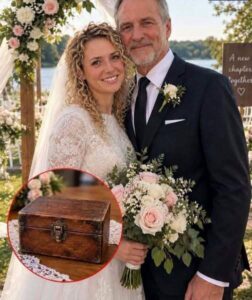
Everyone thought they knew why I married Russell. I was thirty-two, buried in debt, and constantly afraid that one unexpected expense would ruin me. Russell was sixty-two, wealthy, widowed, and living in a beautiful home filled with luxuries I had only seen in magazines.
To outsiders, our marriage seemed obvious: a struggling young woman had traded companionship for financial security. Even I understood why people whispered. But they never knew how our relationship had actually begun.
I met Russell while serving champagne at a charity dinner. Wealthy guests passed me without a glance, but Russell stopped and asked my name. Then he noticed me shifting painfully in my worn shoes.
“Do your feet hurt?” he asked.
It was such a small kindness that I nearly laughed. Nobody had shown concern for me in years.
We met again days later, and our conversations became longer. Three months later, Russell proposed. But when he introduced me to his three adult children, his daughter Marlene looked at me once and immediately decided exactly what kind of woman I was.
She had no idea that, one day, a small wooden box would reveal the truth about her father—and change everything she believed about me.
The Marriage Nobody Believed In
Russell was not the kind of man who needed to impress people. He had made his fortune through years of hard work, careful investments, and a successful manufacturing business. He dressed simply, spoke thoughtfully, and treated everyone with the same quiet respect, whether they were serving dinner or sitting across from him at a board meeting.
I had grown up in a very different world.
My father had died when I was young, and my mother spent years struggling with medical expenses before passing away herself. I worked several jobs to keep myself afloat, but a combination of student loans, unpaid bills, and an unexpected medical emergency left me financially exhausted.
By the time I met Russell, I had stopped making plans beyond the following month.
He never asked me to pretend my life was easier than it was. Instead, he listened.
When I told him about my mother, he remembered her name. When I mentioned working double shifts, he asked whether I was getting enough rest. And when I apologized for wearing an inexpensive dress to our first dinner together, he looked genuinely confused.
“You look lovely,” he said. “Why would the price of a dress change that?”
I fell in love with the way he made ordinary moments feel safe.
When he proposed, I hesitated—not because I doubted my feelings, but because I knew what people would say.
“Everyone will think I’m marrying you for your money,” I told him.
Russell took my hands.
“People are entitled to their opinions,” he replied. “But you and I should know why we’re making this decision.”
So we married in a small ceremony attended by a handful of friends.
I thought love would be enough to help us build a peaceful life.
I underestimated how fiercely his children would fight to protect what they believed belonged to them.
The Daughter Who Never Accepted Me
Marlene was forty, successful, and accustomed to being in control. Her younger brothers, Daniel and Peter, were less confrontational, but neither made much effort to welcome me.
At our first family dinner, Marlene studied me from across the table.
“Thirty-two,” she said, stirring her wine. “That’s quite an age difference.”
I smiled politely.
“It’s certainly noticeable.”
“And you were working at a charity dinner when you met Dad?”
“Yes.”
“How convenient.”
The accusation hung in the air.
Russell put down his fork.
“Marlene, that’s enough.”
She leaned back in her chair, looking more offended than embarrassed.
“I’m only trying to protect you, Dad. You have to admit this looks suspicious.”
“I know exactly what my marriage looks like,” Russell answered. “And I know the woman I married.”
That evening, he apologized to me after everyone had left.
I told him he didn’t need to choose between his children and me.
“They’re my family,” he said quietly. “But that doesn’t give them the right to disrespect you.”
Over the next two years, Marlene continued treating me like an outsider. She questioned my purchases, commented on my clothes, and made remarks about the house whenever she visited.
Once, she found me arranging flowers in the living room and said, “Enjoy it while you can. This house has been in our family for years.”
I wanted to remind her that I had never asked for the house.
Instead, I continued arranging the flowers.
Russell noticed more than I realized.
One night, as we sat together beside the fireplace, he asked whether I regretted marrying him.
“Never,” I answered.
He smiled, but there was sadness in his eyes.
“Good,” he said. “Because someday, you may discover that this family is not quite what it seems.”
I asked what he meant.
He shook his head.
“Not yet. There’s something I need to finish first.”
I assumed he was talking about business.
I never imagined he was preparing for the day he would no longer be there to protect me.
The Illness That Changed Everything
During our third year of marriage, Russell began experiencing health problems. At first, he dismissed them as ordinary signs of aging. But after several hospital visits, his doctors discovered a serious condition that required ongoing treatment.
Our home changed almost overnight.
There were appointments, medications, difficult conversations, and long nights when I sat beside him, listening to his breathing. The man who had once walked beside me through gardens now needed help getting from his bedroom to the living room.
I cared for him because I loved him.
I helped him eat when his hands trembled, read aloud when his eyesight weakened, and held his hand whenever fear crossed his face.
His children visited, but their conversations often returned to the business, the family trust, and the future of his estate.
Marlene was particularly interested in whether Russell had changed his will.
“Dad, we need to know everything is properly arranged,” she said one afternoon.
Russell looked at her.
“Everything is arranged.”
“And she knows about it?”
I was sitting near the window when she said it. I pretended to be absorbed in my book, but every word reached me.
Russell’s expression hardened.
“My wife is not a subject for discussion as though she’s a problem to be managed.”
Marlene left shortly afterward.
That evening, Russell asked me to promise him something.
“When the time comes, don’t let anyone frighten you into signing anything you don’t understand.”
I felt a chill.
“Russell, please don’t talk like that.”
He squeezed my hand.
“Promise me.”
I promised.
Neither of us knew how soon I would need to remember those words.
The Funeral and the Unexpected Visitor
Russell died peacefully one early morning, with my hand resting in his.
For several days, I moved through the world as though I were underwater. His slippers remained beside the bed. His favorite book lay open on the nightstand. Every room seemed to contain some small reminder of a life that had suddenly become impossible to continue.
At the funeral, Marlene barely acknowledged me.
She stood beside her brothers, accepting condolences and speaking with relatives. When I approached to offer her a hug, she stiffened.
“Please don’t make this more difficult than it already is,” she whispered.
I stepped away.
I had lost my husband. Somehow, I was also being made to feel like an intruder at his funeral.
Two days later, I received a call from Russell’s attorney, Mr. Bennett.
He asked me to visit his office because Russell had left specific instructions concerning a personal item that was to be delivered to me after his death.
When I arrived, Mr. Bennett greeted me warmly and placed a small wooden box on the desk.
It was old, with brass corners and a tiny silver key tied around its handle.
“Your husband asked me to give you this personally,” he explained.
I stared at the box.
“What is it?”
Mr. Bennett folded his hands.
“I’m afraid that’s something you’ll have to discover for yourself. However, he left a letter that should be read first.”
He handed me a sealed envelope.
My name was written across the front in Russell’s unmistakable handwriting.
My hands began to tremble.
The Letter That Revealed His Secret
I opened the envelope carefully.
Inside was a short letter.
My dearest Anna,
If you are reading this, I am no longer beside you, and I am sorry I could not tell you everything while I was alive.
You came into my life when I had almost forgotten what genuine kindness felt like. You never treated me as a fortune, a title, or an old man whose days were numbered. You treated me as a person.
I know my children have made you feel unwelcome. I also know they believe they understand everything about my life and my decisions. They do not.
Inside this box is the truth about a promise I made long before I met you. Read everything carefully, and trust the people who have earned your trust—not those who simply share your name.
You gave me more happiness than I ever expected to find again. Please do not let anyone convince you that your love was a mistake.
All my love,
Russell.
Tears blurred the page.
I had spent years wondering whether I could ever prove that my love was genuine. Russell had never demanded proof, but his children’s suspicion had slowly planted doubts in my mind.
Now, even after his death, he was reassuring me.
I turned the tiny key and lifted the lid.
Inside were several documents, a photograph, and a second envelope bearing the words: For Anna’s eyes only.
The photograph showed Russell standing beside a young woman in front of a modest brick house. He looked perhaps thirty years younger. The woman was smiling, and he held a small child in his arms.
I turned the photograph over.
Written on the back were the words: The promise that changed my life.
I looked at Mr. Bennett.
“Who is this woman?”
He took a slow breath.
“Her name was Elizabeth. She was your husband’s first love, before he married his first wife. And the child in the photograph was the reason Russell spent much of his life trying to make things right.”
My heart pounded.
“What happened to them?”
Mr. Bennett pointed toward the second envelope.
“Your husband wanted you to learn the rest from his own words.”
The Truth Behind the Box
Inside the second envelope was a longer letter explaining that Russell had once been engaged to Elizabeth, a woman from a family with very little money. His parents had disapproved of the relationship and pressured him to end it. He eventually married someone else, believing that he had made the responsible choice.
Years later, he learned that Elizabeth had given birth to a daughter. Although he had not known about the child at the time, he quietly arranged financial support once he discovered the truth.
The daughter grew up, built her own life, and wanted nothing to do with his wealth. Russell respected her wishes, but he never stopped regretting the years he had lost.
The documents in the box concerned a charitable foundation he had established in her honor. The foundation supported people facing medical hardship and financial insecurity, the very circumstances that had shaped my early life.
Russell had never told me about it because he wanted our marriage to develop without money or family history defining it.
At the end of the letter, he explained that he had included instructions for the foundation’s future administration. He wanted me to have the opportunity to help guide its work, subject to the foundation’s governing documents.
He had not chosen me because I was young or because he believed I needed rescuing.
He had chosen me because he had seen how I treated people who had nothing to offer me in return.
For the first time, I understood what he had meant when he told me that someday I might discover his family was not what it seemed.
The box was not simply an inheritance.
It was an invitation to continue something meaningful.
The Beginning of a Different Life
When Marlene learned about the foundation, she was furious.
She accused me of manipulating her father and demanded that his attorney explain every document in the estate.
Mr. Bennett remained calm. He explained that the estate and foundation would be administered according to the applicable legal documents, and that any questions about ownership or authority would be addressed through the proper procedures.
I did not argue with Marlene.
I had spent too much of my life trying to convince people who had already decided not to believe me.
Instead, I began learning about the foundation, meeting its advisers, and listening to families who needed help with medical bills, housing expenses, and unexpected emergencies.
Their stories reminded me of the frightened young woman I had been when I first met Russell.
Over time, the foundation helped expand programs that offered practical assistance to people facing difficult circumstances. Every time someone received help, I felt that a small part of Russell’s kindness was continuing in the world.
I still missed him. I missed his laughter, his thoughtful questions, and the way he noticed the smallest details about the people around him.
But I no longer wondered whether our marriage had been a mistake.
I had married a man thirty years older than me, and people had assumed they understood our reasons.
They had judged our relationship by our ages, our circumstances, and their own expectations.
They had never seen the quiet kindness that brought us together.
And they had never understood the truth hidden inside that little wooden box.
Russell left me something more valuable than an explanation for our marriage. He left me the chance to turn love into action, grief into purpose, and a painful beginning into hope for someone else.
In the end, the greatest inheritance was not what he owned.
It was what he taught me to do with the life I still had.
And that was a gift no one could take away.