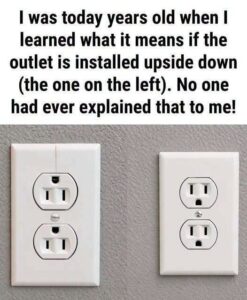
Have you ever walked into a room, glanced at the wall, and noticed an electrical outlet installed upside down? Instead of seeing the familiar ground opening at the bottom, you find it facing upward. At first, you might assume the electrician made a mistake or that someone installed the outlet incorrectly. Surprisingly, that unusual position can sometimes serve a practical purpose.
Although most people rarely think about the direction of their electrical outlets, electricians may choose different orientations for several reasons. These can include identifying switched outlets, accommodating certain installation conditions, and following individual preferences or local conventions. However, there is no single explanation for every upside-down outlet, and its orientation alone cannot tell you exactly how it is wired.
1. Identifying outlets controlled by a wall switch
One possible reason for installing an outlet upside down is to distinguish it from other outlets in the same room.
In many older homes, particularly those built before ceiling lighting became standard in every room, a wall switch controlled a receptacle intended for a table lamp or floor lamp. Instead of installing a dedicated ceiling light, builders provided an outlet that allowed residents to switch a lamp on or off from the doorway.
This arrangement remains common in some homes today.
Imagine entering your living room after sunset. You flip the wall switch beside the door, and a lamp across the room turns on automatically. You can illuminate the space without walking through the darkness to find the lamp’s own switch.
Some electricians have used outlet orientation as a visual clue to distinguish a switched receptacle from a continuously powered one. In certain installations, the outlet with its ground opening facing upward may indicate that the receptacle is connected to a wall switch.
This can be especially useful when one outlet is switched while nearby outlets remain powered continuously.
However, this practice is only a convention. An upside-down outlet does not automatically mean that a wall switch controls it. The only reliable way to determine its function is to test it safely or have a qualified electrician inspect the wiring.
2. Making partially switched outlets easier to identify
Sometimes, only one half of a duplex receptacle is controlled by a wall switch.
A standard duplex outlet has two places to plug in electrical devices. Depending on how it is wired, the upper and lower receptacles may operate differently.
For example, one half might be connected to a wall switch, while the other remains energized continuously.
This arrangement gives homeowners flexibility. They can plug a lamp into the switched half and use the other half for a device that should remain powered, such as a clock or a phone charger.
In some installations, electricians may orient the entire receptacle upside down to help indicate that it has a special function.
Yet the orientation does not reveal which half is switched, nor does it guarantee that the receptacle has been wired in this way. Different electricians may use different identification methods, and some may not use orientation to communicate wiring arrangements at all.
If you have an outlet like this, checking its operation is more useful than relying on its appearance.
3. Helping plugs stay connected in certain situations
Another explanation sometimes offered for upside-down outlets involves the way plugs and cords sit against the wall.
Depending on the outlet location, the shape of a plug, and the direction of its cord, a particular orientation may make the installation more convenient.
For example, a receptacle positioned behind furniture may be arranged to accommodate a specific plug configuration or reduce awkward cord routing.
However, turning an outlet upside down does not automatically make it safer or prevent plugs from falling out. A loose-fitting receptacle should be repaired or replaced appropriately rather than relying on orientation to solve the problem.
Likewise, the direction of the ground opening does not, by itself, determine whether an outlet is correctly installed. Proper grounding, secure connections, suitable electrical protection, and compliance with applicable electrical requirements are far more important.
4. Does electrical code require outlets to face one direction?
Many homeowners assume electrical outlets must always be installed with the ground opening facing downward. In many ordinary installations, however, electrical codes do not establish one universal orientation for every standard wall receptacle.
Requirements can differ depending on the country, jurisdiction, type of installation, and applicable electrical code. Special installations may have additional rules.
In the United States, for example, standard receptacles are often installed with the grounding opening downward, but electricians also encounter installations where the ground opening faces upward or sideways.
The important distinction is between an installation that looks unusual and one that is actually unsafe or noncompliant.
An upside-down outlet is not automatically defective. Similarly, an outlet that looks conventional is not necessarily safe simply because it has the expected orientation.
What matters is whether it has been installed correctly, is properly grounded where required, and complies with the relevant electrical standards.
If you are unsure about an outlet’s condition, a qualified electrician can check it rather than relying on appearance alone.
5. Why electricians sometimes disagree about orientation
Ask several electricians how a receptacle should be positioned, and you may receive different answers.
Some prefer the ground opening at the bottom because it is the arrangement they have used throughout their careers. Others prefer the ground opening at the top because they believe it can offer an advantage in certain situations.
One argument for ground-up installation concerns a loose plug. If a metal object were to fall behind a partially disconnected plug, proponents argue that the grounding pin might make contact with the object before the energized pins, potentially reducing the chance of a short circuit.
However, this is not a guarantee of protection. The outcome depends on the object, plug design, outlet configuration, and circumstances. Proper grounding and electrical protection remain essential regardless of orientation.
Other electricians prefer a consistent orientation throughout a building because it makes installations look uniform and easier to recognize.
Ultimately, the choice may reflect a combination of practical considerations, professional convention, and personal preference.
6. How to find out whether your outlet is switched
If you have discovered an upside-down outlet in your home, you can investigate its function without removing the cover or touching any wiring.
First, plug a small lamp into the receptacle. Make sure the lamp works and that its own switch is turned on.
Next, operate the nearby wall switches one at a time. Observe whether the lamp turns on or off when you use a particular switch.
If your outlet has two receptacles, you can test each one separately.
If the lamp responds to a wall switch, that provides evidence that the receptacle is switched. If nothing happens, the outlet may be continuously powered, or the controlling switch may be elsewhere.
Do not remove the outlet cover, insert tools into the receptacle, or handle exposed wiring to investigate its function. If the outlet is damaged, feels unusually hot, sparks, or produces a burning smell, stop using it and seek assistance from a qualified electrician.
The real reason behind upside-down outlets
The next time you notice an outlet with its ground opening facing upward, remember that its position may have been intentional.
It might be a visual indicator for a switched receptacle, a choice made to suit the installation, or simply the electrician’s preferred orientation.
But there is no universal rule that every upside-down outlet serves a special purpose. Its direction alone cannot tell you whether it is switched, how it is wired, or whether it meets all applicable safety requirements.
Sometimes, the explanation is practical. Other times, it is simply a matter of convention.
What appears to be an installation mistake may actually reflect a deliberate choice—and understanding that possibility can help you see the small design decisions hidden throughout your home.