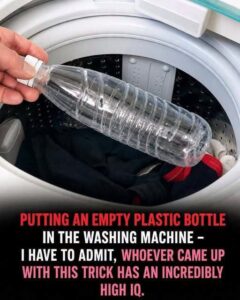
The Unusual Laundry Trick Taking the Internet by Surprise
If you have recently seen videos of people placing empty plastic bottles inside their washing machines, you may have wondered whether they have discovered a clever household trick or are simply risking damage to their appliances.
At first, the idea sounds strange. Most people check their pockets before starting a wash, removing coins, tissues, keys, and other objects that could cause problems. Yet this viral laundry method encourages people to put one or two plastic bottles directly into the drum alongside their clothes.
Supporters claim the bottles may help prevent bedsheets from tangling, keep bulky laundry moving, and potentially reduce wrinkles. Some even suggest that this simple trick can improve washing performance without requiring expensive accessories.
But does it actually work?
The answer is more complicated than social media videos might suggest. While the idea has a certain appeal, there is little reliable evidence that ordinary plastic bottles consistently improve laundry results. Depending on the washing machine, the bottle, and the type of load, the trick may have little effect or create unnecessary problems.
Before trying it yourself, there are several important things to understand.
1. How Is the Plastic Bottle Method Supposed to Work?
The basic idea is simple: place an empty plastic bottle among the laundry and allow it to move around during the wash cycle.
Supporters believe that the bottle can act as a loose object that disturbs the movement of the fabrics. As the drum rotates or water circulates, the bottle may shift between garments and potentially interrupt the formation of large, tangled bundles.
Imagine washing a large bedsheet. During the cycle, the sheet folds over itself and wraps around smaller items, creating a tight bundle. When the cycle finishes, some clothes may still be trapped inside the sheet.
People who promote the bottle method suggest that the bottle might help disturb this bundle, encouraging the laundry to move more independently.
However, this explanation is theoretical. Washing machines use different mechanisms to move clothes, depending on whether they are front-loading or top-loading models. An object that moves freely in one machine might behave very differently in another.
There is no strong evidence that ordinary plastic bottles reliably prevent tangling or produce cleaner clothes.
2. Why Are People Trying It With Bedsheets?
Bulky laundry is one of the main reasons this trick has attracted attention.
Bedsheets, duvet covers, lightweight blankets, and large garments can twist around one another during washing. When this happens, smaller items may become trapped inside the fabric, and the finished load can emerge as one enormous bundle.
This is frustrating because the clothes may not have enough room to move freely, and separating them after the cycle can take extra time.
The bottle trick appeals to people because it appears inexpensive and convenient. Most households have empty plastic bottles available, so there is no need to purchase a special laundry product.
But a simple solution is not necessarily an effective one.
The results may depend on the amount of laundry inside the drum, the dimensions of the bottle, the machine’s design, and the types of fabrics being washed.
In some circumstances, the bottle may have little noticeable effect. In others, it could bounce around, create additional noise, or interfere with the normal movement of the load.
For that reason, it is better not to assume that a viral video demonstrates a method that will work equally well in every home.
3. Can Plastic Bottles Actually Reduce Wrinkles?
Wrinkles are influenced by several factors, including fabric composition, washing temperature, spin speed, load size, and how long wet clothes remain compressed.
When a washing machine is overloaded, garments have less room to move. They may become tightly packed together, increasing the likelihood of creases and making it harder for water and detergent to circulate effectively.
Some people believe that a plastic bottle helps create additional movement and space between garments, potentially reducing wrinkles.
However, this claim has not been established as a reliable laundry technique.
Even if the bottle changes how a particular load moves, that does not necessarily mean the clothes will emerge with fewer creases. The result could vary significantly between fabrics and machines.
If reducing wrinkles is your main goal, more established methods are worth trying first:
- Avoid overloading the washing machine.
- Follow the garment’s care label and select an appropriate cycle.
- Use a suitable spin speed for the fabric.
- Remove clothes promptly after the cycle finishes.
- Shake out garments and smooth them before hanging or drying.
- Use a dryer setting appropriate for the material, if the care label permits tumble drying.
These measures address common causes of wrinkling without introducing an unnecessary object into the drum.
4. Could a Plastic Bottle Damage Your Washing Machine?
This is an important consideration that viral videos do not always address.
Household washing machines are designed to operate with laundry and approved accessories, not necessarily with arbitrary objects placed inside the drum.
A soft, empty bottle might appear harmless, but its behavior during a wash cycle can be difficult to predict.
Depending on its shape and construction, it could become trapped among the clothes, make repeated contact with the drum, or produce unusual noises. If the bottle has a hard cap, damaged edges, or other rigid parts, the potential concerns may increase.
A bottle could also become deformed under pressure or temperature changes, depending on the plastic and the wash conditions.
The risk is not necessarily that every bottle will damage every washing machine. Rather, there is no universal assurance that the practice is safe across different appliances.
Manufacturers may also have specific instructions about objects and accessories that should not be placed inside their machines.
Before experimenting with unusual laundry methods, consult your washing machine’s user manual. If the manufacturer does not recommend the practice, it is best to avoid it.
Never use a bottle that has sharp edges, damaged plastic, loose parts, or a cap that could detach.
5. What About Bottles Filled With Water?
Some online demonstrations may show bottles containing water rather than completely empty ones. These variations should not be treated as equivalent methods.
Adding water changes the bottle’s weight and the way it moves through the load. A heavier object could behave differently from an empty bottle, particularly during spinning.
The washing machine must already manage the weight and distribution of wet laundry. Introducing an improvised object adds another variable without a clearly established benefit.
For that reason, placing water-filled bottles inside a washing machine is not a recommended general-purpose laundry technique.
If a load repeatedly becomes tangled or unbalanced, it is better to address the underlying cause rather than adding objects that the machine was not designed to accommodate.
6. Better Ways to Stop Laundry From Tangling
Fortunately, there are practical ways to reduce tangling without relying on an unproven viral trick.
Separate bulky items. Washing very large sheets with a load of small garments can encourage smaller items to become trapped. When appropriate, wash bulky bedding separately.
Avoid overfilling the drum. Clothes need enough room to move during washing. Follow the manufacturer’s loading guidance rather than packing the machine as tightly as possible.
Use suitable laundry accessories. Purpose-made laundry balls or other accessories may be appropriate for certain tasks, but check that they are compatible with your appliance and follow the product instructions. Their effectiveness depends on the particular product and the intended use.
Choose the correct cycle. Bedding and bulky-item programs are designed for particular types of loads. Consult your manual to determine which cycle is appropriate for your machine.
Check the load if the machine becomes unbalanced. If your washer repeatedly vibrates excessively or stops during spinning, follow the manufacturer’s troubleshooting instructions. Persistent problems may require professional inspection.
These steps are more sensible starting points than experimenting with an ordinary plastic bottle.
7. Why Do Viral Laundry Hacks Spread So Quickly?
The popularity of the bottle trick illustrates how easily a simple household idea can capture attention online.
People appreciate solutions that promise to save money, reduce chores, and make everyday tasks easier. A short video showing an unusual trick followed by a seemingly impressive result can be especially persuasive.
The problem is that videos rarely demonstrate whether the method works consistently under controlled conditions.
A creator may show one successful load without revealing whether the laundry was already less tangled than usual, whether the machine was lightly loaded, or whether other factors contributed to the result.
Viewers may then repeat the trick, share their own experiences, and unintentionally turn an unverified idea into something that appears widely proven.
That does not mean every viral household tip is useless. It means that an appealing demonstration should be treated as a starting point for questions, not as proof that a method is effective or safe.
The Final Verdict: Should You Try It?
Putting an empty plastic bottle inside a washing machine may seem like a harmless way to experiment with laundry, but there is no strong evidence that ordinary bottles reliably prevent tangling, reduce wrinkles, or improve cleaning performance.
The practice also introduces avoidable uncertainty because bottles vary in shape, strength, and construction, while washing machines differ in design and operating instructions.
If your sheets repeatedly twist into bundles, start with appropriate load sizes, suitable wash cycles, and better separation of bulky items. If you are considering any accessory, choose one intended for laundry and approved for your appliance.
The next time you see someone placing a plastic bottle in a washing machine, remember that an unusual trick is not automatically a useful one.
Sometimes, the best household solution is not the most surprising idea on social media. It is the simple, well-established method that works safely and consistently.