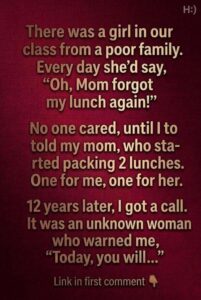
When I was in school, there was a girl in my class who almost never brought lunch. Whenever anyone asked, she would simply say that her mother had forgotten to pack it. But I noticed the way she watched everyone else eat while pretending she wasn’t hungry. One evening, I told my mother about her. The next morning, she packed extra food in my lunchbox and told me to share it with the girl.
From then on, I quietly gave my classmate half my lunch every day. We never discussed why she needed it, and I never expected anything in return. To me, it was simply something kind my mother had taught me to do. Years passed, and I eventually forgot about those lunches. I never imagined that my small gesture had remained in her heart all those years.
Then, twelve years later, I received a call from an unfamiliar number. A woman asked, “Do you remember the girl who always forgot her lunch?”
I immediately knew who she was.
Her name was Sarah, and for a moment, I could hardly believe that I was hearing from her again. We had gone to different schools after graduation, lost touch, and continued with our lives. I had no idea where she lived or what had happened to her over the years.
“Of course I remember you,” I replied. “How have you been?”
There was a brief silence on the other end of the phone. Then she began to cry.
“I have wanted to speak to you for years,” she said. “There is something I have needed to tell you, and I hope you will let me explain.”
I sat down, suddenly worried that something terrible had happened.
Sarah explained that her family had struggled financially when we were children. Her father had lost his job, and her mother worked long hours trying to keep their household running. Some days, there was barely enough food for everyone at home. Her parents did their best to protect her from their problems, but she understood more than they realized.
She had stopped bringing lunch to school because there simply wasn’t enough food to prepare an extra meal for her. She was embarrassed by her family’s situation and afraid that the other students would laugh at her if they discovered the truth.
So she pretended that her mother had forgotten.
Every lunchtime, she watched her classmates open their lunchboxes, hoping that nobody would notice her empty desk. She tried to ignore the hunger in her stomach and told herself that she would eat when she returned home.
Then I started sharing my lunch with her.
“You probably thought it was nothing,” Sarah said through her tears. “But those lunches meant more to me than you could ever imagine. You never asked embarrassing questions. You never made me feel poor. You simply sat beside me and shared what you had.”
I remembered those days clearly. I recalled how we used to talk about our teachers, laugh at silly jokes, and share pieces of bread, fruit, and sandwiches. At the time, I thought I was just being a good friend.
I had never realized how much those ordinary afternoons had meant to her.
Sarah continued explaining that my kindness had helped her through one of the most difficult periods of her childhood. Whenever she felt ashamed of her circumstances, she remembered that someone had noticed her struggle and chosen to help without making her feel small.
That memory stayed with her long after we stopped attending the same school.
But the reason for her call was something I never expected.
After graduating, Sarah had worked hard to continue her education. She took part-time jobs, applied for scholarships, and studied late into the night. Although her journey was not easy, she eventually graduated from university and built a successful career.
She told me that she had promised herself something years earlier: if she ever reached a position where she could help others, she would never forget the people who had shown her kindness when she had nothing to offer in return.
Recently, Sarah had started working with an organization that provided educational support and meals to children from struggling families. During a conversation with one of the program coordinators, she began sharing memories of her school days.
That was when she remembered me.
She had spent months trying to find my contact information through former classmates and old school connections. Eventually, someone helped her locate my number.
“I didn’t call you because I wanted to repay a debt,” she explained. “I called because I wanted you to know that what you did mattered. You helped me feel seen when I thought nobody noticed me.”
I was speechless.
Then she asked whether I would meet her for coffee.
We arranged to meet the following weekend at a small café in the city. When I arrived, I recognized her immediately, although she looked more confident and mature than the girl I remembered. She stood up, smiled, and hugged me tightly.
For a few minutes, we simply laughed about our school days. We remembered our classmates, our strict teachers, and the little things that had once seemed so important.
Then Sarah reached into her bag and handed me an envelope.
Inside was a handwritten letter and a photograph of a group of children sitting around a table, enjoying their lunch.
Sarah explained that she had established a small community initiative to provide meals and school supplies to children whose families were struggling financially. She wanted to expand the program and asked whether I would consider helping her organize it.
“I know you have your own responsibilities,” she said. “You don’t have to say yes. I just thought we could do something meaningful together.”
I looked at the photograph again, thinking about the little girl who had once sat beside me with an empty lunchbox.
Without hesitation, I agreed.
Over the following months, we worked together to support families in our community. We organized food donations, collected school supplies, and partnered with volunteers who wanted to make a difference. The project grew slowly, but every child we helped reminded me why we had started.
One afternoon, while distributing lunch packages at a local school, I noticed a young boy standing alone near the classroom door. Other children were eating, but he had nothing in his hands.
I approached him gently and asked whether he would like to join us.
He looked at me uncertainly before nodding.
As I handed him a meal, I remembered Sarah and the countless lunches we had shared so many years earlier.
In that moment, I understood something I had never fully appreciated as a child. Kindness does not need to be expensive, dramatic, or recognized by the world. Sometimes, it is as simple as noticing another person’s pain and choosing not to ignore it.
Before we left that day, Sarah stood beside me and watched the children playing together.
“Do you remember what you used to tell me when you gave me your lunch?” she asked.
I shook my head.
“You always said, ‘There’s enough for both of us.’”
I smiled as the memory returned.
She continued, “I believed you. Even when everything in my life felt uncertain, I believed that there would always be someone willing to share.”
Her words brought tears to my eyes.
I had spent years thinking that those school lunches were insignificant moments that had disappeared into the past. I never imagined they had helped shape another person’s life or inspired her to help so many others.
That phone call changed my understanding of kindness forever.
I learned that we may never know the full impact of the good things we do. A small gesture can become a treasured memory, a source of courage, or the beginning of something that reaches far beyond our imagination.
Twelve years earlier, I had shared my lunch with a hungry classmate because my mother taught me that helping someone was the right thing to do.
Twelve years later, that same classmate reminded me that kindness never truly disappears.
Sometimes, it simply travels quietly through time until it finds its way back to us.
And sometimes, the smallest thing we give another person becomes the greatest gift we ever receive.