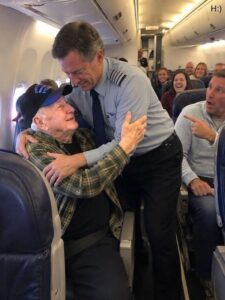
The businessman laughed when my father dropped his boarding pass.
“Seriously? If you can’t even walk through security properly, perhaps you shouldn’t be flying,” he said loudly.
Several passengers turned around.
My father, Arthur, was eighty-one years old. His hands trembled slightly as he bent to retrieve the paper. I immediately stepped forward.
“There’s no reason to speak to him like that,” I said.
The businessman rolled his eyes.
“People like him hold everyone up. Some of us actually have places to be.”
My father gently touched my arm.
“It’s all right, son. Don’t make a scene.”
But it wasn’t all right.
Dad had spent his entire life treating people with dignity. He had worked hard, raised three children, and never complained about the difficulties that came with getting older.
I looked at the businessman.
“You owe him an apology.”
Instead, he laughed.
“Or what?”
Before I could respond, a security officer approached and asked my father to step aside for additional screening.
Dad nodded politely.
As he removed his jacket, the tiny silver airplane keychain slipped from his pocket and landed on the floor.
The businessman picked it up, examined it, and smirked.
“What is this? A toy airplane? Did you get it from a cereal box?”
He tossed it onto the security table.
I watched my father’s expression change.
For the first time that morning, he looked genuinely upset.
“Please be careful with that,” he said quietly.
The businessman ignored him.
Then a voice came from behind us.
“Excuse me. Could I see that keychain?”
A tall man in a pilot’s uniform had approached the security area. He looked directly at my father.
Dad slowly turned around.
The pilot stared at the little silver wings in his hand.
Then he looked at my father’s face.
“Mr. Arthur Bennett?”
My father nodded.
The pilot’s expression changed completely.
“Sir, is that really you?”
I glanced between them, confused.
The pilot straightened his shoulders and extended his hand.
“I’ve spent twenty-six years hoping I’d meet you again.”
The businessman suddenly stopped smiling.
The pilot turned toward the security officer.
“Could you please give this gentleman a moment? I believe there’s something he deserves to know.”
My father looked uncomfortable.
“There’s no need for all that, son.”
But the pilot shook his head.
“With all due respect, sir, there absolutely is.”
He introduced himself as Captain Daniel Brooks.
Then he explained something I had never heard before.
When he was nineteen, Daniel had been a young trainee pilot. During an early training assignment, he had made a serious mistake that could have ended his aviation career.
He had misjudged a difficult landing exercise and damaged an aircraft.
His instructors were furious. An investigation followed, and Daniel believed his dream of becoming a pilot was over.
But one experienced flight instructor had stepped forward and taken the time to review what happened.
That instructor was my father.
“Your father didn’t make excuses for me,” Daniel explained. “He made me take responsibility. But he also refused to let one mistake define my entire future.”
Daniel looked at Dad.
“You stayed late for weeks, helping me rebuild my confidence. You told me that a good pilot isn’t someone who never makes mistakes. It’s someone who learns, takes responsibility, and never forgets the lives depending on him.”
I stared at my father.
All these years, he had told us he worked in aviation administration.
Apparently, there was much more to his story.
Daniel continued.
“After that incident, you recommended that I receive another opportunity. I eventually completed my training. Today, I command international flights. I have a family, a career, and a life I once thought I’d lost.”
His voice became emotional.
“I wouldn’t be standing here in this uniform if you hadn’t believed I deserved another chance.”
My father looked down at the silver wings.
“I was only doing my job.”
Daniel smiled.
“No, sir. You were doing much more than that.”
Then he turned toward the businessman.
“May I ask why you were speaking to this gentleman that way?”
The man shifted uncomfortably.
“I didn’t know who he was.”
Daniel’s expression became serious.
“That shouldn’t matter. He deserved respect before you knew his name, his history, or his profession.”
Nobody around us said anything.
The businessman muttered something that sounded like an apology, then stepped away.
Dad picked up his keychain and carefully placed it back in his pocket.
Captain Daniel then asked whether he could accompany us to the gate.
On the way, he asked my father about his retirement, his family, and the years he had spent teaching young pilots.
For the first time that morning, Dad began smiling.
When we reached the aircraft, Daniel stopped beside the entrance.
“Mr. Bennett, would you do me one favor?”
“What is it?”
“Let me welcome you aboard properly.”
He turned toward the waiting passengers and introduced my father as one of the instructors who had helped shape his career.
A few people applauded.
My father became embarrassed and waved his hand.
“Please, everyone. I’m just an old man trying to visit his granddaughter.”
Daniel laughed.
“That’s exactly what I would expect you to say.”
Before we boarded, Daniel handed Dad a small envelope.
Inside was a photograph of a group of young aviation trainees standing beside an aircraft. My father was in the middle, looking considerably younger.
On the back, Daniel had written:
To the man who taught me that one mistake doesn’t have to become the end of someone’s story. Thank you for believing in me.
Dad stared at the photograph for a long time.
Then his eyes filled with tears.
I put my arm around him.
“Why didn’t you ever tell us about this?”
He smiled sadly.
“Because I never thought it was anything special. I was lucky enough to have a job I loved. I helped a few young people along the way. That’s all.”
But as we walked onto the aircraft, I realized something.
My father had spent his entire life measuring success not by the titles he held or the money he earned, but by the people he helped.
The businessman had seen an elderly man struggling with a boarding pass.
Captain Daniel had seen the teacher who had changed his life.
And I had finally seen a part of my father I had never fully understood.
That flight became one of our most memorable family experiences.
When we landed, Dad carefully placed the old photograph beside his silver airplane keychain.
He still carries both today.
And whenever someone asks about the little silver wings, he tells them about a young pilot who made a mistake, worked hard, and never gave up.
Because my father believes something worth remembering:
You never know what someone has been through, how many lives they’ve touched, or what their quietest moments have meant to others.
Respect should never depend on someone’s age, appearance, position, or ability to move quickly through an airport.
It should be given simply because they are human.