I stared at the envelope for nearly ten minutes before I found the courage to open it.
My mother’s handwriting was unmistakable. The same handwriting that had appeared on birthday cards, school lunch notes, and little reminders she used to leave beside my bed.
I hadn’t seen it in eighteen years.
My name was written across the front.
Thomas, please read this first.
I carefully unfolded the letter.
My mother began by apologizing for something she said she had never found the courage to tell me while she was alive.
She explained that before she became seriously ill, she had discovered that my father, Ray, had been hiding financial problems and making decisions that affected our family.
But the biggest revelation wasn’t about money.
It was about the day he abandoned me.
According to my mother, she had discovered that Ray was planning to send me away to live with relatives after she died. He believed raising a child alone would interfere with his business and his plans to start a new family.
She had confronted him.
He promised to change.
She wanted desperately to believe him.
Then, shortly before her death, she discovered something else: Ray had been telling people that I wasn’t his biological son.
My mother insisted that this was a lie.
She wrote that Ray had known the truth from the beginning but had allowed his resentment and jealousy to grow.
At the bottom of the letter, she included the name of a lawyer and a date.
She had arranged for certain family documents to be kept safely in case I ever needed them.
I sat motionless.
For eighteen years, I had believed my father abandoned me because I wasn’t strong enough, smart enough, or good enough.
Now I wondered whether he had spent years making me feel unwanted because he couldn’t face his own choices.
I called Aunt Diane immediately.
She answered on the second ring.
“Thomas? Is everything okay?”
I could barely speak.
“Aunt Diane, did you know Mom left me a letter?”
There was a long silence.
Then she sighed.
“Yes, sweetheart. I wondered when it would find you.”
“Why didn’t you tell me?”
“Your mother asked me to let you decide when you were ready. I didn’t want to force that truth on you while you were still growing up.”
I looked down at the letter.
“Was Dad really planning to get rid of me?”
Diane took a deep breath.
“Your mother was afraid he would. She asked me to promise that if anything happened to her, I would never let you feel unwanted.”
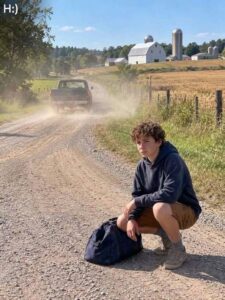
I remembered that dirt road.
I remembered carrying my duffel bag, watching my father’s truck disappear, and wondering what I had done wrong.
For the first time, I understood that the failure had never been mine.
The following morning, I contacted the lawyer mentioned in the letter.
His name was Robert Ellis, and although he was retired, he remembered my mother.
He arranged to meet me at his office.
When I arrived, he brought out a small box containing documents, photographs, and several sealed envelopes.
“Your mother trusted me with these,” he explained. “She wanted you to have them when you were old enough to understand.”
Inside was a copy of my birth certificate, several family photographs, and a handwritten statement from my mother.
There was also a document relating to a savings account she had established for my education.
She had been putting money aside for me since I was born.
Ray had known about the account.
According to the records, he had tried to access it after her death, but the arrangements she had made prevented him from withdrawing the funds without the proper authorization.
I couldn’t believe it.
The money had helped pay for my education, and eventually, I had built my heating and air-conditioning business with the confidence that my mother had always wanted me to have.
But there was another envelope.
This one contained a letter from my father.
It was dated only a few months after he left me on the dirt road.
I opened it.
The letter was short.
Ray admitted that he had been angry, overwhelmed, and ashamed of how his life had changed after my mother’s death.
He wrote that he knew he had treated me terribly.
He also admitted that he had heard from Diane that I was safe, but he hadn’t known how to face me.
At the end, he wrote:
I don’t expect you to forgive me. I only hope one day you’ll understand that I was a weak man who made a terrible decision.
I folded the paper.
It didn’t excuse anything.
But it explained something I had spent eighteen years trying to understand.
My father had not abandoned me because I was impossible to love.
He had abandoned me because he was unwilling to become the father I needed.
Three days later, I received a phone call.
It was Ray.
I almost ignored it.
Then I answered.
“Thomas?”
His voice sounded older and weaker than I remembered.
“It’s me.”
“I received a message from Megan. She said you got the invitation.”
“I did.”
“I was hoping you might come to the wedding.”
I looked out my office window.
“Why now, Dad?”
He sighed.
“Because I’m getting older. And I don’t want to spend the rest of my life knowing my son won’t speak to me.”
I remained silent.
Then he said something I never expected.
“I know I don’t deserve it, but I’d like to apologize.”
For eighteen years, I had imagined what I would say if I ever heard those words.
I had pictured myself shouting, demanding answers, and making him feel the same pain I had carried.
Instead, I simply asked:
“Do you remember the dirt road?”
He began crying.
“Yes.”
“I walked for nearly two hours. I was thirteen. I kept thinking you’d come back.”
“I know.”
“No, Dad. You don’t know. I waited at that gas station for someone to help me because I didn’t know where else to go. Aunt Diane came. You didn’t.”
He sobbed quietly.
“I am sorry, son.”
I closed my eyes.
“I believe you’re sorry. But that doesn’t mean everything can go back to the way it was.”
“I understand.”
I didn’t promise to attend the wedding.
I didn’t promise to forgive him.
But I agreed to meet him once.
We met at a small restaurant a week later.
When he walked through the door, I barely recognized him. His hair had turned almost completely white, and he walked slowly.
He stood beside the table.
“Can I sit?”
I nodded.
For nearly an hour, we talked.
He told me about his life, his second marriage, and Megan’s childhood. I told him about my business, my house, and how Diane had helped me build a life.
At one point, he looked at me and said:
“Your mother would have been proud of you.”
I looked down at my coffee.
“She was proud of me when I was thirteen, too.”
He nodded, unable to answer.
Eventually, I agreed to attend Megan’s wedding.
When I arrived, she ran toward me and hugged me tightly.
“I’m so happy you came,” she whispered.
I realized that none of this was her fault.
She was my sister, and she deserved the chance to know me.
During the reception, Ray approached me again.
“I don’t expect us to become a family overnight,” he said. “But if you ever want to try, I’d be grateful.”
I looked at him for a long moment.
“Maybe we can start with the truth. No more secrets. No more pretending nothing happened.”
He nodded.
That evening, I returned home and placed my mother’s letter inside a wooden box beside her photographs.
I had spent eighteen years believing that the day my father left me was the day my family ended.
But it wasn’t.
That was the day my aunt Diane became my protector, the day I began learning how to stand on my own, and the beginning of a life my mother had hoped I would have.
I still carry the memory of that dirt road.
I don’t think I’ll ever forget it.
But I no longer see myself as the thirteen-year-old boy who wasn’t wanted.
I see a boy who deserved better, a woman who loved him enough to plan for his future, and an aunt who kept her promise.
And I’ve learned something important:
Sometimes the people who bring us into this world aren’t the people who teach us what family truly means. Family is built by those who stay, protect us, and love us when walking away would have been easier.