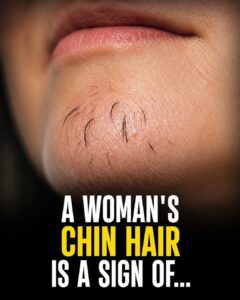
Noticing a few unexpected hairs growing on your chin can be surprising, especially if you have never experienced noticeable facial hair before. Many women discover darker, thicker hairs appearing around their chin, upper lip, or jawline as they get older. Although this change can sometimes raise concerns, it is often a completely natural part of aging and changing hormone levels.
However, facial hair growth can occasionally provide clues about what is happening inside the body. Understanding the possible causes can help women recognize when the change is normal and when it might be worth discussing with a healthcare professional.
Why Do Women Develop Chin Hair?
Hair growth is influenced by several factors, including genetics, age, and hormones.
Both men and women naturally produce hormones called androgens. Testosterone is one of the best-known androgens. Although women generally produce lower amounts than men, these hormones still play important roles in maintaining muscle mass, bone health, energy, and other bodily functions.
Hair follicles can respond to androgens differently depending on their location and individual sensitivity.
Some follicles on the face are particularly sensitive to hormonal signals. When these follicles respond more strongly, fine, light-colored hairs may gradually become darker, thicker, and more noticeable.
This process can happen even when hormone levels are within the normal range.
That is why two women of the same age can experience completely different patterns of facial hair growth.
How Aging and Menopause Affect Facial Hair
One of the most common reasons women notice new chin hairs is the natural hormonal changes associated with aging.
During the reproductive years, estrogen and androgen levels exist in a changing balance. As women approach menopause, estrogen production gradually decreases.
Although androgen levels may also change with age, the reduction in estrogen can alter the balance between these hormones.
As a result, some women notice increased facial hair, particularly around the chin and upper lip.
Menopause can also bring other changes, including:
- Thinning hair on the scalp.
- Changes in skin texture.
- Increased facial dryness.
- Changes in body composition.
- Alterations in sleep and energy levels.
A few isolated chin hairs are therefore not necessarily a sign of a medical problem.
For many women, they are simply another part of the natural aging process.
Could Chin Hair Be a Sign of PCOS?
Another possible explanation for increased facial hair is polycystic ovary syndrome, commonly known as PCOS.
PCOS is a hormonal condition that can affect women during their reproductive years. It is associated with higher androgen activity in some women, which can encourage thicker hair growth in areas where facial hair is more commonly seen in men.
Women with PCOS may notice:
- Darker hair on the chin and upper lip.
- Irregular or absent menstrual periods.
- Persistent acne.
- Thinning hair on the scalp.
- Difficulty managing weight.
- Challenges with ovulation or fertility.
Not every woman with PCOS experiences all these symptoms.
Some women primarily notice changes in their menstrual cycles, while others experience more obvious skin or hair-related symptoms.
If facial hair appears alongside irregular periods or persistent acne, discussing the symptoms with a healthcare professional can help determine whether PCOS or another hormonal condition is involved.
Other Possible Causes of Chin Hair
PCOS is not the only condition associated with increased facial hair.
Certain medications can influence hormone activity or hair growth. Some treatments involving hormones, for example, may contribute to changes in facial hair.
In less common cases, increased androgen production can be associated with conditions involving the adrenal glands or ovaries.
A condition called Cushing’s syndrome can also cause hormonal changes and may be accompanied by other symptoms, such as unusual weight gain, easy bruising, and muscle weakness.
Rarely, an androgen-producing ovarian or adrenal tumor can cause facial hair to develop rapidly.
These conditions are uncommon, but they explain why sudden or dramatic changes should not automatically be dismissed as ordinary aging.
When Should You Be Concerned?
A couple of coarse hairs appearing on your chin over several years generally do not require alarm.
However, certain changes deserve medical attention.
Consider speaking with a healthcare professional if you notice:
- Facial hair appearing suddenly or increasing rapidly.
- New, extensive hair growth on the chin, chest, or abdomen.
- A noticeably deeper voice.
- Severe or rapidly worsening acne.
- Unexplained changes in menstrual periods.
- Thinning scalp hair alongside increased facial hair.
- Other unusual physical changes occurring at the same time.
Rapid development of several androgen-related changes, particularly a deeper voice or increased muscle mass, should be assessed promptly.
A healthcare professional may review your medical history, examine your symptoms, and recommend blood tests to assess hormone levels.
Depending on the findings, additional investigations may be necessary.
The goal is not simply to remove unwanted hair but to understand whether an underlying condition needs attention.
Simple Ways to Manage Unwanted Chin Hair
For women who prefer smoother skin, several safe and practical hair-removal options are available.
Tweezing is one of the easiest methods for removing a few isolated hairs. It can be convenient at home, although clean tweezers should always be used to reduce irritation and infection.
Shaving is another option. Contrary to a common myth, shaving does not make hair grow back thicker or darker. It simply creates a blunt edge that can temporarily make regrowing hair feel more noticeable.
Waxing and threading can remove several hairs at once. However, sensitive skin may become irritated, particularly when these methods are used frequently.
For longer-lasting results, professional laser hair reduction may be worth considering. Laser treatments work best on certain combinations of skin and hair color, and multiple sessions are generally necessary.
Electrolysis is another option that can provide permanent hair removal by treating individual hair follicles.
Women experiencing significant hormonal hair growth may also discuss medical treatments with their healthcare provider.
Depending on the underlying cause, certain prescription medications can help reduce androgen-related symptoms. These treatments require professional assessment because they may have side effects and are not suitable for everyone.
Learning to Understand Your Body
Perhaps the most important thing to remember is that developing a few chin hairs does not make a woman unusual, unhealthy, or less feminine.
Bodies change throughout life. Hormones fluctuate, hair follicles respond differently with age, and genetics influence how those changes appear.
Some women notice their first coarse chin hair in their thirties, while others do not experience noticeable facial hair until menopause.
There is no single pattern that applies to everyone.
If you are concerned about a change, seeking medical advice is a sensible way to gain reassurance and identify possible causes.
At the same time, removing unwanted hair is a personal choice, not an obligation.
Whether you prefer tweezing a few hairs, choosing professional treatment, or leaving them alone, the decision belongs entirely to you.
The most important thing is understanding what your body is telling you, recognizing unusual changes, and remembering that natural aging is nothing to be ashamed of.