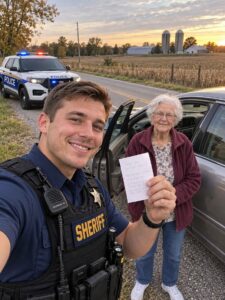
The afternoon sun was so hot that the road seemed to shimmer beneath our feet. My seventy-three-year-old mother, Shirley, stood beside our old Buick, holding her brown handbag and trying to explain something to a young deputy who clearly wasn’t interested in listening.
I had never seen anyone speak to my mother that way.
“I’m telling you, officer, this is the temporary license the courthouse gave me,” she explained politely, holding out the document.
The deputy barely glanced at it.
“Ma’am, I’m not interested in excuses. You should have made sure your paperwork was in order before driving.”
Mom lowered her eyes.
I stepped forward, but she gently touched my arm.
“It’s all right, Michael. Let me explain.”
The deputy ordered her to remain beside the vehicle while he checked the information. Ten minutes passed, then twenty. The temperature kept rising, and Mom began wiping sweat from her forehead with a handkerchief.
“Officer, could I please sit inside the car?” she asked.
He shook his head.
“Stay where you are until I finish.”
I was furious, but I didn’t want to make the situation worse. I handed Mom a bottle of water, and she took a small sip.
After forty-five minutes, the deputy finally returned to his cruiser and lifted his radio microphone.
“Dispatch, I have a female driver with questionable identification. Her name is Shirley—”
The dispatcher interrupted him.
“Fourteen, remain where you are. Do not issue another citation until you receive further instructions.”
His expression hardened.
“What is the problem?” he demanded.
The dispatcher didn’t answer immediately.
Instead, she asked a very specific question.
“Is the woman beside the Buick wearing a blue floral dress and carrying a brown handbag?”
The deputy looked toward Mom.
“Yes,” he answered slowly.
“Please confirm her full name.”
He turned toward her again.
Mom quietly provided her full name.
A few seconds passed.
Then the radio crackled.
“Fourteen, Sheriff Cooper is on his way. Keep the woman comfortable and do not leave the scene.”
For the first time that afternoon, the deputy looked genuinely uncertain.
Mom simply asked whether she could sit inside our Buick.
This time, he opened the passenger door without arguing.
I helped her settle into the seat, handed her another bottle of water, and watched the color slowly return to her face.
Three minutes later, a county vehicle appeared through the shimmering heat.
Sheriff Cooper stepped out, removed his sunglasses, and walked directly toward Mom.
He didn’t begin by questioning the deputy.
He didn’t ask about the traffic stop.
Instead, he leaned slightly toward the open passenger door.
“Shirley, are you feeling all right? Do you need medical attention?”
Mom smiled faintly.
“I think I’ll be fine now, Sheriff.”
He nodded, then turned toward the deputy.
“I’m deeply sorry you were treated this way, Shirley.”
The deputy stood rigid beside his patrol car.
“Sheriff, I believed her temporary license was questionable,” he began. “I was only following procedure.”
Cooper held out his hand.
“Let me see the document.”
The deputy handed it over.
The sheriff examined the courthouse stamp and printed information before looking back at him.
“This is an official temporary license. You could have verified it without leaving an elderly woman standing in dangerous heat for forty-five minutes.”
The deputy tried to explain himself again, but Cooper raised his hand.
“Document the stop and report to your supervisor. The department will review your conduct.”
I watched the exchange in disbelief.
Why had the dispatcher’s voice changed when she heard my mother’s name? Why had the sheriff personally driven out to meet her?
Then Cooper turned toward me.
“Michael, I imagine you have some questions.”
I nodded.
He looked at Mom and smiled.
“Perhaps it’s time your son heard a few stories about his mother.”
And that’s when I learned something I had never known about the woman who raised me.
For thirty-six years, Mom had worked overnight in the county courthouse communications office.
Her job involved coordinating urgent messages between law enforcement officers, emergency crews, and county officials. She rarely spoke about it at home because she considered it ordinary work.
But decades earlier, during a devastating winter storm, the county had experienced a major communications failure.
Roads were blocked, power was interrupted, and several families were stranded in isolated areas.
Mom stayed at her station long after her shift ended, helping coordinate emergency calls and keeping communication running while equipment was repaired.
Sheriff Cooper had been a young officer at the time.
He remembered her clearly.
“She was one of the people who kept our department connected that night,” he explained. “When the equipment failed, Shirley helped us get messages through and made sure emergency crews knew where assistance was needed. A lot of people made it home safely because she refused to abandon her station.”
He continued explaining that many of today’s senior officers had learned their first radio procedures from her.
Mom looked embarrassed.
“Oh, Sheriff, I was just doing my job.”
Cooper shook his head.
“You did much more than that.”
I finally understood why the dispatcher had recognized her name.
My mother had spent decades helping people she would never meet. She had never demanded recognition, special treatment, or public praise.
Yet the most important thing she said that afternoon came when the sheriff asked whether she wanted to pursue a formal complaint.
“I wasn’t asking him to treat me differently because of who I am,” she explained quietly. “I was asking him to remember that every person deserves respect.”
Cooper nodded.
“And he should have known that without recognizing your name.”
Before we left, the sheriff gave Mom his direct office number and explained how to submit a formal complaint if she wished.
He assured us that the department would review the roadside detention, the handling of her valid document, and the deputy’s conduct.
Mom declined an interview and refused to turn the incident into a public spectacle.
She had only one request.
She wanted the department to remind officers about the dangers of prolonged exposure to extreme heat, especially for elderly residents.
The sheriff promised to include her concerns in the review.
As we drove away, I glanced at her hands resting calmly in her lap.
“I’m sorry I didn’t do more,” I admitted.
She squeezed my fingers.
“You listened when I asked you to stay in the car. That mattered.”
I still wished I had found a better way to help, but I began to understand that following her lead had been an act of trust, not cowardice.
When we reached home, Mom insisted that the lemon bars were still perfectly edible, even though the powdered sugar had melted.
We sat at the kitchen table, drinking cold lemonade and laughing about how the afternoon had ruined our plans but not our dessert.
Several weeks later, Sheriff Cooper contacted us.
The department had completed its review and taken appropriate disciplinary action. Additional guidance concerning roadside stops, extreme heat, and respectful treatment had also been provided to the officers involved.
Mom never asked what happened to the deputy afterward.
She was satisfied that her complaint had been heard and that the incident had been taken seriously.
That evening, while we were washing the dishes, I finally asked her something that had been bothering me.
“Mom, why were you so calm when he treated you like that?”
She dried her hands, looked out the kitchen window, and smiled.
“Michael, you don’t need a powerful name to deserve decent treatment. You deserve it before anyone knows who you are.”
I stood quietly, thinking about everything that had happened.
For years, I had underestimated my mother’s quiet work. I thought importance came from impressive titles, public recognition, and people knowing your name.
But that afternoon taught me something different.
The sheriff recognized Shirley because of the difference she had made decades earlier.
The dispatcher remembered her because her work had mattered.
But my mother never needed either of them to recognize her to know her worth.
Her name opened a conversation that afternoon.
Her dignity had never depended on anyone knowing it.