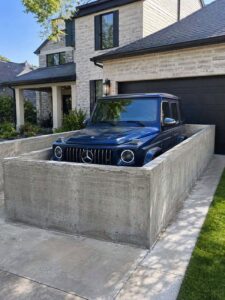
For twenty-two years, Robert had taken enormous pride in maintaining his lawn. At forty-eight, he had learned that sometimes the simplest things in life could bring the greatest happiness. After going through a difficult divorce, caring for his garden became more than a weekend hobby. It gave him peace, purpose, and something beautiful to look forward to every morning.
Working as a groundskeeper at Pine Ridge Golf Club had taught him everything about maintaining healthy grass, repairing damaged areas, and creating attractive outdoor spaces. His own lawn was his personal masterpiece.
But all that changed when his wealthy neighbor, Richard Vance, began treating Robert’s carefully maintained grass like a private parking lot.
Richard drove an expensive silver Mercedes and repeatedly parked it on Robert’s lawn, leaving tire marks and destroying patches of grass that had taken months to grow.
At first, Robert tried to handle the situation politely.
He spoke to Richard, left written notes, and repeatedly asked him to stop. But his neighbor seemed to find the entire situation amusing.
“It’s just grass, old man,” Richard laughed.
Robert tried contacting the police, hoping someone could help resolve the dispute. Unfortunately, the problem continued.
After six months and twenty-three unsuccessful attempts to convince Richard to respect his property, Robert finally reached his breaking point.
He decided that if his neighbor refused to listen to words, perhaps an unmistakable physical reminder would get his attention.
What happened next would turn an ordinary neighborhood disagreement into an expensive disaster neither man would forget.
Twenty-Three Warnings and One Terrible Decision
Robert had always believed that neighbors should respect one another’s property.
He never expected Richard to admire his lawn or share his enthusiasm for gardening. All he wanted was for the man to park his car somewhere else.
But Richard seemed determined to make life difficult.
Sometimes he parked directly across the healthiest section of grass. Other times, he left the Mercedes in an area Robert had recently reseeded.
Robert began documenting the damage.
He photographed tire marks, saved copies of his written requests, and recorded the dates when the vehicle appeared on his property.
Every time he approached Richard, he received another dismissive response.
Eventually, Robert started feeling that his neighbor was deliberately testing his patience.
His friend Fletcher, who worked in construction, listened to the story one afternoon.
“Why don’t you just put something there so he can’t park?” Fletcher asked.
Robert considered the suggestion.
He knew that a physical barrier might prevent further damage, but he was also frustrated enough to consider something more dramatic.
Unfortunately, instead of choosing a reasonable property boundary solution, he allowed his anger to influence his judgment.
The Concrete Wall That Shocked the Neighborhood
One Saturday evening, Robert and Fletcher arranged to borrow six large concrete highway barriers.
By the following morning, Richard’s silver Mercedes was surrounded by an enormous concrete enclosure on Robert’s property.
The vehicle was completely trapped.
From the street, the scene looked almost unbelievable. A luxury automobile sat inside a concrete fortress, with its owner suddenly unable to drive away.
Robert stood on his porch, looking at the result of his overnight decision.
For the first time in months, Richard could no longer park wherever he pleased.
But the satisfaction didn’t last long.
Richard came outside, saw what had happened, and immediately exploded with anger.
“What have you done to my car?”
Robert folded his arms.
“I asked you twenty-three times not to park on my grass. Maybe now you’ll understand.”
Richard threatened to sue him and demanded that the barriers be removed immediately.
The disagreement quickly attracted attention from other neighbors, several of whom came outside to see what was happening.
Some thought Richard deserved to learn a lesson. Others believed Robert had gone too far.
Neither man was willing to admit defeat.
Richard’s Expensive Plan to Escape
Rather than negotiating with Robert, Richard decided to find another way to retrieve his Mercedes.
He contacted a crane operator named Orson and arranged for the vehicle to be lifted over the concrete barriers.
Orson inspected the situation and immediately recognized that the operation involved significant risks.
Moving a heavy luxury vehicle through the air required careful planning, appropriate lifting equipment, stable ground, and adequate clearance.
He warned Richard that the surrounding property and nearby structures could be damaged if the operation went wrong.
Richard was impatient.
He wanted his car back and was determined to avoid further discussions with his neighbor.
Despite the warnings, he insisted on proceeding.
Robert watched from his property as the equipment was brought into position.
He began realizing that the situation had become much more serious than an argument about grass.
The crane operator wanted to avoid unnecessary risks, but Richard continued pushing for the operation.
Then everything went wrong.
The Accident That Changed Everything
During the attempted lift, the Mercedes began swinging unexpectedly.
The vehicle moved out of control and struck Robert’s porch.
A loud crash echoed through the neighborhood.
The porch railing was destroyed, and one of the main support posts holding up the roof suffered serious damage.
Robert stood frozen.
The same property he had worked so hard to maintain had suddenly suffered thousands of dollars in damage.
Richard was equally shocked.
His expensive vehicle had been involved in an accident, and the damage to Robert’s house was substantial.
The repair estimates eventually exceeded $14,000.
What had begun as a dispute over damaged grass had become a serious financial problem involving property damage, insurance questions, and possible legal responsibility.
Robert looked at the destroyed porch and realized that his decision to trap the car had helped create a situation far more complicated than the original problem.
Richard, meanwhile, was beginning to understand that his stubbornness had contributed to an entirely unnecessary disaster.
Neither man had won.
Both had lost.
The Apology Nobody Expected
A few days after the accident, Richard approached Robert.
This time, there was no laughter, sarcasm, or angry shouting.
He looked tired and uncomfortable.
“I owe you an apology,” he said.
Robert wasn’t sure what to say.
Richard admitted that he had repeatedly ignored Robert’s requests because he believed his neighbor was making too much of a small problem.
He acknowledged that parking on someone else’s lawn was disrespectful, regardless of how wealthy he was or how inexpensive he considered the grass.
Then he revealed something unexpected.
Years earlier, Richard had experienced a similar disagreement with a longtime friend.
A parking dispute had gradually turned into resentment, harsh words, and eventually twelve years of silence.
He had never repaired that friendship.
Now, standing in front of Robert’s damaged porch, he realized that he had repeated the same pattern.
“I kept thinking I had to win,” Richard admitted. “I never stopped to think about what I was destroying.”
Robert listened.
He still felt angry about the damage, but he could recognize that Richard was finally speaking honestly.
For the first time since the disagreement began, they had a conversation without trying to humiliate one another.
Working Together to Repair the Damage
The two men eventually agreed that continuing their argument would only make matters worse.
Richard agreed to pay for restoring Robert’s damaged lawn.
They also began working with their respective insurance companies to determine responsibility for the porch damage and vehicle recovery.
The repair process took time.
Contractors inspected the damaged structure, assessed the support post, and prepared a plan to restore the porch safely.
Robert was particularly concerned about the roof support because he understood that structural damage could not simply be covered with a new coat of paint.
The porch was eventually rebuilt, and the damaged railing was replaced.
The concrete barriers were removed, and the Mercedes was finally taken away.
The lawn also received attention. New grass was planted, damaged areas were restored, and Robert gradually returned the garden to the condition he had always wanted.
The neighborhood dispute that once seemed impossible to resolve had finally reached a peaceful conclusion.
The Twelve-Year Friendship Richard Tried to Repair
Perhaps the most surprising development happened several months later.
Richard contacted his former friend, the man with whom he had stopped speaking twelve years earlier.
He admitted that he had allowed pride and stubbornness to destroy a meaningful relationship.
This time, he wanted to apologize before more years passed.
The conversation was difficult, and there was no guarantee that everything could return to the way it had been.
But Richard had finally taken the first step.
Robert learned about the conversation when Richard mentioned it during one of their later discussions.
For Robert, that moment was almost more meaningful than seeing his lawn restored.
The incident had forced two men to confront the consequences of their behavior.
One had learned that property and personal pride were not worth risking everything over.
The other had learned that anger could lead him into decisions that created even bigger problems.
The Lesson Hidden Behind the Concrete Barriers
Months later, Robert stood on his porch looking across his green lawn.
The grass had recovered, the damaged structure had been repaired, and the neighborhood had returned to normal.
Richard’s Mercedes was no longer a regular visitor to his property.
More importantly, the two neighbors had learned to communicate.
Robert sometimes thought about that Saturday night when he had decided to surround the car with concrete barriers.
At the time, he believed he was finally taking control of an unfair situation.
But looking back, he understood that being right about a problem did not automatically make every possible response reasonable.
Richard had been wrong to repeatedly damage someone else’s property and dismiss polite requests.
Robert had also made a dangerous decision by allowing frustration to dictate his actions.
The accident demonstrated how quickly a relatively small disagreement could become a costly and potentially dangerous situation.
There was a better way to handle the original problem: clear property boundaries, appropriate barriers, documented communication, and lawful dispute resolution.
Both men had needed to learn that lesson.
Today, Robert still takes enormous pride in his lawn. He continues caring for it with the same dedication he developed over twenty-two years as a groundskeeper.
But he no longer sees it as something worth fighting over at any cost.
Because sometimes, the greatest victory is not making someone else regret their behavior.
It is finding a way to protect what matters without destroying something even more valuable in the process.
And for Robert and Richard, that lesson turned out to be worth far more than the cost of repairing a porch or replacing a damaged lawn.