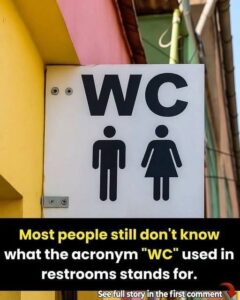
When traveling to another country, you may notice something interesting on public restroom signs. Instead of seeing familiar words such as “Bathroom,” “Restroom,” or “Toilet,” you might find two simple letters: WC. These letters appear in airports, hotels, shopping centers, train stations, restaurants, and public buildings around the world.
Although many people recognize WC as a sign for a public restroom, not everyone knows what the abbreviation actually means or where it originated. Surprisingly, these two letters have a long history connected to the development of indoor plumbing and modern sanitation.
The abbreviation WC stands for “water closet,” an expression that dates back to the 19th century. While the term may sound unusual today, it once described an important improvement in household design that helped change the way people managed personal hygiene.
1. What Does WC Actually Stand For?
The letters WC are short for “water closet.” Historically, this expression referred to a small, separate room containing a toilet connected to a water-flushing system.
The word “closet” originally referred to a small private room rather than simply a storage space. The word “water” described the plumbing system used to flush waste away.
Together, the expression described a dedicated space for a water-flush toilet.
Today, most people no longer use the full expression in everyday conversation. However, the abbreviation remains familiar in many parts of the world, particularly across Europe and other international travel destinations.
For visitors, understanding this simple abbreviation can make navigating unfamiliar public buildings much easier.
2. The History Behind the Water Closet
The expression water closet became popular during the 19th century, when indoor plumbing systems were gradually becoming more common.
Before modern plumbing became widely available, many households relied on chamber pots, outdoor toilets, and other basic sanitation arrangements. Access to convenient indoor toilets was limited, particularly for ordinary families living in crowded cities.
Personal washing and sanitation were also often handled separately. Bathing might take place in one area, while toilet facilities were located elsewhere.
As plumbing technology improved, homes and public buildings increasingly began incorporating dedicated indoor toilet rooms.
The water closet provided a practical solution by creating a separate, private space where people could use a flushable toilet without sharing the same area used for bathing or washing.
This change represented an important step toward the modern bathroom designs we recognize today.
3. Why Were Toilets Originally Kept Separate From Bathrooms?
In earlier homes, bathing and using the toilet were not always considered activities that belonged in the same room.
Bathrooms were traditionally associated with washing, bathing, and personal cleanliness. Toilet facilities, meanwhile, could be placed in a separate small room.
This arrangement offered several practical advantages.
First, it provided additional privacy. Someone could use the toilet while another person continued washing or bathing.
Second, separating the facilities made it easier to organize limited household space, particularly in older buildings.
Third, dedicated toilet rooms reflected changing ideas about sanitation and cleanliness as indoor plumbing became more widely available.
Although modern homes frequently combine showers, bathtubs, sinks, and toilets in one bathroom, separate toilet rooms remain common in many countries.
The traditional water closet therefore continues to influence how residential and public bathrooms are designed.
4. Why Is WC Still Used Around the World?
You might wonder why an expression from the 19th century remains visible on modern restroom signs.
One major reason is tradition. Once an abbreviation becomes widely recognized, it can remain in everyday use even when the original expression becomes less common.
WC is also short, simple, and relatively easy to recognize. These qualities make it useful for signs in public spaces where visitors may speak different languages.
Airports, hotels, railway stations, and shopping centers welcome people from many countries. Using familiar international symbols and abbreviations helps travelers identify essential facilities without needing to understand the local language.
In many European countries, WC remains a commonly recognized abbreviation. It can also appear in international travel guides, maps, building directories, and public information signs.
Even though modern plumbing has changed considerably, the traditional abbreviation has survived.
5. Different Countries Use Different Words for Restrooms
One interesting aspect of restroom terminology is that the same facility can have several different names depending on where you are.
In the United States, people commonly say “bathroom” or “restroom.” The word bathroom is frequently used even when the room contains only a toilet and sink.
In the United Kingdom, people often use “toilet,” “loo,” or “lavatory.”
In other English-speaking countries, expressions such as “washroom” and “public toilets” are also common.
Meanwhile, many European destinations use WC on public signs because the abbreviation is widely understood.
These differences can sometimes confuse international visitors, especially when they are unfamiliar with local expressions.
However, recognizing a few common terms can make traveling much easier and help you find the facilities you need without unnecessary confusion.
6. WC Does Not Always Mean a Separate Toilet Room Today
Originally, a water closet referred to a small room specifically designed for a toilet. However, the meaning has gradually become broader in everyday use.
Today, a WC sign may simply indicate the location of public toilet facilities, regardless of whether they are separate from the washing area.
In some buildings, the facilities may include multiple toilet cubicles, sinks, mirrors, and other hygiene amenities.
The abbreviation has therefore evolved from describing a particular room arrangement to serving as a familiar label for restroom facilities.
This is a good example of how language changes over time. Words and expressions can retain their historical origins while developing new meanings through everyday use.
7. A Small Abbreviation With a Surprisingly Long History
It is easy to overlook ordinary signs when walking through an airport, hotel, or train station. Most people see WC, understand that it means toilets, and continue on their way.
However, those two letters represent an important chapter in the history of modern sanitation.
The development of indoor plumbing transformed homes, public buildings, and everyday hygiene practices. What was once a relatively new convenience eventually became an essential part of modern life.
The water closet was part of that transformation, helping establish the idea of a dedicated indoor space for toilet facilities.
Although today’s bathrooms are much more advanced, the abbreviation remains a reminder of how earlier generations described these important household conveniences.
Final Thoughts
The next time you see WC on a restroom sign, you will know that it stands for “water closet,” a term that originated during the development of modern indoor plumbing.
What appears to be a simple international abbreviation actually reflects more than a century of changes in household design, sanitation, and everyday language.
From its original meaning as a small, separate room containing a flushable toilet to its modern use as a general restroom label, WC has remained surprisingly familiar.
So, whether you are traveling through an airport, checking into a hotel, or exploring a new country, those two letters can tell you something interesting about the history of everyday life.
Sometimes, even the simplest signs have the most fascinating stories behind them.