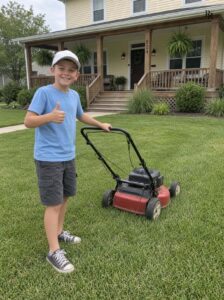
It was an ordinary afternoon when two police officers knocked on my front door. I immediately wondered whether something had happened in our neighborhood. My thirteen-year-old son, Caleb, was sitting at the kitchen table, finishing a snack after spending the morning mowing lawns for several neighbors.
When I opened the door, the older officer introduced himself and politely asked whether Caleb was home.
My stomach tightened.
“Has he done something wrong?” I asked.
The officer smiled gently.
“Actually, we’re here because your son did something very important.”
I turned toward Caleb, who had already stopped eating. He looked confused and slightly frightened, as though he were trying to remember whether he had accidentally broken a rule.
The older officer stepped inside and crouched until he was at eye level with my son.
“Caleb, did you mow a yard on Ridgeway this morning?”
Caleb nodded.
“Yes, sir.”
“Did you notice anything unusual while you were there?”
My son hesitated before explaining what had happened.
He told the officer that he had noticed a large pile of unopened mail outside one particular house. He had passed the property several times during the previous few days, and something about it had caught his attention.
The front curtain was also open.
That might not sound unusual to most people, but Caleb knew the woman who lived there. Mrs. Alvarado, a seventy-nine-year-old neighbor, normally kept her curtains closed during the day.
He remembered that detail.
Instead of ignoring it, he walked toward the front door and knocked. Nobody answered.
He waited a little longer before walking around the side of the property and knocking again near the back entrance.
Still, there was no response.
Something felt wrong, so Caleb borrowed a neighbor’s phone and contacted the appropriate emergency service. After making the call, he returned home without telling me because he was worried that he might have done something inappropriate by investigating the situation.
The officer listened carefully.
Then he explained what had actually happened.
Mrs. Alvarado had suffered a serious fall on Saturday. She had been alone inside her home and unable to reach her telephone. Nobody had realized she needed help.
She was eventually discovered on Monday morning after Caleb noticed the unusual signs around her property.
By the time the officers arrived at our house, Mrs. Alvarado was undergoing surgery for a serious hip injury.
The officers had come to thank my son.
There was another detail that made the visit especially meaningful. The second officer was Mrs. Alvarado’s nephew. He had specifically requested to accompany his colleague because he wanted to personally thank the young boy whose observations had helped bring assistance to his aunt.
I looked at Caleb.
He was sitting quietly, his hands resting in his lap.
“Why didn’t you tell me?” I asked.
He shrugged.
“I didn’t know if I was supposed to go around the house. I thought maybe I had done something wrong.”
I felt an unexpected lump in my throat.
I explained that he had made a sensible decision by asking for help rather than entering the property or trying to handle the situation himself. Most importantly, he had recognized that something might be wrong and contacted someone who could respond.
The officers stayed for several minutes, telling him how important his actions had been.
After they left, I hugged my son longer than usual.
I had always considered Caleb a thoughtful child, but I had never realized how closely he paid attention to the people around him.
A few days later, we learned that Mrs. Alvarado had survived surgery and was beginning her recovery.
She was expected to need considerable assistance during rehabilitation, and her family began making arrangements for her return home.
Caleb asked about her almost every day.
“Is she getting better?”
“Can she walk yet?”
“Will she come home soon?”
I explained that recovery would take time, but the doctors were hopeful.
When October arrived, Mrs. Alvarado finally returned home. She used a walker and had several medical appointments ahead of her, but she was happy to be back in familiar surroundings.
Caleb wanted to visit her immediately.
We brought over a small arrangement of flowers, and she welcomed us with tears in her eyes.
She held Caleb’s hands and thanked him repeatedly.
“You noticed me when I needed somebody,” she told him.
My son looked embarrassed.
“I just saw your mail.”
Mrs. Alvarado smiled.
“Sometimes that’s all it takes.”
From that afternoon onward, something special developed between them.
During the winter, Caleb began shoveling her driveway whenever snow accumulated. He never asked for money, and whenever she offered to pay him, he politely refused.
He simply wanted to make sure she could safely reach her front door.
When spring arrived, Mrs. Alvarado decided to teach him how to prepare her mother’s arroz con gandules, a traditional Puerto Rican rice dish.
Their first attempts were not particularly successful.
Caleb added too much seasoning, struggled with the rice, and occasionally forgot what step came next. Mrs. Alvarado laughed and patiently corrected him.
He ate every unsuccessful batch.
Their friendship became one of those unexpected relationships that quietly improves everyday life. She shared stories about her childhood, her family, and the neighborhood as it had looked many decades earlier. Caleb listened, asked questions, and learned things that no school lesson could have taught him.
But something else was happening beyond their friendship.
News of what Caleb had done gradually spread throughout our street.
At first, neighbors simply mentioned the incident during conversations. Some parents began talking about how important it was to teach children to notice unusual situations and seek help when someone might be in danger.
By June, nine other children had started paying closer attention to the people living around them.
Nobody organized a formal program. There were no meetings, posters, or official instructions.
The children simply began noticing things.
They remembered which neighbors usually collected their mail. They noticed when a familiar car had not moved for several days. They paid attention to lights left on unusually late and curtains that suddenly looked different.
When something seemed concerning, they told a responsible adult rather than investigating on their own.
That year, two additional calls were made because children noticed unusual circumstances around neighboring homes.
Both situations turned out to be harmless.
One involved a family that had gone away for a few days. The other involved a neighbor who had changed his usual routine.
Nobody was upset about the calls.
In fact, several adults said they would rather receive a mistaken concern than discover that somebody had needed help and nobody had spoken up.
Our street gradually became a little more connected.
People started checking on older neighbors, exchanging telephone numbers, and asking whether anyone needed assistance with groceries or outdoor work.
It was not a dramatic transformation. There were still arguments about parking, noisy lawnmowers, and children leaving bicycles in inconvenient places.
But people were paying attention.
Caleb is fourteen now.
He is still an ordinary teenager. He received a C in geometry, forgets to close kitchen cabinets, and regularly leaves wet towels on his bedroom floor. He sometimes needs three reminders to complete something he promised to do.
He still refuses money when helping Mrs. Alvarado.
And he still visits her whenever his schedule allows.
Sometimes I watch him walking toward her house and remember that afternoon when two police officers stood in our living room.
I remember how frightened he looked when they first asked him questions. I remember how carefully he explained the details about the mail and the open curtain.
Most of all, I remember realizing that my son had spent the summer noticing people whom many others might have overlooked.
He had not been trying to become a hero. He had not expected recognition, praise, or a reward.
He had simply seen something unusual and decided that another person might need help.
That experience changed the way I think about community.
We often imagine that making a difference requires extraordinary courage, special training, or some enormous act of generosity. Sometimes, however, it begins with something much smaller.
Remembering that an elderly neighbor usually collects her mail.
Noticing when someone who normally opens their curtains has suddenly stopped.
Asking whether everything is all right.
And knowing when to contact someone who can help.
Mrs. Alvarado is doing better now, Caleb has gained a grandmother-like friend, and our street has become more attentive to the people who live along it.
The two officers came to our house to thank a thirteen-year-old boy for noticing something unusual.
But they left us with a lesson that reached much further than that one afternoon.
People do not always need grand gestures to know they matter. Sometimes, they simply need someone to notice when something is wrong.
And sometimes, that someone is an ordinary teenager who remembers that a neighbor’s curtain is usually closed.