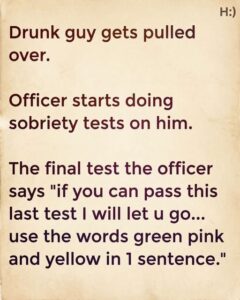
The driver was convinced he could make it home without anyone noticing his condition. It was nearly midnight, the roads were quiet, and he believed there was little chance of encountering the police.
Unfortunately for him, he had already made several mistakes.
His vehicle had drifted across the center line twice, and he had nearly mounted the curb while turning onto a residential street. When the flashing red and blue lights appeared behind him, he immediately knew his evening had taken an unexpected turn.
He pulled over, rolled down his window, and greeted the approaching officer with an exaggerated smile.
“Good evening, officer! Beautiful night, isn’t it?”
The officer looked at him carefully.
“Good evening. Do you know why I stopped you?”
The driver shrugged.
“Honestly, officer, I have absolutely no idea. Maybe my car has a problem.”
“Your vehicle crossed the center line several times.”
The driver laughed nervously.
“These roads are terrible. You should see the potholes around here.”
The officer remained professional.
“Have you been drinking tonight?”
“Not at all,” the driver replied quickly. “I’m completely sober.”
The officer noticed his bloodshot eyes, slurred speech, and the strong smell of alcohol coming from inside the vehicle.
“Could you please provide your driver’s license and registration?”
The driver began searching through his wallet. He dropped his license, picked up an old receipt, and eventually handed over the correct document.
The officer examined it.
“All right. I’d like you to step outside.”
The man sighed.
“Is that really necessary? I’m perfectly fine.”
“Please step outside, sir.”
Reluctantly, the driver opened the door and climbed out.
The moment his feet touched the pavement, he stumbled slightly.
The officer noticed.
“Are you having trouble standing?”
“No, no. It’s these shoes. They’re new.”
The officer glanced at his footwear.
They were ordinary sneakers.
“All right. Let’s try something simple. Please stand with your feet together and keep your arms at your sides.”
The driver attempted to follow the instructions but swayed noticeably.
“See?” he said. “The road is uneven.”
The officer looked at the flat pavement.
“Sir, we’re standing on level ground.”
The driver smiled awkwardly.
“Then perhaps it’s the darkness.”
The officer switched on his flashlight.
“Can you see clearly now?”
“Absolutely.”
The officer continued with the roadside assessment, carefully explaining each instruction.
The driver struggled to maintain his balance and repeatedly misunderstood what he was being asked to do.
His earlier confidence began disappearing.
“Officer, this is getting ridiculous. I told you I’m fine.”
The officer remained calm.
“I’m simply assessing whether you’re safe to drive.”
The driver shook his head.
“I have work tomorrow. I can’t spend the entire night here.”
“Then it’s important that we establish what’s happening.”
The man crossed his arms.
“Fine. Give me your final test. I’ll pass it, and then we can both go home.”
The officer paused.
He studied the driver for several seconds before replying.
“All right. I have one final question.”
The driver straightened his jacket.
“Go ahead.”
The officer pointed toward the vehicle.
“Can you tell me where you were planning to go tonight?”
The driver answered immediately.
“Home.”
“And where is home?”
“About ten minutes from here.”
The officer nodded.
“Interesting. Then why did you just tell me you were driving to the airport?”
The driver’s smile disappeared.
He stared at the officer.
“I… what?”
The officer continued.
“Earlier, you told me you were returning from work. Then you said you had been visiting a friend. Now you’re telling me you were going home.”
The driver opened his mouth but couldn’t find an answer.
The officer folded his arms.
“Perhaps we should stop trying to come up with explanations and focus on your safety.”
For the first time that night, the driver said nothing.
The officer explained that the roadside observations had raised serious concerns about impairment. He would not be allowed to continue driving while the investigation was underway.
The driver suddenly became defensive.
“But I only had a few drinks!”
The officer answered calmly.
“Even a small amount of alcohol can affect driving ability. Based on what I’ve observed, I have sufficient reason to investigate further.”
The officer followed the applicable procedures and arranged an evidential alcohol test.
The driver initially insisted that the result would prove his innocence.
But when the result came back, his expression changed completely.
He was over the legal limit.
The officer explained the next steps, including the consequences he could face under local traffic laws. His vehicle was not permitted to continue with him driving, and arrangements were made to ensure it could be moved safely.
As the situation unfolded, the driver finally began to understand how serious his decision had been.
A few minutes earlier, he had been joking about potholes and blaming his shoes.
Now he was facing the possibility of losing his driving privileges, paying substantial penalties, and dealing with a criminal or administrative process depending on the applicable law.
But the officer had one more thing to say.
“You’re fortunate nobody was hurt tonight.”
The driver looked down.
The officer continued.
“You could have hit another vehicle, injured a pedestrian, or never made it home yourself. This isn’t just about whether you can fool a police officer. It’s about the people sharing the road with you.”
Those words stayed with him.
He had spent the entire stop trying to avoid responsibility. He had blamed the road, his shoes, the lighting, and even the officer’s questions.
But none of those things had put alcohol into his system.
That had been his decision.
Later, when the driver was finally able to contact someone to collect him, he sat quietly and thought about how differently the night could have ended.
He had been lucky.
The officer had not needed to shout, threaten, or argue. He had simply observed the situation, followed the proper procedures, and refused to be distracted by excuses.
And that was the real lesson of the night.
The driver had believed the final test would be some clever trick he could somehow defeat.
Instead, the final test was whether he would finally accept responsibility for his actions.
He had failed that test long before the police lights appeared behind him.
Because the most important part of driving safely is making the right decision before turning the key.
And no excuse, clever answer, or confident smile can change the consequences of getting behind the wheel while impaired.