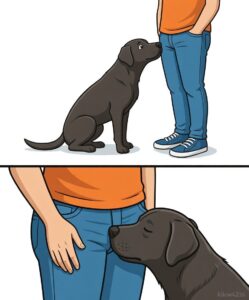
Dogs experience the world in a way that is fundamentally different from humans. While people rely heavily on vision and language to interpret their surroundings, dogs depend primarily on scent. Their noses are not just tools for smelling—they are highly advanced biological instruments capable of detecting and analyzing chemical signals at a level that far surpasses human ability. One of the most misunderstood behaviors stemming from this extraordinary sense is when a dog sniffs a human’s private area. To us, it can feel awkward or even inappropriate. To a dog, however, it is completely natural and deeply informative.
To understand this behavior, it helps to begin with the anatomy of a dog’s nose. Humans have roughly 5 to 6 million olfactory receptors. Dogs, depending on the breed, have between 100 million and 300 million. This means their sense of smell is not just slightly better—it is exponentially more sensitive. In addition, a much larger portion of a dog’s brain is devoted to processing scents compared to humans. What we perceive as a single odor, a dog experiences as a layered and complex mixture of chemical information.
Dogs also possess a specialized structure called the vomeronasal organ, sometimes referred to as Jacobson’s organ. This organ is specifically designed to detect pheromones—chemical signals released by living beings that convey information about identity, reproductive status, emotional state, and more. While humans also produce pheromones, our reliance on them for communication is minimal compared to animals. Dogs, on the other hand, are constantly interpreting these signals.
The reason dogs often target the groin area when sniffing humans comes down to biology. Certain regions of the human body contain a high concentration of apocrine sweat glands. These glands are found in areas such as the armpits and groin, and they release a thicker type of sweat that interacts with bacteria on the skin to produce strong, distinctive odors. These odors carry a wealth of chemical data, making them particularly interesting to a dog.
When a dog approaches and sniffs this area, it is not behaving rudely. It is gathering information. Through scent alone, a dog can determine a person’s sex, approximate age, hormonal status, and even emotional condition. For example, hormonal fluctuations during menstruation, pregnancy, or puberty subtly change the body’s chemical output. Dogs can detect these changes instantly. Similarly, stress hormones like cortisol and adrenaline alter body odor, allowing dogs to sense when a person is anxious, fearful, or relaxed.
This ability extends beyond emotions and into health. Research has shown that dogs can detect certain diseases through smell. Conditions such as cancer, diabetes, and infections can alter the body’s chemistry in ways that produce detectable scent changes. In some cases, trained dogs have been able to identify these conditions earlier than conventional medical tests. The groin area, being rich in sweat glands and close to major blood vessels, can emit particularly strong signals related to these changes.
From an evolutionary perspective, this behavior makes perfect sense. Dogs evolved from wolves, animals that relied heavily on scent for survival. In the wild, scent helps identify members of a pack, determine reproductive readiness, mark territory, and detect threats. Social interactions among dogs often begin with scent investigation, particularly in areas where pheromones are most concentrated. When dogs meet each other, they typically sniff each other’s rear ends. This is not random—it is an efficient way of exchanging detailed biological information.
When dogs interact with humans, they apply the same instinctive behavior. They do not understand human social norms about personal space or privacy. To them, a human is simply another being emitting scent signals worth analyzing. Sniffing is their version of a handshake, introduction, and conversation all in one.
Interestingly, some people attract more attention from dogs than others. This is often due to differences in body chemistry. Individuals undergoing hormonal changes—such as pregnant women or those on certain medications—may emit stronger or unfamiliar scents. Dogs are naturally curious about new information, so they may investigate more thoroughly. Even changes in diet, hygiene products, or recent physical activity can alter a person’s scent profile enough to draw a dog’s attention.
While the behavior is natural, it can still be uncomfortable for humans. Fortunately, dogs are highly trainable and can learn alternative ways to greet people. The key is to respond calmly and consistently. Punishing a dog for sniffing can create confusion or anxiety, as the dog does not understand that it has done something wrong. Instead, gentle redirection is more effective. Offering a hand to sniff or guiding the dog into a sitting position can help shift its focus.
Positive reinforcement plays an important role in shaping behavior. When a dog greets someone appropriately—by remaining calm or sniffing in a less intrusive way—it should be rewarded with praise or treats. Over time, the dog learns that these behaviors are preferred. Training commands such as “sit,” “leave it,” or “off” can also help establish boundaries without suppressing the dog’s natural instincts entirely.
It is important to remember that sniffing is not just a habit for dogs—it is a need. Smelling is how they interpret their environment and feel secure. Providing opportunities for dogs to use their noses in appropriate ways can reduce unwanted behaviors. Activities such as scent games, tracking exercises, or simply allowing a dog to explore smells during walks can satisfy this instinct.
Another fascinating aspect of canine scent detection is its role in emotional bonding. Dogs are highly attuned to their owners’ emotional states. When a person is stressed or upset, their body releases chemicals that dogs can detect. Many dogs respond by offering comfort, staying close, or becoming more attentive. This sensitivity is one of the reasons dogs are often used as therapy animals. Their ability to “read” human emotions through scent and behavior makes them uniquely suited for providing support.
The connection between scent and emotion also works in reverse. Dogs can be influenced by human pheromones and may mirror the feelings they detect. A calm, relaxed person can help a dog feel at ease, while a tense or anxious individual may inadvertently make a dog more alert or uneasy. This dynamic highlights the depth of communication that exists between humans and dogs, much of which occurs below the level of conscious awareness.
There are also many misconceptions about this behavior. Some people believe that dogs who sniff private areas are poorly trained or misbehaving. In reality, this is an instinctive action, not a sign of disobedience. Others assume it is related to dominance, but sniffing is not about asserting control—it is about gathering information. Similarly, the idea that dogs are acting in a sexual manner toward humans is a misunderstanding. Dogs do not interpret these interactions in the same way humans do; they are simply responding to chemical cues.
Cultural differences also play a role in how this behavior is perceived. In human society, personal space and privacy are deeply ingrained concepts. Behaviors that violate these norms can feel uncomfortable or embarrassing. Dogs, however, operate outside of these constructs. Their actions are guided by instinct rather than social convention. Recognizing this difference can help people respond with understanding rather than frustration.
Hygiene and environmental factors can influence how strongly a dog reacts to certain scents. Sweating, for example, increases the production of odor molecules, making them more noticeable. Bacteria on the skin break down sweat into compounds that produce stronger smells. While humans often attempt to mask these odors with deodorants or perfumes, dogs can still detect the underlying chemical signals. In some cases, artificial scents may even pique a dog’s curiosity further, as they introduce unfamiliar elements into the scent profile.
Ultimately, this behavior offers a glimpse into the remarkable sensory world of dogs. It highlights how much information exists beyond human perception and how differently other species experience reality. For dogs, smell is not just a sense—it is a language. Every scent carries meaning, and every interaction provides data.
Understanding why dogs sniff human private areas can transform an awkward moment into an opportunity for appreciation. It reveals the sophistication of canine biology and the depth of the human-dog relationship. Rather than viewing the behavior as inappropriate, it can be seen as a form of communication—one that is rooted in millions of years of evolution.
At the same time, it is reasonable for humans to set boundaries that align with social comfort. Training and consistency can help bridge the gap between canine instincts and human expectations. By guiding dogs toward acceptable behaviors while respecting their natural tendencies, it is possible to maintain both harmony and understanding.
In the end, this behavior serves as a reminder of how closely dogs are attuned to us. They perceive details about our bodies and emotions that we may not even be aware of ourselves. Their curiosity is not invasive—it is attentive. It reflects a desire to understand, connect, and respond.
The next time a dog greets someone in this way, it may still feel a bit awkward. But with a deeper understanding of the science behind it, that moment can also inspire a sense of wonder. It is a small but powerful example of how extraordinary dogs truly are—and how much of their world remains invisible to us, yet constantly at work just beneath the surface.