For forty-two years, my husband Arthur and I shared almost everything.
We shared a small house, countless Sunday breakfasts, family holidays, arguments over silly things, and the kind of love that grows quietly with time.
But there was one thing in our home I had never managed to replace.
Our old brown sofa.
I had complained about it for years.
The cushions were worn, the fabric had faded, and anyone who sat on it slowly slid toward the middle.
“Arthur, please,” I would say. “Can’t we buy a new couch?”
He would laugh and pat the cushions.
“This old thing has supported our marriage longer than most people stay married.”
I would roll my eyes, but secretly, I loved his silly jokes.
Then, one winter morning, Arthur died unexpectedly from a heart attack.
My world changed overnight.
The house became unbearably quiet. His slippers remained beside the bedroom door, his favorite coffee mug stayed in the cupboard, and his reading glasses were still on the table.
I couldn’t bring myself to move anything.
Most of all, I couldn’t let go of the old sofa.
After his funeral, I began sleeping on it.
I wrapped myself in his favorite blanket and rested my head against the cushion where he used to sit.
It was ridiculous, perhaps, but the sofa still smelled faintly of him.
Sometimes I imagined he was sitting beside me, telling another one of his terrible jokes.
My daughter, Emily, worried about me.
“Mom, you can’t spend the rest of your life sleeping on that uncomfortable couch.”
“I know,” I answered.
But knowing something and accepting it are two different things.
Eventually, I agreed to sell it.
I listed it online for twenty dollars.
A divorced father named Eli Navarro contacted me. He explained that he was furnishing a small apartment for himself and his young daughter, Mila.
He arrived the following afternoon with a borrowed truck.
When he saw the sofa, he smiled.
“This looks perfect.”
I laughed.
“Perfect isn’t the word I’d use.”
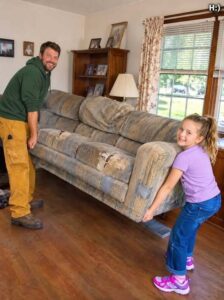
His daughter climbed onto the cushions and immediately slid toward the middle.
She burst into laughter.
“Dad! It’s like the couch is giving me a hug!”
For a moment, I couldn’t speak.
That was exactly what Arthur used to say.
I sold the sofa for twenty dollars and watched Eli and Mila drive away.
That evening, for the first time since Arthur died, I slept in my own bed.
I cried a little, but I also felt strangely peaceful.
Perhaps it was finally time to move forward.
The following morning, someone knocked on my door.
When I opened it, Eli was standing there.
He looked pale and nervous.
“Mrs. Delaney, I’m sorry to bother you so early. But I think you need to see something.”
My heart tightened.
“Is something wrong with the sofa?”
He shook his head.
“It’s what’s inside it.”
I invited him in.
He placed a small brown package on my dining table.
“I was looking for my daughter’s missing pencil last night. It had fallen between the cushions, and when I lifted them, I noticed a loose wooden panel underneath.”
He paused.
“There was a hidden compartment.”
I stared at the package.
My name was written across the front.
The handwriting was unmistakable.
Arthur’s.
My hands began trembling.
“Where did you find this?”
“Under the sofa.”
I carefully opened the package.
Inside were dozens of envelopes, several photographs, and a small handwritten notebook.
The first envelope was dated 1986.
The year our daughter Rose was born.
My breath caught.
Rose.
Our first child.
She had died only days after birth because of a serious heart condition.
I had been critically ill following the delivery and spent several days in intensive care.
Arthur had handled everything.
When I finally recovered enough to ask about our baby, he told me she had passed away peacefully.
He also told me that no medical procedures had been performed after her death.
I had believed him.
For forty years, I had carried that painful memory.
Now I was holding a package he had hidden from me.
I opened the first letter.
My darling Frances,
There is something I have never found the courage to tell you.
I stopped reading.
Eli quietly excused himself, explaining that he would wait outside.
I continued.
Arthur explained that after Rose died, doctors had approached him with a heartbreaking request.
Another newborn baby was critically ill.
The child had a serious condition involving a damaged pulmonary valve, and the medical team believed that tissue recovered from Rose might help save the baby’s life.
Arthur had been devastated.
He had already lost his daughter.
He had also watched me fighting for my life in the hospital.
The doctors explained the situation and sought his authorization.
After agonizing over the decision, Arthur agreed.
He authorized the recovery of Rose’s pulmonary valve for the other child.
I covered my mouth.
He had told me nothing.
The letter continued.
I know you would have wanted to protect every part of our little girl. I wanted that too. But another family was losing their baby, and I couldn’t stop thinking about how much I would have wanted someone to help us.
Tears ran down my face.
I felt anger, confusion, and an unexpected sense of gratitude all at once.
Why had he hidden this from me?
Why had he allowed me to believe something different for forty years?
I opened the next envelope.
It contained a photograph of a smiling young boy.
On the back, Arthur had written:
The little life Rose helped save.
His name was Daniel Hartwell.
According to the letters, Daniel’s parents had stayed in contact with Arthur for years.
They sent photographs, birthday updates, school reports, and eventually news of his graduation.
Daniel had survived.
He had grown into a healthy young man, married, and become a neonatal nurse.
He had even named his daughter Rose.
I began crying harder.
The letters continued for decades.
Arthur had quietly followed Daniel’s life, receiving occasional updates from his family.
He had never contacted me because he feared reopening the wound of losing our daughter.
At the bottom of the package was a final letter.
It was dated only a few months before Arthur died.
Frances, my love,
I have kept these letters because I wanted you to know that Rose’s short life did not end without leaving something beautiful behind.
I should have told you sooner. I was afraid of hurting you, but perhaps I was also afraid of facing my own grief.
I planned to tell you everything on Rose’s fortieth birthday.
If I never get that chance, please forgive me.
I held the letter against my chest.
Arthur had carried this secret for forty years.
And the old sofa, the very thing I had complained about for decades, had been hiding the truth.
That afternoon, I called Emily and told her everything.
She arrived within an hour.
We read the letters together, crying and remembering the little sister she had never known.
Then Emily suggested something.
“Mom, maybe we should find Daniel.”
I hesitated.
“Would he even want to meet us?”
“We won’t know unless we ask.”
With help from the contact details in Arthur’s letters, we eventually reached Daniel’s family.
When I spoke to him on the phone, his voice trembled.
“Mrs. Delaney,” he said, “your husband changed my family’s life.”
He explained that his parents had told him about the transplant when he was old enough to understand.
He had grown up knowing that another family had made an extraordinary decision during an incredibly painful time.
“I’ve wanted to thank you both for years,” he said.
I began crying.
“You don’t need to thank me. I didn’t even know.”
There was a pause.
Then Daniel answered gently.
“I know. But your daughter gave me a chance to grow up.”
A few weeks later, we arranged to meet.
Daniel arrived with his wife and little daughter.
The moment I saw him, I felt something I couldn’t explain.
He was a stranger, yet his life was connected to the little girl I had lost.
His daughter, Rose, ran toward me holding a drawing.
“Grandma Frances,” she said shyly, “Dad told me about the baby I was named after.”
I knelt and hugged her.
For the first time in forty years, Rose’s name was spoken in our home without only sadness.
Daniel told me about his work as a neonatal nurse and how he had dedicated his career to helping newborn babies and their families.
I listened with tears in my eyes.
Then he gently placed my hand against his chest.
I heard his heartbeat.
A heartbeat that existed because of the decision Arthur had made all those years ago.
I finally understood the meaning of his letters.
That evening, I visited Arthur’s grave.
I placed a photograph of Daniel and his daughter beside the flowers.
“I wish you had told me,” I whispered. “I wish we had carried this together.”
Then I smiled through my tears.
“But I understand now.”
The following spring, our families celebrated little Rose’s birthday together.
There were balloons, laughter, photographs, and a cake decorated with pink flowers.
I looked around the room and thought about the old brown sofa.
For years, I had believed it was simply an uncomfortable piece of furniture that Arthur refused to replace.
Now I understood why he had kept it.
It had held a secret, a memory, and a connection to the little girl we had lost.
I had sold it for twenty dollars.
But what came back to me was worth more than anything money could buy.
Sometimes the people we lose leave behind a love that continues changing lives long after they are gone. And sometimes, the most unexpected discoveries remind us that even the shortest lives can leave the longest legacies.