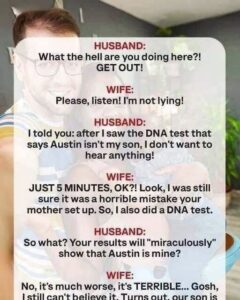
I stood frozen, holding my phone against my ear.
“What do you mean I’m not the only parent?” I asked.
Emily was crying so hard that I could barely understand her words.
“Please, Daniel. Just come to the hospital. There’s something wrong with the records, and I don’t think our son is the only baby whose identity was mixed up.”
For a moment, I couldn’t speak.
Three months earlier, I had walked out of our home believing Emily had betrayed me. I remembered her standing in the doorway, holding our newborn son, begging me not to leave.
I had ignored her.
Now she was telling me something that could change everything.
“Which hospital?” I finally asked.
She gave me the address.
I drove there immediately.
When I arrived, Emily was sitting outside a private consultation room. She looked exhausted, thinner than I remembered, and frightened.
She stood when she saw me.
“Thank you for coming.”
I nodded without answering.
A doctor named Dr. Harris soon joined us. He introduced himself as the head of the hospital’s patient safety department and explained that an internal review had uncovered a serious discrepancy involving newborn identification records.
Emily looked at me.
“Daniel, I told you something was wrong from the beginning.”
The doctor placed several documents on the table.
He explained that shortly after our son was born, the hospital had experienced a technical problem with its newborn identification system. Two infants had been moved between departments during a busy shift, and their identification records had not been properly reconciled.
I felt my stomach tighten.
“Are you saying our baby was switched?”
Dr. Harris took a breath.
“We have identified a possible newborn identification error. We are conducting additional testing to establish exactly what happened.”
Emily began crying again.
She explained that she had received a call from the hospital several weeks earlier. They had asked her to return for additional tests because some of the original records appeared inconsistent.
At first, she thought it was an administrative mistake.
Then the hospital requested DNA testing.
The results revealed that the baby she had taken home was not biologically related to either of us.
I stared at the doctor.
“Neither of us?”
He nodded.
“That’s correct. The initial findings indicate that the infant’s biological parents may be another couple whose child was delivered at this hospital around the same time.”
I couldn’t process what I was hearing.
The paternity test I had ordered three months earlier suddenly seemed different.
I had believed it proved Emily had been unfaithful.
But it might actually have been the first warning that something had gone terribly wrong at the hospital.
“Why wasn’t I contacted?” I asked.
Dr. Harris explained that the hospital had initially contacted Emily because she was listed as the primary contact on the newborn records. The investigation was still ongoing, and they were now trying to identify everyone affected.
I turned toward Emily.
“Why didn’t you tell me sooner?”
Her eyes filled with tears.
“I tried calling you. You blocked my number. I sent messages, but you never answered. I even went to your apartment, but you refused to see me.”
I lowered my head.
I remembered those messages.
I had deleted them without reading them.
For months, I had convinced myself that Emily was simply trying to manipulate me.
Now I realized she had been trying to tell me the truth.
The doctor continued explaining that the hospital had arranged independent DNA testing for all potentially affected families. They would also investigate the original laboratory results and the handling of the newborn identification samples.
I asked whether my original paternity test could have been wrong.
Dr. Harris explained that laboratory errors, sample mix-ups, and identification mistakes were possible, although the hospital needed to review the original testing process before drawing conclusions.
He recommended that we undergo fresh, independently supervised DNA testing.
I agreed immediately.
Emily reached for my hand, but I wasn’t ready to take it.
Not because I didn’t care about her.
Because I was overwhelmed by the realization that I had spent three months blaming the person who had been telling me the truth.
Two weeks later, the new results arrived.
I sat in the hospital consultation room with Emily while Dr. Harris opened the report.
He read it carefully before looking at us.
“The new testing confirms that neither of you is biologically related to the child currently in your care.”
My heart sank.
Then he turned to another document.
“We have also identified a second family whose biological child appears to have been affected by the same identification discrepancy.”
Emily covered her mouth.
“Where is our baby?” she whispered.
The doctor explained that the other family had been contacted and that the hospital was arranging a supervised meeting after confirming the identities of both infants.
I felt a mixture of fear and hope.
For three months, I had believed I had lost my family because of betrayal.
Now I was learning that two families might have been separated by a hospital error.
The following day, we met the other couple.
Their names were Michael and Sarah.
They had also been raising a baby they believed was theirs.
Sarah entered the room holding a photograph of the little boy she had cared for since birth.
Her eyes immediately filled with tears when she saw Emily.
“I never imagined something like this could happen,” she whispered.
Michael looked equally devastated.
None of us knew what to say.
The hospital arranged another round of verification before any changes in care could take place. We were told that the children’s safety and emotional well-being had to come first.
During the following weeks, we attended meetings with medical specialists and family counselors.
The hospital also began a formal investigation into its procedures.
Eventually, the evidence confirmed that the two newborns had been incorrectly identified during their hospital stay.
The hospital accepted responsibility for the identification failure and began discussing the next steps with both families.
But there was something else I needed to do.
I needed to apologize to Emily.
One evening, after another counseling session, I asked her to sit with me.
“I was wrong,” I said.
She looked at me silently.
“I questioned your honesty when I should have listened. I saw one test result and decided I knew everything. I didn’t give you a chance to explain.”
Emily wiped her eyes.
“You didn’t just leave me, Daniel. You left our family when we needed each other most.”
Her words hurt because they were true.
“I know,” I whispered. “And I don’t expect you to forgive me immediately.”
She looked toward the nursery photographs on her phone.
“Whatever happens next, those three months are something we can never get back.”
I nodded.
For the first time, I understood the full cost of my decision.
The paternity test hadn’t destroyed our family by itself.
My refusal to listen had made the damage worse.
Over time, both families began carefully navigating the difficult process of rebuilding their lives around the truth. The babies had already formed bonds with the people who had cared for them, and every decision had to consider their needs rather than simply the adults’ emotions.
I didn’t know what the future would hold for Emily and me.
But I knew I wanted to be part of our son’s life, regardless of the circumstances of his birth.
One afternoon, I sat beside his crib and watched him sleep.
Emily stood in the doorway.
“He doesn’t understand any of this,” she said softly.
I reached down and gently held his tiny hand.
“No,” I replied. “And he shouldn’t have to carry the weight of our mistakes.”
She came and sat beside me.
For a long time, neither of us spoke.
Then I looked at her.
“I can’t change what happened. But I can promise never to let suspicion make decisions for me again.”
She didn’t answer immediately.
Instead, she placed her hand over mine.
It wasn’t forgiveness.
Not yet.
But it was a beginning.
And I finally understood something I wished I had known on the day our son was born: being a parent is not simply about biology, and being a husband is not simply about demanding proof.
Sometimes the greatest damage comes from making a decision before hearing the whole truth.
I had lost three months with my family because I believed one test told me everything.
I would spend the rest of my life making sure that mistake never defined the future of the child I had learned to love.