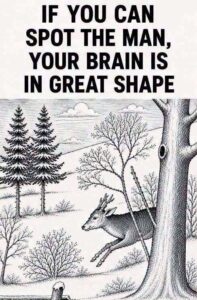
At first, I thought the photograph was simply another beautiful winter landscape. A deer stood quietly in the snow-covered forest, surrounded by tall trees and delicate branches. The entire scene looked peaceful, almost like something taken from a winter postcard.
But when I read the caption claiming that a human face was hidden somewhere in the picture, I decided to take another look.
I zoomed in.
Nothing.
I studied the deer, examined the tree trunks, and followed the shadows stretching across the snowy ground. Still, I couldn’t find anything that resembled a face.
Then I noticed something interesting.
The deer was positioned in a way that naturally attracted attention. Its body stood out against the white snow, while the surrounding trees created a complicated arrangement of dark and light shapes.
It suddenly occurred to me that the animal might be the biggest distraction in the entire puzzle.
I moved my attention away from it and began examining the background.
That’s when the challenge became much more interesting.
The forest was filled with patterns that initially appeared random. Some branches curved like eyebrows, while others created shapes resembling noses or mouths. Snow-covered areas provided lighter sections that could easily be interpreted as facial features.
But there was a problem.
Once I started looking for faces, I began seeing them everywhere.
A dark patch between two trees looked like an eye. A crooked branch seemed like a nose. Another section appeared to form a mouth.
I realized that I needed to approach the puzzle differently.
Instead of searching for individual facial features, I needed to look for a complete arrangement.
This is one of the reasons hidden-image puzzles can be surprisingly difficult.
The human brain is naturally designed to recognize familiar patterns. We recognize faces almost instantly, even when the available information is incomplete.
A few dark marks on a light background can sometimes be enough for our minds to imagine an entire expression.
This tendency is known as pareidolia.
It explains why people sometimes recognize faces in clouds, patterns on walls, tree bark, or even ordinary household objects.
In a winter forest, where branches and shadows create countless irregular shapes, the possibilities become almost endless.
The photograph seemed to take advantage of exactly that tendency.
I returned to the image and began examining the spaces between the tree trunks.
Rather than focusing on the objects themselves, I looked at the empty areas surrounding them.
That made a surprising difference.
The spaces between branches can create outlines that are just as important as the branches themselves. A curved gap might resemble the shape of a forehead, while a dark opening could suggest an eye socket.
Suddenly, the photograph seemed less like a simple landscape and more like a visual puzzle.
I asked a friend to look at it.
Within seconds, she pointed toward the background.
“Wait. Is that supposed to be a face?”
I moved closer to see what she meant.
She explained that she had noticed a possible outline formed by several neighboring trees. Once she concentrated on that region, she began identifying shapes that resembled facial features.
I still wasn’t completely convinced.
We spent several minutes comparing our interpretations, turning the phone slightly and adjusting the image size.
Then something became clear: the hidden image wasn’t necessarily created by one obvious object.
It appeared to depend on how several separate elements were perceived together.
This is a common technique in optical illusions. Artists and puzzle designers use contrast, perspective, negative space, and visual grouping to make ordinary objects appear to form something entirely different.
A tree branch can become an eyebrow.
A patch of shadow can resemble an eye.
A snow-covered trunk can suggest the edge of a cheek.
Individually, these objects have nothing to do with a human face. But when viewed together, they can create a recognizable pattern.
That is what makes this kind of challenge so entertaining.
The answer isn’t always hidden in the smallest detail. Sometimes the secret is understanding how the entire scene works together.
I returned my attention to the deer one final time.
It was easy to understand why so many viewers missed the hidden image. The animal was the most recognizable subject in the photograph, and our eyes naturally gravitated toward it.
The deer also provided a sense of scale and direction, encouraging viewers to interpret the surrounding forest as ordinary scenery.
But the real challenge was happening behind it.
The snowy trees created a complicated mixture of overlapping shapes, and the hidden face depended on recognizing a pattern that wasn’t immediately obvious.
I began wondering how many other details I had overlooked.
Perhaps there were smaller shapes hidden in the branches. Perhaps the artist had intentionally arranged the scene to create multiple interpretations.
That is another fascinating feature of visual puzzles: two people can look at the same photograph and notice completely different things.
One person might immediately recognize the deer and overlook everything else.
Another might notice the arrangement of the trees.
Someone else might discover the hidden face almost instantly.
There is no single speed at which people solve these challenges.
Some viewers recognize the pattern in seconds, while others need several minutes of careful observation.
And sometimes, even after someone explains the answer, it can be difficult to understand how the image went unnoticed in the first place.
The best way to approach this particular puzzle is to take a short break from looking at the deer.
Then examine the background from a distance.
Pay attention to the contrast between the dark tree trunks and the white snow. Look for symmetrical arrangements, unusual gaps, and groups of branches that seem to create a larger outline.
Don’t immediately assume that every dark shape represents a facial feature.
Instead, allow your eyes to move across the entire forest.
If you discover a possible face, try looking away for a moment before returning to the image. Sometimes changing your visual focus makes a hidden pattern easier to recognize.
And remember, the goal isn’t simply to find something that vaguely resembles a face. It is to identify a combination of shapes that creates a recognizable human appearance.
That distinction makes the challenge much more interesting.
Ultimately, this winter photograph demonstrates how easily our attention can be controlled by the most obvious subject in a scene.
The deer captures our eyes, the snow creates a peaceful atmosphere, and the trees appear to be nothing more than part of the background.
Yet the background may contain the most interesting part of the entire image.
So, before giving up, take one more look.
Ignore the deer.
Study the trees.
And ask yourself whether the forest is showing you something that wasn’t obvious at first.
Did you manage to spot the hidden human face without someone giving you the answer?
If you did, you may have noticed something that thousands of other viewers completely overlooked.
And if you didn’t, don’t worry. Sometimes the hardest part of an optical illusion isn’t finding the hidden object.
It’s realizing that you’ve been looking right at it all along.