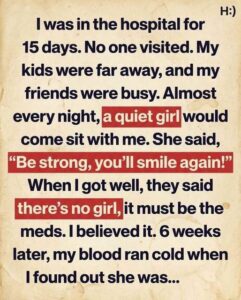
After fifteen painful days in the hospital following a terrible car accident, I began noticing a young girl sitting beside my bed every evening.
She looked about thirteen years old. She had dark hair, gentle eyes, and a quiet smile. She never disturbed the nurses or asked for anything. She simply sat beside me, sometimes holding a little white flower, sometimes watching the evening light disappear through the window.
At first, I assumed she was visiting another patient.
But she came every night.
My name is Margaret, and I was sixty-eight years old when the accident happened. My children lived in different cities, and neither could visit regularly because of their work and family responsibilities.
The hospital room was often silent. My injuries made even small movements painful, and the doctors warned me that recovery would take considerable time.
I had never felt so lonely.
Then the girl started visiting.
“How are you feeling today?” she would ask.
“Still not very good,” I answered one evening.
She smiled gently.
“Tomorrow might be better.”
Her words were simple, but somehow they made me feel less frightened.
Every evening, she appeared around seven. She never stayed long, and whenever I asked her name, she simply smiled.
One night, after another difficult day of treatment, I began crying.
“I don’t think I’ll ever be normal again,” I whispered.
The girl moved her chair closer.
“Be strong. You’ll smile again.”
I looked at her.
“How do you know?”
She lowered her eyes.
“Because people who love you never really leave you alone.”
I didn’t understand what she meant, but her words stayed with me.
The following evening, I decided to ask the nurses about her.
When a nurse named Helen entered my room, I mentioned the girl.
“There’s a young visitor who comes here every evening. Do you know her?”
Helen stopped arranging my medication.
“What girl?”
“The one with dark hair. She’s about thirteen. She sits beside my bed.”
Helen exchanged a glance with another nurse.
“Margaret, are you sure?”
“Of course. She’s been visiting for several nights.”
Helen checked the visitor records and asked the other staff members.
Nobody knew who I was talking about.
Nobody had seen a girl sitting beside my bed.
Then Helen quietly asked something that made my blood run cold.
“Margaret, did she ever tell you her name?”
“No. Why?”
Helen hesitated.
“Could you describe her again?”
I explained everything: her dark hair, gentle eyes, small hands, and the white flower she sometimes carried.
Helen became unusually quiet.
Then she asked whether I had any photographs of my family.
I reached for my handbag and took out an old photograph of my daughter, Emily, when she was thirteen.
Helen stared at it.
“Is this the girl?”
My heart began racing.
“Yes,” I whispered. “She looks just like her.”
Helen gently returned the photograph.
“Margaret, I think you should call your daughter.”
I immediately asked why, but Helen said she didn’t want to make assumptions.
The next morning, I called Emily.
She answered after the second ring.
“Mom! How are you feeling?”
I asked her to come to the hospital as soon as she could.
There was something I needed to understand.
Emily arrived that afternoon with her husband. She looked exhausted, and her eyes filled with tears when she saw me sitting up.
After we talked about my recovery, I showed her the photograph.
“Do you remember this picture?”
She smiled.
“Of course. I was thirteen.”
I took a deep breath.
“Emily, there’s something strange happening. A girl who looks exactly like you visits me every evening. She tells me not to lose hope.”
Emily’s smile disappeared.
“Mom, what does she look like?”
I described the girl again.
Then Emily began crying.
I reached for her hand.
“What’s wrong?”
She opened her handbag and took out her phone. After searching through several photographs, she showed me one.
It was a picture of a teenage girl with dark hair and gentle eyes.
I felt my entire body go cold.
It was the girl.
“Who is she?” I whispered.
Emily struggled to speak.
“Mom, that’s Sophie.”
I stared at the screen.
Sophie was my granddaughter.
She had died three years earlier in a tragic illness at the age of thirteen.
I remembered the hospital visits, the little flowers she used to bring me, and the way she would sit quietly whenever I was upset.
But I had never expected to see her face again.
Emily held my hand tightly.
“Mom, Sophie used to tell me that she wanted to be a nurse when she grew up. She always said she wanted to make sick people feel less afraid.”
I began crying.
“She told me I would smile again.”
Emily leaned forward and hugged me.
“She would have wanted that.”
For several minutes, neither of us spoke.
I looked toward the chair beside my bed.
It was empty.
That evening, I asked the nurse to leave the little white flower Emily had brought me on the bedside table.
I wanted to remember Sophie.
Over the next few days, I continued my physical therapy. The pain didn’t disappear overnight, and recovery was still difficult, but something inside me had changed.
I began looking forward to tomorrow.
A week later, the doctors finally approved my discharge.
Emily helped me pack my belongings, and Helen came to say goodbye.
Before leaving, I turned toward the empty chair one last time.
“Thank you,” I whispered.
I didn’t know whether the girl I remembered had been a dream, a memory, or something my tired mind had created while I was recovering.
But I knew what her visits had given me.
Hope.
When I returned home, Emily placed Sophie’s photograph beside my bed. I also began keeping fresh flowers in a small vase near the window.
Every morning, I looked at that photograph and remembered her words.
“Be strong. You’ll smile again.”
And slowly, I did.
I learned that grief doesn’t disappear simply because time passes. Sometimes the people we miss remain part of our lives through memories, photographs, and the love they leave behind.
I never discovered exactly what had happened during those hospital evenings.
But I no longer needed an explanation to appreciate what those moments meant to me.
Sophie had been my little ray of sunshine during the darkest days of my recovery.
And whether she had visited me in a dream or through a mystery I could never explain, her message stayed with me forever:
Even after the hardest nights, there is still a reason to welcome the morning.