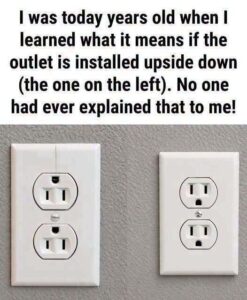
Daniel had lived in his old house for nearly twelve years, but there was one small detail he had never managed to understand.
In the living room, a single electrical outlet was installed upside down.
Every other outlet in the house had its grounding opening in the usual position, but this one faced the opposite direction. It had always worked perfectly, so Daniel assumed an electrician had simply installed it incorrectly.
Still, the unusual detail bothered him.
Whenever guests visited, someone eventually noticed it.
“Why is that outlet upside down?” they would ask.
Daniel always gave the same answer.
“I have no idea. Maybe the electrician was having a bad day.”
One Saturday afternoon, Daniel decided to rearrange his living room. While moving an old bookshelf, he noticed the outlet again. Its unusual position made him curious enough to search for an explanation.
He discovered that electrical outlets are not always installed in the same orientation. In some homes, an upside-down receptacle may be an intentional choice rather than an installation mistake.
But why?
Daniel remembered that the house had undergone several renovations over the years. The previous owner had been a retired electrician, and some of the wiring arrangements might have been designed for a particular purpose.
Wanting to understand the mystery, Daniel contacted a licensed electrician named Robert.
Robert agreed to inspect the outlet.
When he arrived, Daniel immediately pointed toward the unusual receptacle.
“That’s the one I’ve been wondering about for years.”
Robert examined it without removing anything.
“Interesting,” he said. “There are several reasons an electrician might install an outlet this way.”
Daniel looked surprised.
“So it isn’t necessarily wrong?”
“Not at all. Orientation alone doesn’t tell us whether an installation is safe or unsafe.”
Robert explained that electricians sometimes use different orientations to make certain receptacles easier to identify.
For example, an outlet installed upside down might indicate that it is controlled by a wall switch. In some homes, this arrangement helps distinguish a switched receptacle from one that remains powered continuously.
Daniel immediately remembered something.
There was a wall switch near the living room entrance that he had never understood.
It looked almost identical to the other switches, but he rarely used it.
“Could that switch be connected to this outlet?” he asked.
Robert checked the home’s electrical documentation and began a professional inspection.
After completing the necessary safety checks, he discovered that the unusual receptacle was indeed connected to the wall switch.
The previous owner had designed the arrangement so that a floor lamp could be controlled from the entrance.
Daniel laughed.
“So all these years, I thought someone had made a mistake.”
Robert smiled.
“Actually, somebody was being practical.”
But the inspection revealed another interesting detail.
The outlet was part of an older wiring arrangement that had been modified during a previous renovation. Robert explained that the house contained several electrical updates from different periods.
Some connections were newer, while others belonged to the original installation.
He recommended checking the entire circuit to ensure that the wiring, grounding, and protective devices met current safety requirements.
Daniel agreed.
During the inspection, Robert explained several things Daniel had never considered.
First, an upside-down outlet is not automatically dangerous. There is no universal rule requiring every ordinary receptacle in a home to face one particular direction.
Second, electricians sometimes use orientation as a visual clue. A switched outlet, a dedicated receptacle, or a particular electrical arrangement may be easier to recognize when its position differs from the others.
Third, the appearance of an outlet cannot reliably reveal what is happening behind the wall. Two receptacles can look identical while serving completely different purposes.
Daniel found this especially interesting.
He had always assumed electrical work was mostly about connecting wires and installing switches. Now he understood how much planning could go into a home’s electrical layout.
Robert also warned him against treating an unusual outlet as a harmless curiosity without inspection.
Old wiring can deteriorate, connections can loosen, and previous renovations may leave problems hidden behind walls.
A professional inspection is especially important when an outlet feels warm, produces sparks, makes buzzing sounds, or shows signs of discoloration.
Daniel thanked Robert and asked one final question.
“Why didn’t the previous owner simply explain the arrangement?”
Robert laughed.
“Maybe he thought the next owner would figure it out.”
After the electrician left, Daniel stood in the living room and looked at the upside-down outlet again.
It no longer looked like an installation mistake.
It was a small reminder that houses often contain stories hidden in ordinary details.
The next day, Daniel explained the discovery to his neighbor, who immediately checked the outlets in his own home.
He had two receptacles installed differently from the others and had always wondered why.
Daniel told him what Robert had explained: unusual orientation can sometimes have a practical purpose, but it should never be treated as proof of a particular wiring arrangement.
Only a proper inspection can establish what an outlet is connected to and whether it is safe.
That evening, Daniel switched on the living room lamp using the wall switch near the entrance.
The lamp illuminated the room.
He smiled.
For twelve years, he had looked at that upside-down outlet and seen a mistake.
Now he understood that it had been part of a thoughtful design.
Sometimes, the smallest details in an old house reveal the most interesting stories.
And sometimes, what appears to be an error is simply a clever solution waiting to be understood.