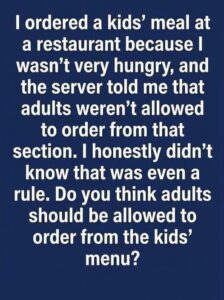
I never expected ordering a small meal at a restaurant to become such a big discussion. I wasn’t trying to get special treatment, avoid paying, or cause trouble. I simply wanted something smaller than the regular portions.
But one ordinary lunch turned into an experience that made me question how restaurants treat their customers.
It happened on a Saturday afternoon when I stopped at a popular family restaurant after running several errands. I hadn’t eaten much that day, and I wasn’t particularly hungry. I wanted something simple, preferably a small burger with fries and a drink.
I picked up the menu and immediately noticed the children’s section.
There it was: a smaller cheeseburger, a portion of fries, and a drink for considerably less than the regular meal.
It sounded perfect.
I called the server over and pointed to the item.
“Could I please have the kids’ cheeseburger meal?”
The server smiled politely but hesitated.
“Is that for a child?”
“No,” I answered. “It’s for me. I just don’t want a large meal today.”
Her expression changed slightly.
“I’m not sure we’re allowed to do that for adults. Let me check.”
I didn’t think much of it. I assumed she needed to confirm the price or portion size.
A few minutes later, she returned with the restaurant manager.
He stood beside the table holding a small notepad.
“I’m sorry,” he began, “but our children’s meals are intended for customers under twelve.”
I looked at him, surprised.
“Is that a restaurant policy?”
“Yes. We reserve those meals for children.”
I glanced at the menu.
There was no obvious warning beside the item. Nothing indicated that adults were prohibited from ordering it.
I explained that I wasn’t asking for a discount or a special modification. I simply wanted a smaller serving.
The manager remained polite but firm.
“Unfortunately, I can’t authorize that.”
I looked around the restaurant. Several tables were occupied by families, and children were happily eating their smaller meals.
I wondered why the same food couldn’t be served to an adult who wanted it.
“Could I pay a little extra for the kids’ portion?” I asked.
The manager shook his head.
“Our system doesn’t allow adults to order children’s meals.”
At that point, I decided not to argue.
I ordered a regular burger instead, even though I knew I would probably leave half of it.
But the conversation stayed in my mind.
Why was a restaurant unwilling to sell me a smaller portion when I was perfectly happy to pay?
The Debate Begins
Later that evening, I mentioned the experience to a friend.
She immediately laughed.
“That’s ridiculous. If you’re paying for the food, why should your age matter?”
Another friend disagreed.
“Restaurants have children’s menus for a reason. They’re designed to attract families, not provide cheaper meals for everyone.”
That was when I realized the issue wasn’t as straightforward as I had initially thought.
There were reasonable arguments on both sides.
Customers often see children’s meals as smaller versions of regular dishes. If an adult has a smaller appetite, ordering one can seem practical.
Restaurants, however, may view those meals as part of a specific business strategy.
Children’s menus are frequently designed to make family dining more affordable. Their prices may be intentionally lower to encourage parents to visit with their children.
The restaurant might earn less from those meals than it would from regular menu items.
That doesn’t necessarily mean the restaurant is wrong to establish restrictions, but it explains why some businesses enforce them.
Why Adults Sometimes Prefer Children’s Meals
There are several understandable reasons why an adult might choose a smaller meal.
1. Smaller appetites
Not everyone wants a large serving. Some people naturally eat less, while others simply aren’t very hungry at certain times of the day.
2. Avoiding food waste
Ordering a large meal and leaving half of it untouched can feel wasteful. A smaller serving may be more appropriate.
3. Budget considerations
Some customers are trying to manage their spending. A smaller meal can be an attractive option when available.
4. Simple food preferences
Children’s menus often include familiar dishes such as grilled cheese, chicken tenders, pasta, and small burgers.
Adults may enjoy those foods just as much as children do.
There is no universal reason why someone should stop enjoying a particular meal simply because they have reached adulthood.
Why Restaurants Sometimes Say No
From the restaurant’s perspective, children’s meals can serve a particular commercial purpose.
They may be priced to encourage families to dine together rather than to maximize profit on each individual plate.
Restaurants also have to consider their food costs, staffing, preparation procedures, and overall pricing structure.
If every adult could order a discounted children’s meal, the restaurant might find it difficult to maintain the pricing model it designed for families.
Some establishments therefore introduce age restrictions.
Others allow adults to order smaller portions but charge a different price.
There is no single policy followed by every restaurant.
The important thing is that customers should be able to understand the rules before ordering.
What Happened Next?
A few days later, I returned to the same restaurant with my sister.
She had heard the story and wanted to see whether the policy was really enforced.
When the server approached, my sister asked whether adults could order smaller portions.
The server explained that children’s meals were reserved for children but that the kitchen could sometimes prepare a smaller version of a regular dish.
That sounded reasonable.
My sister ordered a regular burger with a smaller serving of fries.
I ordered a side portion of chicken tenders.
Neither of us had any difficulty.
Before leaving, I asked whether the restaurant considered introducing a dedicated small-portion menu for adults.
The manager happened to be nearby and joined the conversation.
He explained that customers occasionally requested smaller servings, especially older adults and people dining alone.
He admitted that the restaurant had received similar feedback before.
“We’re always looking at ways to improve the menu,” he said.
I appreciated that response.
I wasn’t expecting the restaurant to change its entire business model because of one customer.
I simply wanted a practical option.
So, Should Adults Be Allowed to Order From the Kids’ Menu?
There isn’t one answer that will satisfy everyone.
Some people believe that if a restaurant lists an item on its menu, any paying customer should be able to purchase it.
Others believe restaurants have the right to establish reasonable restrictions on discounted meals.
Both perspectives raise important questions about customer choice, business decisions, and fair pricing.
Perhaps the best solution is for restaurants to offer smaller adult portions at reasonable prices.
That would give customers more flexibility without necessarily undermining the purpose of children’s menus.
After all, portion sizes should reflect appetite, not just age.
I still remember that Saturday afternoon whenever I look at a restaurant menu.
I never wanted special treatment. I simply wanted a meal that matched how hungry I was.
And I suspect many other customers feel the same way.