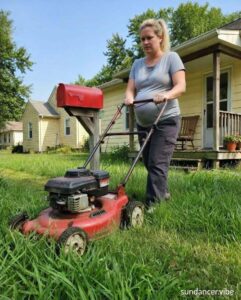
At thirty-four weeks pregnant, I was preparing to become a mother while struggling to keep a roof over my head. The father of my baby had disappeared months earlier, leaving me with unpaid bills, unanswered messages, and a future that seemed increasingly uncertain. I had always believed that working hard and doing the right thing would eventually make life easier. But that summer, I was beginning to lose faith in everything.
My mortgage payments were overdue, my savings were almost gone, and the bank had officially started foreclosure proceedings. Every morning, I checked the mailbox with a knot in my stomach, hoping there wouldn’t be another threatening letter.
One afternoon, after receiving another call from the bank, I stepped outside to breathe. That’s when I noticed my elderly neighbor, Mrs. Higgins, struggling to push her lawn mower across her overgrown yard.
She was eighty-two years old, lived alone, and had always been kind to everyone on our street. Her husband had passed away several years earlier, and I rarely saw visitors coming to her house.
That afternoon, the summer heat was particularly intense. Mrs. Higgins was moving slowly, stopping every few minutes to catch her breath.
I knew I shouldn’t be doing anything physically demanding so late in my pregnancy, but I couldn’t simply watch her struggle.
“Mrs. Higgins, would you like me to finish that lawn for you?” I called.
She turned around, surprised.
“Oh, sweetheart, you have enough on your hands. You shouldn’t be worrying about my grass.”
I smiled.
“Please let me help. You can sit in the shade.”
After a little hesitation, she accepted.
I carefully finished the remaining sections while she watched from her porch. When I finally switched off the mower, my back was aching, and I was ready to sit down.
Mrs. Higgins disappeared inside and returned with two glasses of homemade lemonade.
“Now, that’s what I call a good neighbor,” she said.
We sat together for nearly an hour.
At first, we discussed ordinary things: the weather, the neighborhood, and the flowers growing beside her porch. But eventually, she asked how my pregnancy was going.
I tried to smile.
“It’s going well. I’m just trying to figure out a few things.”
She studied my face.
“Are you sure you’re all right?”
Something about her gentle voice made it difficult to continue pretending.
I told her everything.
I explained that the baby’s father had abandoned me, that the bank was threatening to take my house, and that I was terrified of bringing a child into a world where I couldn’t even guarantee a safe place to live.
Mrs. Higgins listened without interrupting.
When I finished, she reached across the small table and held my hand.
“Listen to me, sweetheart. Being strong doesn’t mean you never need help. Sometimes it means allowing someone else to stand beside you.”
Her words brought tears to my eyes.
Before I left, she told me something I would remember for the rest of my life.
“Never let difficult circumstances turn you into someone who stops caring.”
I thanked her and slowly walked home.
I had no idea that our conversation would become one of the most important moments of my life.
The Sheriff at My Door
The following morning, I woke to the sound of vehicles outside.
When I looked through the window, I noticed a sheriff’s vehicle parked near my driveway.
My heart immediately began racing.
I wondered whether something had happened with the foreclosure proceedings or whether another problem had appeared.
I opened the front door.
The sheriff introduced himself politely and asked whether I was familiar with Mrs. Higgins.
“Yes,” I answered. “She’s my neighbor. Is everything okay?”
His expression softened.
“I’m sorry to tell you that Mrs. Higgins passed away early this morning.”
For several seconds, I couldn’t speak.
He explained that she had apparently suffered a medical emergency on her porch. Before her death, security footage showed her walking toward my mailbox.
The sheriff handed me a thick envelope.
“She left this for you. Her attorney asked that it be delivered personally.”
My hands trembled as I accepted it.
My name was written across the front in Mrs. Higgins’ familiar handwriting.
I thanked him and returned inside.
Then I sat at the kitchen table and carefully opened the envelope.
Inside were several official documents and a handwritten letter.
The first document caught my attention immediately.
It was a statement from my mortgage lender showing that the outstanding balance had been paid in full.
I read it once.
Then again.
I couldn’t believe what I was seeing.
My home, the place I had been preparing to lose, was no longer facing foreclosure.
The Secret She Had Kept
I unfolded the letter.
Mrs. Higgins explained that she had known about my financial difficulties for longer than I realized.
She had noticed the foreclosure notices arriving in my mailbox. She had also seen me returning home from work with grocery bags and struggling to keep everything together.
She hadn’t wanted to embarrass me by asking questions.
Instead, she had quietly spoken with her attorney and arranged to use part of her savings to pay off my mortgage.
She wrote that her late husband had always believed money was most valuable when it could make a meaningful difference in someone’s life.
They had saved for decades, and she had eventually realized that she no longer needed to preserve every dollar for herself.
She wanted to help someone who would appreciate the opportunity to begin again.
Then came the words that made me cry.
“Yesterday, when you helped me finish my lawn, you were carrying more worries than I could possibly imagine. Yet you still stopped to help an old woman who needed a little kindness. I hope you understand that I didn’t choose to help you because I felt sorry for you. I chose to help because I saw the kind of person you are.”
She continued:
“Please don’t spend your life believing that you owe me something. Give your daughter the childhood you deserve to give her. When she grows up, teach her that kindness is never wasted, even when we don’t immediately see what it can become.”
At the bottom, she had signed her name.
I pressed the letter against my chest and cried.
For months, I had felt abandoned by everyone. Yet an elderly woman who had never asked me for anything had made a decision that completely changed my future.
A New Beginning
Over the following days, I contacted the attorney named in the letter.
He confirmed the arrangement and helped me verify the mortgage payment with the lender. Everything had been properly documented, and the foreclosure proceedings were being resolved.
For the first time in months, I could think about something other than overdue payments.
I began preparing for my daughter’s arrival.
I painted the small nursery, organized the baby clothes, and placed a comfortable rocking chair beside the window.
Whenever I felt overwhelmed, I reread Mrs. Higgins’ letter.
Her kindness had given me something more valuable than financial relief.
It had given me the chance to welcome my child without the constant fear of losing our home.
A few weeks later, my beautiful daughter was born.
I named her Mabel.
The name felt right because I wanted her to grow up knowing about the extraordinary woman who had helped her mother when life seemed impossible.
I kept a photograph of Mrs. Higgins on the nursery shelf.
Beside it, I placed a small framed copy of the final sentence from her letter.
The Promise I Made
As Mabel grew, I began looking for ways to honor Mrs. Higgins.
I started helping other struggling families in our neighborhood. Sometimes that meant bringing groceries to an elderly resident. Other times, it meant helping a new mother with childcare or assisting someone who had lost a job.
I couldn’t help everyone, but I could help someone.
Years later, I still remember that afternoon when I pushed a lawn mower across an elderly woman’s yard while worrying about my own collapsing future.
I had thought I was simply doing a small favor.
I never imagined that the woman sitting on the porch would change the direction of my life.
Mrs. Higgins taught me that generosity isn’t always about having plenty. Sometimes the most meaningful kindness comes from people who understand hardship and recognize it in someone else.
She also taught me that accepting help is not a weakness.
I had spent so long trying to prove that I could manage everything alone that I had forgotten people were allowed to care for one another.
Today, my daughter knows the story of the woman whose kindness helped give her a secure beginning.
Whenever we pass Mrs. Higgins’ old house, I tell Mabel about her.
And I always finish with the same words:
“Remember, sweetheart, you never know how much a small act of kindness might mean to someone else.”
Because I learned something that summer that I will never forget.
Sometimes, the person you help when you have almost nothing turns out to be the person who gives you a reason to believe in tomorrow.