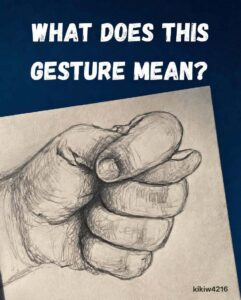
Long before people communicated through smartphones, emojis, and instant messages, a simple movement of the hand could express an entire message. It could reject an unwanted demand, challenge someone without speaking, or supposedly protect a person from harmful supernatural forces. Known as making a fig, this unusual gesture involved closing the fingers into a fist and placing the thumb between the index and middle fingers. Although it might appear insignificant today, the gesture carries a fascinating history that stretches back thousands of years.
Across different cultures, the fig gesture developed several meanings. Sometimes it represented refusal or mockery. In other situations, it was associated with fertility, good fortune, and protection against the evil eye. People believed that certain hand movements could repel jealousy, curses, and misfortune. What made this particular gesture especially interesting was its ability to communicate both playful defiance and spiritual protection without requiring a single spoken word.
The gesture became known in Latin as manus fica, a name connected to the resemblance between the hand position and a fig. In ancient Roman society, figs were associated with fertility and symbolism connected to life and reproduction. The gesture could therefore carry meanings that were both protective and suggestive, depending on the situation and the people using it.
Ancient Romans lived in a world where religious traditions and everyday superstitions influenced many aspects of daily life. People frequently sought protection from forces they believed could bring illness, misfortune, or personal suffering. Amulets, religious objects, household rituals, and symbolic gestures offered reassurance against these dangers.
The fig gesture became part of this wider tradition of protective symbolism. Similar hand-shaped objects were produced from materials such as bronze, silver, and other decorative substances. Some were worn as jewelry, while others were kept as personal charms. Their purpose was not simply decoration. Many people believed these objects could protect their owners against the evil eye.
The evil eye was a widespread Mediterranean belief that jealousy or malicious attention could bring harm to an innocent person. A successful business, a healthy child, an attractive appearance, or a fortunate marriage might attract unwanted envy. Protective symbols offered people a way to feel safer in situations they could not fully control.
The fig gesture was particularly interesting because it combined several symbolic ideas. Its association with fertility gave it a connection to life and prosperity, while its use as a protective sign made it useful in everyday interactions. Depending on the circumstances, it could communicate rejection, express humor, or serve as a symbolic defense against misfortune.
As Roman influence spread throughout Europe, related customs and beliefs continued developing in different regions. The gesture became associated with various folk traditions, particularly around the Mediterranean. Although its meaning was never completely uniform, its appearance in different cultural settings demonstrates how easily symbolic gestures can travel between generations.
During the Middle Ages, everyday communication often depended heavily on gestures, expressions, and other nonverbal signals. Many people lived in communities where social expectations were strict and openly challenging someone more powerful could create serious problems. A discreet gesture could sometimes express disagreement more safely than a direct verbal confrontation.
The fig could function as a playful response to teasing or an understated expression of refusal. Someone might use it during a disagreement, a joke, or a moment when they wanted to communicate that they would not accept another person’s demands.
However, it is important to recognize that historical meanings varied considerably. The gesture was not necessarily a universal symbol of political resistance, and its use depended on regional customs and social circumstances. Its reputation as a sign of defiance developed alongside its more playful and protective associations.
In Southern Europe, especially in parts of Italy, related hand gestures remained recognizable within popular culture. Some families passed down traditional beliefs about protecting children from jealousy and bad luck. Grandparents might teach younger relatives gestures intended to ward off negative influences, particularly when someone received unwanted attention.
The fig also developed associations with sexuality and fertility. Because of its resemblance to reproductive symbolism, it could sometimes carry an offensive or suggestive meaning. This made it a surprisingly versatile gesture. In one situation, it could be a protective charm. In another, it could become a cheeky insult or humorous response.
This mixture of meanings helps explain why the gesture survived for so long. It was not restricted to religious ceremonies or formal traditions. People could use it in ordinary social situations, adapting its meaning according to their surroundings.
During the Renaissance, European interest in classical symbolism and traditional beliefs helped preserve many older cultural practices. Artists, writers, and collectors frequently incorporated symbolic objects into their work, while folk customs continued through family traditions.
Small protective objects shaped like hands were particularly interesting because they represented beliefs that people carried into their everyday lives. Jewelry and amulets were personal items, allowing individuals to keep symbolic protection close without needing to participate in elaborate ceremonies.
The Industrial Revolution gradually transformed European society. People moved from rural communities into expanding cities, traditional family structures changed, and new forms of education and communication became increasingly widespread.
As lifestyles changed, many older folk practices became less common. Younger generations were increasingly influenced by urban culture, modern science, and changing social attitudes. Beliefs about supernatural protection did not disappear completely, but their influence on everyday behavior gradually changed.
The arrival of photography, radio, television, and eventually digital communication further transformed how people expressed themselves. Gestures that once carried important regional meanings became less familiar outside the communities where they had survived.
Nevertheless, the fig gesture never disappeared entirely. Variations remain recognizable in certain Mediterranean and European cultural traditions, although their meanings can differ significantly from one country to another.
Today, the gesture offers an interesting glimpse into the history of human communication. It reminds us that people have always relied on more than spoken language to express feelings, intentions, and beliefs. A movement of the hand could communicate disagreement, humor, affection, or protection, depending on the cultural context.
Perhaps the most fascinating aspect of making a fig is the way one small gesture could hold so many different meanings. It could be playful or insulting, religious or practical, protective or rebellious. Its history reflects the creativity of societies that developed complicated systems of communication long before modern technology existed.
Although many of the supernatural beliefs associated with the gesture cannot be scientifically established, their cultural importance remains worth understanding. They reveal how earlier generations responded to uncertainty, expressed their fears, and found comfort in traditions passed down through families.
The next time someone makes this unusual hand gesture, it may be worth remembering that its history extends far beyond a simple movement of the fingers. Behind it lies a fascinating mixture of ancient symbolism, Mediterranean folklore, social humor, and beliefs about protection that survived across generations.
In an age when almost every emotion can be expressed through a digital symbol, the forgotten fig reminds us that human communication has always been wonderfully imaginative. Sometimes, a closed fist and a carefully positioned thumb can tell a story that words alone cannot capture.