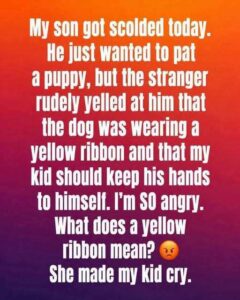
I was walking through my neighborhood one sunny afternoon when I noticed a beautiful golden retriever approaching with its owner. The dog had a shiny coat, gentle eyes, and a wagging tail. Naturally, I smiled and stepped forward to greet it. I have always loved dogs, and this particular one looked especially friendly.
But before I could get closer, the owner politely asked me to keep my distance.
I felt confused. The dog wasn’t barking, growling, or showing any obvious signs of aggression. In fact, it seemed perfectly calm.
Then I noticed a small yellow ribbon attached to its collar.
Assuming it was merely decoration, I asked the woman what it meant.
Her answer surprised me.
She explained that the ribbon was a signal asking strangers to give her dog some space. It wasn’t a fashion accessory or a random decoration. It was a way of communicating that the animal needed extra consideration and should not be approached without permission.
Before she could explain further, the dog suddenly moved behind her legs, trembling slightly.
That was when I realized there was something about this beautiful animal’s past that I hadn’t expected.
What a yellow ribbon actually means
The woman introduced herself as Sarah and explained that her golden retriever, Bailey, had a history that made unfamiliar interactions difficult.
Although Bailey looked friendly, he wasn’t comfortable with strangers approaching suddenly, reaching toward his head, or attempting to pet him without warning.
Sarah explained that the yellow ribbon was part of an awareness initiative commonly associated with the Yellow Dog Project.
The idea is straightforward: a yellow ribbon or other clearly visible yellow accessory can communicate that a dog needs additional space.
It is a reminder to people nearby not to approach, touch, or allow their pets to run toward the animal without first asking the owner.
Some dogs wear yellow because they are nervous around unfamiliar people. Others may be recovering from surgery, dealing with physical discomfort, undergoing behavioral training, or learning to feel comfortable in new environments.
The important thing to understand is that a yellow ribbon doesn’t necessarily mean a dog is dangerous.
It means the dog and its owner are asking for consideration.
Sarah smiled when I thanked her for explaining.
“Bailey is a lovely dog,” she said. “He just needs people to understand that he doesn’t enjoy being approached by everyone.”
I nodded and stepped back.
For the first time, I understood that an animal could appear perfectly relaxed while still feeling uncomfortable about an approaching stranger.
The difficult experience behind Bailey’s ribbon
As we continued talking, Sarah explained that Bailey hadn’t always been so nervous.
When he was younger, he had been an affectionate, energetic dog who enjoyed meeting people. He loved playing in the garden, chasing tennis balls, and greeting familiar visitors.
But one frightening experience changed his behavior.
During a visit to a busy public park, several unfamiliar people approached him at once. Some tried to pet him while others leaned over him to take photographs.
Bailey became overwhelmed.
When someone suddenly reached toward his face, he panicked and tried to move away. His leash tightened, and the situation became even more frightening for him.
After that incident, he gradually became uncomfortable around unfamiliar people.
He started moving behind Sarah whenever someone approached. Sometimes he trembled, and occasionally he tried to hide.
Sarah initially thought he would simply grow out of the behavior.
But after speaking with a veterinarian and consulting a qualified dog behavior professional, she learned that Bailey needed a more gradual approach to unfamiliar interactions.
The yellow ribbon became one of the ways she communicated his needs during walks.
“It helps people understand before they get too close,” she explained.
I looked at Bailey again.
He was standing quietly beside his owner, watching the surroundings.
He didn’t look aggressive.
He looked like an animal that wanted to feel safe.
Why some dogs need extra space
Sarah explained that Bailey wasn’t unusual.
There are many reasons a dog might benefit from wearing a yellow ribbon or another visible yellow accessory.
Some dogs are naturally cautious around unfamiliar people. Others may have experienced frightening situations, changes in their environment, or inadequate socialization when they were young.
Here are some common reasons owners may ask for additional distance:
1. Anxiety and nervousness
Some dogs become frightened when unfamiliar people approach too quickly. Crowded sidewalks, loud noises, and unexpected touching can make them uncomfortable.
2. Previous traumatic experiences
Dogs that have experienced neglect, rough handling, abandonment, or frightening encounters may need additional time to develop trust.
3. Medical recovery
An injured dog or an animal recovering from surgery may be particularly sensitive to movement and physical contact.
Even a normally affectionate dog might become uncomfortable if someone accidentally touches a painful area.
4. Training and rehabilitation
Some owners use yellow accessories while working with professional trainers to help their dogs develop confidence and appropriate social behavior.
5. Sensory or age-related difficulties
Older dogs or animals with vision and hearing difficulties may become startled when someone approaches unexpectedly.
In these situations, allowing the dog to observe its surroundings without pressure can make a significant difference.
The reasons vary, but the message remains the same: give the dog room.
What you should do when you see a yellow ribbon
After speaking with Sarah, I asked what people should do if they encounter a dog wearing one.
She explained that the most helpful response is surprisingly simple.
Respect the distance requested by the owner.
Here are some important guidelines to remember.
1. Don’t approach the dog without permission.
Even if the animal looks friendly, avoid walking directly toward it or reaching out to touch it.
2. Keep your children at a comfortable distance.
Children often become excited when they see dogs. Teach them that they should never run toward an unfamiliar animal, especially one wearing a yellow ribbon.
3. Keep your own dog under control.
If you’re walking another dog, give the yellow-ribbon dog plenty of room. Avoid allowing your pet to rush over for a greeting.
4. Don’t assume a wagging tail means an invitation.
Dogs communicate through their entire body. A wagging tail alone doesn’t necessarily mean an animal is comfortable or wants to interact.
5. Listen to the owner.
If someone asks you to move away, don’t take it personally. The owner is communicating an important need.
6. Avoid photographing or filming the dog without permission.
Some animals become uncomfortable when strangers crowd around them or point cameras toward their faces.
7. Give the dog an easy way to move away.
Avoid blocking its path or surrounding it. Space and freedom of movement can help an anxious animal feel more secure.
These simple actions can prevent unnecessary stress and make public spaces safer for everyone.
The misunderstanding that can put dogs at risk
One thing Sarah emphasized was that people sometimes misunderstand the meaning of a yellow ribbon.
They assume that a dog wearing one must be aggressive or dangerous.
But that isn’t necessarily true.
A yellow ribbon is a communication signal, not a formal temperament assessment or guarantee of behavior.
Some dogs wearing yellow may be recovering from injuries. Others might be frightened, easily overwhelmed, or simply uncomfortable with unfamiliar physical contact.
Likewise, a dog without a yellow ribbon isn’t automatically comfortable being approached.
Every dog deserves to have its personal boundaries respected.
Sarah explained that she sometimes receives uncomfortable comments from strangers who assume she is being overly protective.
People occasionally tell her that dogs need to socialize or that Bailey would become friendlier if everyone simply petted him.
But she has learned that forcing interactions can make an anxious dog even more uncomfortable.
“Trust takes time,” she told me. “I can’t expect Bailey to feel safe just because someone wants to pet him.”
That sentence stayed with me.
We often expect animals to adapt to our behavior without considering how intimidating human attention can feel from their perspective.
A small ribbon can make a big difference
Before we went our separate ways, Sarah thanked me for respecting Bailey’s space.
I told her that I would remember what she had explained and would share the information with my family and friends.
Bailey had stopped trembling.
He was now sitting beside Sarah, calmly watching a bird moving across the grass.
I didn’t try to pet him.
I didn’t ask for a photograph.
I simply smiled from a comfortable distance and wished them a pleasant afternoon.
As I continued walking, I thought about how easily I could have misunderstood the situation.
If Sarah hadn’t explained the ribbon, I might have assumed it was decorative and approached Bailey without realizing that I was making him uncomfortable.
That small piece of yellow fabric communicated something important without requiring the dog to bark, growl, or become frightened.
It gave the owner a simple way to ask strangers for cooperation.
And it reminded me that responsible animal ownership involves more than feeding, walking, and loving a pet. It also means understanding its individual needs and helping others respect them.
The next time you see a dog wearing a yellow ribbon, remember that it isn’t necessarily a warning that the animal is aggressive.
It is a request for space.
Don’t approach without permission. Keep your children and pets at a distance, and allow the owner to decide whether an interaction is appropriate.
Sometimes the kindest thing you can do for an animal isn’t reaching out to pet it.
It’s giving it the freedom to feel safe.