Daniel had lived in his old house for nearly twelve years, and he thought he knew almost every detail about it. He understood which windows rattled during storms, which floorboards creaked at night, and which doors needed an extra push to close properly.
But there was one small detail he had never managed to explain.
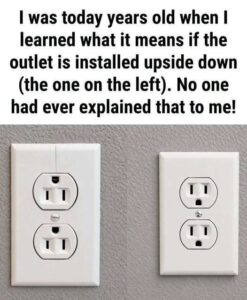
In the living room, one electrical outlet was installed upside down.
Every other receptacle appeared in the familiar orientation, but this particular outlet looked as though someone had deliberately turned it around. It worked perfectly, so Daniel had never considered it a serious problem.
Still, whenever he noticed it, the same question came to mind.
Why would an electrician install an outlet that way?
One evening, while moving a bookshelf, Daniel decided to investigate. He remembered hearing that electrical installations in older houses sometimes contained unusual details that had practical explanations.
What he discovered changed the way he looked at something most people never think twice about.
Why Some Electrical Outlets Are Installed Upside Down
The first surprising fact Daniel discovered was that an upside-down electrical outlet is not necessarily installed incorrectly.
In countries such as the United States, standard receptacles are often installed with the grounding opening facing downward, although many homes have outlets installed in the opposite direction.
There is no universal rule requiring every receptacle to face the same way.
In fact, electricians sometimes choose a particular orientation for practical reasons.
One common explanation involves switched outlets.
In some homes, one half of a receptacle is controlled by a wall switch, allowing a homeowner to operate a nearby lamp without using a separate lighting fixture.
An unusual outlet orientation may help an electrician or homeowner distinguish that receptacle from others.
However, orientation alone does not reliably identify a switched outlet. The actual wiring and circuit arrangement must be checked.
The Clever Reason Behind Some Unusual Installations
Another possible explanation involves identifying different electrical circuits.
In certain commercial buildings, hospitals, workshops, and other facilities, electricians may use different outlet orientations or other visual identification methods to distinguish between electrical supplies.
For example, a receptacle connected to an emergency power system may be marked differently from an ordinary receptacle.
This can help people recognize which outlets are connected to particular circuits.
In some installations, an upside-down outlet may also be used to indicate that a receptacle has a special function or is controlled by a particular switch.
However, these practices are not standardized everywhere.
An upside-down outlet in an ordinary home does not automatically mean it is connected to emergency power, a separate circuit, or a special electrical system.
Sometimes the explanation is much simpler: the electrician preferred that orientation.
The Grounding Connection Explained
Daniel also discovered that the orientation of a receptacle can influence how people think about its grounding connection.
In a typical American three-prong outlet, the grounding opening is round, while the two power slots are vertical.
Some electricians prefer installing receptacles with the grounding opening facing upward.
One argument is that if a metal object accidentally falls behind a partially inserted plug, an upward-facing grounding pin could reduce the possibility of the object bridging the two energized power contacts.
Others prefer the traditional grounding-down orientation.
There is debate about the practical benefits of these arrangements, and simply turning a receptacle upside down does not guarantee electrical safety.
Proper grounding, secure connections, correct wiring, and suitable protective devices are far more important than appearance.
What Daniel Found Behind the Outlet
As Daniel researched the subject, he realized that the unusual orientation was only one part of the story.
The house had been renovated several times before he purchased it. Previous owners had changed lighting fixtures, replaced switches, and added electrical outlets in different rooms.
It was entirely possible that the living-room receptacle had been installed during one of those renovations.
He also learned that older electrical systems sometimes contain wiring arrangements that deserve professional inspection.
For example, an outlet may have been connected to a switched circuit, modified during a renovation, or replaced without correcting an older wiring problem.
Daniel decided that guessing was not worth the risk.
Rather than removing the receptacle himself, he contacted a licensed electrician and explained what he had noticed.
The electrician inspected the installation, checked the circuit, and examined whether the receptacle was properly grounded.
He explained that the unusual orientation was not automatically a sign of faulty wiring.
The important questions were whether the connections were correct, whether the grounding path was effective, and whether the outlet was protected appropriately for its location.
After completing the inspection, he reassured Daniel that the outlet’s orientation alone did not indicate a problem.
Five Electrical Details Homeowners Should Never Ignore
Daniel’s experience encouraged him to pay closer attention to other electrical details around the house.
Some seemingly minor warning signs can deserve more attention than an unusual outlet orientation.
1. Warm or hot outlets
An outlet that becomes unusually warm may indicate an overloaded circuit, loose connection, or another electrical problem. Stop using it and arrange a professional inspection.
2. Burning smells
A persistent burning or plastic-like smell near an outlet or switch should never be ignored. Stop using the affected area and seek qualified electrical assistance.
3. Flickering lights
Occasional flickering may have a simple explanation, but repeated flickering, particularly when appliances are operating, can indicate a wiring or circuit problem.
4. Loose receptacles
Outlets that move when plugs are inserted or removed may have damaged mounting arrangements or other problems requiring repair.
5. Missing grounding protection
Older houses may contain receptacles that do not provide the grounding protection expected in modern installations. A qualified electrician can determine whether upgrades are needed.
Homeowners should never assume that an outlet is safe simply because an appliance works when plugged into it.
Why Older Homes Deserve Special Attention
Older houses often contain several generations of electrical work.
A property may have originally been built with one electrical arrangement and later modified to accommodate modern appliances, additional rooms, heating equipment, and entertainment systems.
Over time, different electricians may have made changes according to the standards and practices of their period.
This does not mean every old house is dangerous.
However, it does mean that homeowners should pay attention to electrical maintenance, particularly when purchasing an older property or planning renovations.
A professional inspection can identify outdated components, overloaded circuits, inadequate grounding, and other issues that may not be visible from the outside.
It is also worth remembering that electrical safety requirements differ between countries. Homeowners should follow local regulations and use appropriately qualified professionals.
The Small Detail That Changed Daniel’s Perspective
When the electrician finished inspecting the outlet, Daniel felt slightly embarrassed that he had spent so much time wondering about something that turned out to be relatively ordinary.
But the experience taught him something valuable.
Not every unusual detail in an old house is evidence of a mistake. Sometimes it reflects a practical decision made by someone who understood the installation.
At the same time, appearances alone cannot establish whether an electrical installation is safe.
Daniel had initially focused on the direction of the outlet. The electrician focused on what really mattered: the wiring, grounding, connections, and overall condition of the circuit.
That distinction made a lasting impression.
The next time Daniel noticed an unusual feature around the house, he decided he would approach it with curiosity rather than assumptions.
Because sometimes the smallest details reveal fascinating stories about how a house was built, modified, and maintained.
And sometimes, the most important discovery is not a hidden wiring secret at all.
It is learning which details deserve attention, which are simply harmless design choices, and when it is best to call a professional.