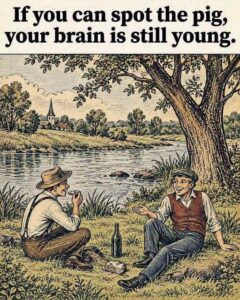
At first glance, this vintage illustration looks like an ordinary countryside scene. Two friends are enjoying a peaceful picnic beneath several bare trees. Everything appears harmless, and nothing seems out of place. But hidden somewhere inside the drawing is a pig that has fooled countless viewers.
The challenge sounds simple: find the animal before someone reveals its location. Yet the longer people examine the picture, the more difficult the task becomes. Their eyes keep returning to the people, picnic items, and branches, while the cleverly disguised animal remains unnoticed.
I decided to examine every corner carefully, but something about the drawing made me pause. One unusual detail seemed completely out of place. Was that really part of a tree, or was I finally getting closer?
A Simple Picture With a Clever Secret
Vintage hidden-object puzzles have entertained generations of families. Long before smartphones and online brain games became popular, people gathered around newspapers, magazines, and illustrated activity books to challenge one another with these visual mysteries.
The appeal was simple: an ordinary-looking picture contained something unexpected, and finding it required patience, concentration, and a willingness to look beyond the obvious.
This particular illustration follows that familiar tradition.
Two people sit beneath leafless trees, apparently enjoying a relaxing afternoon outdoors. Their picnic creates an inviting focal point, encouraging viewers to concentrate on the figures and objects closest to them.
But the pig is hidden in a way that makes the challenge considerably more interesting.
Instead of appearing as a clearly recognizable animal, its features blend into the surrounding shapes. The artist relies on visual confusion, using familiar outlines to disguise something unexpected.
Why Finding the Pig Is So Difficult
The human brain is remarkably good at recognizing familiar patterns.
When we look at a countryside illustration, we automatically identify trees, people, food, and other recognizable objects.
This process helps us understand images quickly, but it can also make hidden-object puzzles surprisingly difficult.
Our attention becomes focused on what we expect to see.
As a result, unusual shapes may remain unnoticed even when they are directly in front of us.
The hidden pig takes advantage of this natural tendency.
Rather than immediately searching for four legs, a snout, and two ears, viewers should pay attention to unusual combinations of lines and curves.
A shape that initially resembles part of a tree might actually contain the outline of the animal.
That is the trick that makes this puzzle so entertaining.
Three Strategies That Can Help
If you have been staring at the illustration without success, try approaching it differently.
1. Stop looking for a complete animal.
The pig may not appear in its familiar standing position. Look for partial features, including a curved snout, rounded body, or unusual ear-shaped outline.
2. Examine the background carefully.
People naturally concentrate on the picnic and the two characters. Instead, shift your attention toward the surrounding trees, branches, and empty spaces.
3. Change your perspective.
Sometimes an image becomes easier to understand when viewed from a different distance. Step back from the screen, relax your eyes, and look at the entire composition rather than individual details.
These small changes can make a surprising difference.
Why People Love These Vintage Brain Teasers
Hidden-object puzzles offer more than a few minutes of entertainment.
They encourage concentration, observation, and patience. They also create enjoyable opportunities for friends and family members to compete.
One person might discover the answer almost immediately, while another spends several minutes examining every corner.
That difference makes the experience especially entertaining.
Older illustrated puzzles also carry a special nostalgic appeal. Their detailed drawings, traditional countryside settings, and playful visual tricks remind many people of childhood magazines and activity books.
Unlike modern games filled with flashing lights and complicated instructions, these puzzles require nothing more than an image and a curious mind.
The Moment of Discovery
Eventually, I stopped concentrating on the picnic itself and began examining the shapes surrounding the two people.
That was when the possibility of the hidden animal became much clearer.
The unusual detail I had noticed earlier suddenly seemed less like an ordinary part of the landscape and more like a deliberate piece of visual camouflage.
I realized that the secret was not necessarily hidden through darkness or complicated drawing.
It was hidden through familiarity.
The artist had created an image in which the brain naturally overlooked the very shape it was supposed to find.
And that is what makes a successful visual puzzle so satisfying.
Did You Find the Hidden Pig?
Before looking for the solution, give yourself another moment.
Look carefully at the tree branches, the spaces between objects, and the unusual outlines throughout the illustration.
Try not to let the picnic distract you.
If you spotted the pig without assistance, congratulations! You have demonstrated excellent attention to visual detail.
If you haven’t found it yet, don’t feel discouraged. These puzzles are specifically designed to make ordinary shapes look like something else.
The real pleasure comes from that unexpected moment when everything suddenly makes sense.
So, did you discover the cleverly disguised pig, or is it still hiding in plain sight?
Share the puzzle with a friend or family member and see who can solve it first.
Sometimes the smallest details create the biggest surprises.