Eleanor had always considered herself a neighbor who preferred peace over arguments. When Monica moved in next door, Eleanor tried to be welcoming, overlooking small things that gradually became harder to ignore.
Monica occasionally borrowed garden items without asking and sometimes wandered onto Eleanor’s driveway as though the property line were merely a suggestion.
Eleanor said nothing because each incident seemed too minor to justify a confrontation.
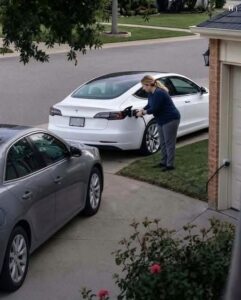
Then Monica bought an electric car and discovered that an outlet near Eleanor’s garage was convenient for charging it.
At first, Eleanor assumed it was temporary. But the charging cable began appearing regularly, often overnight, while Eleanor’s electricity bill quietly increased.
She finally mentioned it, expecting a simple apology.
Monica only laughed and said it was “just a little electricity” and that Eleanor probably wouldn’t notice.
Eleanor wanted to believe her neighbor would understand if given time, but the behavior continued.
Then one afternoon, Eleanor noticed something missing from her garden and discovered Monica had taken another item without asking.
That was when Eleanor stopped thinking about each incident separately.
The problem was no longer one outlet or one decoration.
It was a pattern.
She decided she would not argue or retaliate. Instead, she quietly installed something beside the garage that would make her boundary impossible to misunderstand.
The Final Straw
The following morning, Eleanor walked into her garden and noticed that her favorite ceramic birdbath decoration was missing.
It wasn’t particularly expensive, but it had belonged to her late mother.
She searched around the flowerbeds before spotting something familiar near Monica’s patio.
There it was.
The little ceramic decoration sat beside Monica’s flowerpots as though it had always belonged there.
Eleanor stood silently for several seconds.
She could have knocked on Monica’s door immediately, but she decided to approach the situation calmly.
That afternoon, she walked next door.
“Monica, I noticed my ceramic decoration is in your garden.”
Monica glanced toward it.
“Oh, that little thing? I thought you weren’t using it. It looked better over here.”
Eleanor was stunned.
“It belonged to my mother. I’d appreciate it if you returned it.”
Monica shrugged.
“Of course. No need to make such a big deal.”
But Eleanor had already realized something important.
Her neighbor didn’t seem to recognize that other people’s property and resources deserved respect.
A Simple Solution
That evening, Eleanor sat at her kitchen table with her electricity bill.
She compared the latest statement with previous months and noticed the increase.
She couldn’t establish exactly how much electricity Monica had used, but the repeated overnight charging was clearly something she could no longer ignore.
The next morning, Eleanor contacted an electrician.
She explained the situation and asked for a practical solution.
The electrician recommended installing a weatherproof lockable enclosure around the outdoor electrical outlet.
He also checked the circuit and confirmed that the installation could be completed safely.
Eleanor approved the work.
By the afternoon, the outlet was protected behind a sturdy enclosure with a small combination lock.
Beside it, she placed a discreet sign:
PRIVATE ELECTRICITY SUPPLY — PLEASE ASK BEFORE USING.
It wasn’t threatening.
It wasn’t rude.
It was simply clear.
Monica Notices the Difference
That evening, Monica appeared beside Eleanor’s garage carrying her charging cable.
She stopped when she saw the new enclosure.
“What happened to the outlet?” she asked.
Eleanor was watering her flowers.
“Nothing happened. I simply decided to secure my private electrical supply.”
Monica looked confused.
“But I usually charge my car here.”
Eleanor turned toward her.
“I know. That’s why I installed the lock.”
Monica laughed nervously.
“You’re not seriously making a big deal over a little electricity?”
Eleanor remained calm.
“It’s my electricity, Monica. If you need to charge your vehicle, you’ll need to arrange your own charging.”
For several seconds, Monica said nothing.
Then she folded her charging cable and walked away.
Eleanor returned to her flowers.
There was no shouting, no argument, and no dramatic confrontation.
Just a boundary.
The Unexpected Conversation
Two days later, Monica knocked on Eleanor’s front door.
She looked less confident than usual.
“Can I ask you something?”
“Of course.”
Monica explained that she had been using Eleanor’s outlet because installing a home charging station seemed expensive.
She admitted that she had assumed Eleanor wouldn’t mind.
“I honestly thought it was harmless,” she said.
Eleanor listened.
“I understand that installing a charger can be expensive. But that doesn’t mean you can use someone else’s electricity without permission.”
Monica looked down.
“You’re right. I should have asked.”
Eleanor nodded.
“That’s all I wanted you to understand.”
Monica then returned the ceramic decoration she had borrowed.
She placed it carefully in Eleanor’s hands.
“I’m sorry about this, too.”
Eleanor thanked her.
It wasn’t a perfect reconciliation, but it was a beginning.
A New Understanding Between Neighbors
Over the following weeks, things gradually improved.
Monica stopped walking onto Eleanor’s driveway without permission.
She no longer borrowed gardening supplies without asking.
Most importantly, she arranged charging for her electric vehicle through her own electrical supply.
The relationship between the two women became more polite.
They occasionally exchanged greetings and discussed the weather, but Eleanor no longer felt obligated to overlook behavior that made her uncomfortable.
She had discovered that being a good neighbor didn’t mean allowing someone else to take advantage of her kindness.
One afternoon, while planting new flowers, Eleanor noticed Monica approaching.
“Those look beautiful,” Monica said.
“Thank you.”
“I was wondering whether you’d mind if I borrowed your garden shears sometime. Mine broke.”
Eleanor smiled.
“Of course. Just bring them back when you’re finished.”
Monica laughed.
“I promise.”
It was a small conversation, but Eleanor appreciated the difference.
This time, her neighbor had asked.
The Lesson Eleanor Never Forgot
Months later, Eleanor thought about everything that had happened.
At first, she had believed that keeping the peace meant staying quiet.
She had ignored the borrowed gardening supplies, the unauthorized use of her driveway, and the growing electricity bill.
Each individual incident seemed too small to justify an uncomfortable conversation.
But together, they had become a pattern that affected her home and peace of mind.
The lock beside her garage had changed more than access to an electrical outlet.
It had reminded both women that kindness and boundaries could exist together.
Eleanor didn’t need to be aggressive to protect her property.
She didn’t need to embarrass Monica or start a neighborhood feud.
She simply needed to communicate what was acceptable.
And that became the most valuable lesson of all.
Being considerate doesn’t mean giving everyone unlimited access to your time, belongings, or resources.
Sometimes, the simplest boundary is also the clearest message.
And sometimes, all it takes to restore a little peace between neighbors is one small lock, one honest conversation, and the courage to say no.