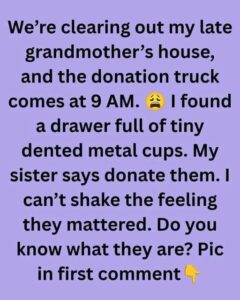
When my grandmother passed away, I never imagined that one of the most fascinating discoveries among her belongings would be something so small that it could easily disappear between my fingers. As our family gathered to sort through her possessions, we uncovered countless reminders of her life: old photographs, handwritten letters, faded dresses, and household objects she had carefully preserved for decades. Every item seemed to carry a memory, but one unusual object caught my attention more than anything else.
It was hidden at the bottom of her old wooden sewing box.
At first, I thought it was a tiny metal cup. It was barely larger than my thumb, slightly tarnished, and covered with hundreds of little indentations. Its shape was unusual, and I couldn’t understand why my grandmother had kept something so small for so many years.
I turned it around several times, examining its edges and looking for markings that might explain its purpose. It didn’t resemble any ordinary sewing accessory I recognized. Curious, I carried it into the kitchen and showed it to my mother.
The moment she saw it, she smiled.
“That’s your grandmother’s thimble,” she explained.
I had heard of thimbles before, but I had never really understood their importance. My mother explained that people wear them on their fingers when sewing by hand to protect themselves from accidentally pushing a needle into their skin. The small indentations across the metal surface help keep the needle from slipping.
Suddenly, the strange little cup made sense.
But my mother wasn’t finished.
She picked it up again and examined the inside carefully. Then her expression changed. She turned the thimble toward the kitchen window and pointed to a tiny engraved symbol near its rim.
I had never noticed it before.
It was a small letter followed by a date: 1948.
My mother became unusually quiet.
“Your grandmother never told you about this, did she?” she asked.
I shook my head.
She explained that the thimble had belonged to my great-grandmother before it became my grandmother’s most treasured sewing tool. It had been passed down through the family for generations, long before I was born.
According to my mother, my great-grandmother had been an exceptionally talented seamstress. During difficult years, she repaired clothes for neighbors and sometimes made dresses for families who couldn’t afford to purchase new ones. Sewing wasn’t simply a hobby for her. It was one of the ways she helped support her family.
The thimble had accompanied her through countless hours of work.
But there was something else.
My mother remembered hearing a story about a young woman who had received the thimble as a gift shortly before leaving her hometown. The woman had promised to keep it safe and eventually pass it to someone she loved.
That woman was my grandmother.
The following morning, I returned to the sewing box and began examining everything more carefully. Beneath several folded pieces of fabric, I discovered a small envelope that had become yellow with age. My grandmother’s handwriting appeared on the front.
It simply said, “For the day someone asks about the little thimble.”
My hands began trembling as I opened it.
Inside was a photograph of a young woman standing beside an older woman. The younger woman was holding the exact same metal thimble I had discovered the previous day.
Behind the photograph was a handwritten letter.
It explained that the thimble had originally belonged to a woman named Margaret, who had worked as a seamstress during a particularly difficult period in her family’s history. She had used her sewing skills to help raise her children after losing the person who had once supported the household.
The letter also revealed something my family had never discussed openly.
One of those children had been adopted within the extended family after a difficult family tragedy. The decision had been made quietly, with the intention of protecting the child and giving her a stable home.
That child eventually became my grandmother.
I stared at the letter, struggling to understand what I had just read.
My grandmother had never been abandoned, as I had always believed. Instead, she had been lovingly raised by relatives who had made an extraordinary sacrifice to give her a better future. The woman in the photograph was her biological mother, and the thimble was the one object that connected them.
Suddenly, many little details from my childhood began making sense.
My grandmother had always spoken about family loyalty, kindness, and the importance of protecting children. She had also kept certain photographs separate from the others, never explaining who the people in them were.
I realized that she had carried this secret throughout her life.
I showed the letter to my mother, who became emotional as she read it. She admitted that she had known part of the story but had never understood all the details. My grandmother had apparently wanted to explain everything one day, but circumstances had prevented that conversation from happening.
We spent the next few days searching through old photographs, letters, and family documents. Slowly, we began piecing together the history of the women who had owned the thimble.
What surprised me most was discovering how much love had existed behind a decision that had remained a secret for so many years.
The little metal object was no longer just a sewing tool. It represented sacrifice, protection, and the complicated ways families sometimes find themselves connected.
I decided not to polish the thimble or change its appearance. Its small dents, faded surface, and engraved date were part of its history. I placed it carefully inside a protective case alongside the photograph and letter.
Today, whenever I look at it, I think about the women who held it before me. I imagine them sitting beside windows, repairing clothes, raising children, and finding ways to survive difficult circumstances.
I also think about my grandmother and how she chose to preserve this tiny object until someone was ready to understand its meaning.
I originally believed I had discovered an old sewing accessory that nobody had bothered to throw away.
Instead, I discovered a missing chapter of my family’s history.
Sometimes, the smallest objects carry the biggest stories. And sometimes, the things our grandparents leave behind are not simply possessions. They are messages from the past, waiting patiently for someone to find them.