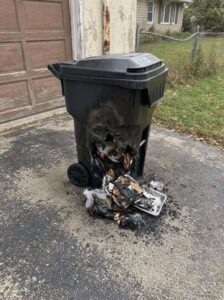
My trash can melted on Thanksgiving morning, and when I discovered it, I stood at the end of my driveway holding a full garbage bag, completely speechless.
The green plastic container had collapsed inward. Its lid was twisted, gray ashes covered the driveway, and pieces of charcoal were scattered among the remains of my kitchen garbage. At first, I couldn’t understand what had happened.
Then I remembered seeing my neighbor, Denise, using her barbecue grill that morning.
She had been cooking breakfast outside, laughing with several guests while smoke drifted across our shared property line. Apparently, the hot ashes from her grill had somehow ended up against my trash can, destroying it completely.
I was seventy-six years old. I had lived in that house for forty-one years, and I had never experienced anything quite like this.
But the damaged trash can wasn’t really the problem.
It was the final incident in a long series of disrespectful actions that had begun months earlier.
My husband, Frank, and I had purchased our home in 1983. Our son Danny was only four years old at the time, and the neighborhood was still surrounded by open fields. Back then, neighbors helped one another, shared gardening tools, exchanged homemade food, and looked after each other’s children.
Our previous neighbor, Ellen, had been one of my closest friends for more than thirty years. When Frank underwent knee surgery, she walked our dog every morning. When her furnace broke during winter, I brought her dinner until the repairs were completed.
We trusted each other completely.
Unfortunately, everything changed when Denise purchased the house next door.
At first, she seemed friendly enough. She was energetic, talkative, and always busy with something. I even baked her banana bread when she moved in because I wanted her to feel welcome.
I had no idea that kindness would eventually be mistaken for weakness.
Part 2 — The Neighbor Who Thought Everything Belonged To Her
The first incident happened in April.
I walked into our garage and discovered Denise carrying two of my expensive terracotta flowerpots. She also had Frank’s garden rake tucked beneath her arm.
When I asked what she was doing, she barely seemed embarrassed.
“Oh, I just needed a few things. I’ll bring them back later.”
I was uncomfortable, but I didn’t want to start an argument with someone who had only recently moved into the neighborhood.
Unfortunately, she never returned the flowerpots.
Instead, she placed them beside her front entrance and filled them with beautiful yellow flowers.
A few days later, I found my rake lying outside her house in the rain. Its metal surface had started rusting.
Then other gardening tools began disappearing.
First, my small trowel vanished. Then the hand rake disappeared, followed by a cultivator that Frank had repaired himself years earlier.
We searched the garage and garden, assuming we had misplaced everything.
Then our lawn mower disappeared.
Frank was furious.
We had installed a small security camera above the garage after several packages went missing from neighboring properties. When he checked the recordings, we saw Denise walking directly into our garage and wheeling our lawn mower out.
There was no misunderstanding.
She had taken it without asking.
I finally walked over to her house and politely requested its return.
She was sitting beside her swimming pool when I arrived.
“Oh, hey, Ruth! You need it already?” she asked cheerfully.
I reminded her that it belonged to us.
She waved toward the mower and told me I could take it.
I pushed it home without arguing.
Frank couldn’t understand why I continued being polite.
“She’s treating our property like a free rental service,” he complained.
I knew he was right.
From that day forward, I started locking the garage whenever I wasn’t using it.
But Denise’s behavior didn’t improve.
Part 3 — The Thanksgiving Incident
Over the following months, there were more problems.
She occasionally parked across part of our driveway, left garbage near our fence, and allowed her little white dog to wander into our garden.
Whenever I mentioned something, she acted as though I was being unreasonable.
Then came Thanksgiving morning.
Our family was expected to arrive for dinner, and I had spent several days preparing food. The kitchen was filled with the smell of roasting turkey, freshly baked bread, and homemade pumpkin pie.
I stepped outside to dispose of the morning’s garbage.
That was when I discovered the melted trash can.
I immediately photographed everything.
Frank came outside, examined the damage, and shook his head.
“That’s enough,” he said.
For once, I agreed.
I wasn’t going to scream at Denise, damage her property, or create a neighborhood argument.
Instead, I decided to handle the situation properly.
I photographed the damaged container, saved the security camera footage showing the earlier incidents, and contacted the appropriate local waste collection service to ask about replacing the bin.
I also reviewed our camera recordings to understand exactly what had happened that morning.
The footage showed Denise moving her barbecue equipment near the property boundary. Shortly afterward, smoke drifted toward our driveway, and the damaged container was visible in the same area.
The recording didn’t establish every detail of how the damage occurred, but it provided important evidence of the circumstances.
I saved everything.
Then I made a phone call.
Part 4 — The Surprise Nobody Expected
That afternoon, I contacted our neighborhood association and explained the repeated problems.
I provided photographs of the damaged trash can, explained the missing gardening equipment, and shared the relevant recordings.
I also contacted Denise directly in writing, requesting reimbursement for the damaged container and asking her to stop entering our property without permission.
She responded with a message that made my blood boil.
“Maybe you should stop making such a big deal out of everything. It’s only a trash can.”
I didn’t answer.
Instead, I focused on Thanksgiving dinner.
By four o’clock, our driveway was full of cars. My children, grandchildren, and several relatives had arrived. The house was filled with laughter, conversation, and the delicious smell of food.
Then Frank received a message.
The neighborhood association had reviewed the complaint and scheduled a formal discussion about the repeated property disputes.
Apparently, Denise had already received a notice.
She wasn’t happy.
A little later, she appeared at our front door.
“Ruth, can we talk?” she asked.
I invited her inside, although I could tell she was expecting an argument.
She immediately complained that I had embarrassed her by reporting the situation.
I looked at her calmly.
“You took our belongings without permission. You repeatedly ignored our boundaries, and now our property has been damaged. What exactly did you expect me to do?”
She crossed her arms.
“I said I was sorry about the trash can.”
I reminded her that an apology didn’t replace the cost of something she had damaged.
For several seconds, she said nothing.
Then Frank brought out a folder containing the photographs, receipts, and relevant recordings.
Denise’s expression changed.
She had apparently assumed we would never document anything.
But the biggest surprise came when our adult son Danny joined the conversation.
He explained that he had already contacted the waste collection company and arranged for a replacement container. He had also helped his father organize the evidence concerning the missing equipment.
Denise looked increasingly uncomfortable.
For the first time, she realized that our family was no longer willing to ignore her behavior.
Part 5 — The Lesson That Changed Our Neighborhood
The following weeks brought several changes.
Denise agreed to reimburse us for the damaged trash container after the circumstances were discussed. She also returned the remaining gardening equipment that had been taken from our property.
The neighborhood association reminded residents that entering another person’s property without permission and damaging belongings were unacceptable.
The situation wasn’t resolved through revenge or humiliation. It was resolved through documentation, communication, and clear boundaries.
Interestingly, other neighbors began sharing similar experiences.
One resident explained that Denise had repeatedly left unwanted items near his driveway. Another mentioned that she had borrowed gardening equipment without returning it promptly.
Our street slowly began discussing the importance of respecting everyone’s property.
As for me, I learned something important at seventy-six.
Being kind doesn’t mean allowing people to take advantage of you.
For years, I had avoided confrontation because I believed maintaining peace was more important than standing up for myself. I had convinced myself that ignoring small problems would eventually make them disappear.
But sometimes silence simply encourages someone to continue.
On the next Thanksgiving, I placed a brand-new trash can beside our driveway. It was clean, sturdy, and securely positioned away from anything that could damage it.
Denise walked past while I was arranging the decorations.
She stopped, looked at the container, and quietly said hello.
I returned the greeting.
We weren’t friends, but we were finally respectful neighbors.
And that was enough.
I never needed to destroy her property or embarrass her in front of the entire street. I simply needed to make it clear that my home, my belongings, and my kindness deserved respect.