The first sign that something in my father had shifted didn’t come through words or tears, but through a quiet, unfamiliar sound—the steady hum of a sewing machine echoing softly through our home. It felt out of place, almost surreal, because my father had always been a man of practicality, someone who worked with tools that were heavy, solid, and predictable. His world had been built on structure, repetition, and things that made sense when held firmly in hand. After my mother passed away, he didn’t collapse in the way I had feared he might. Instead, he absorbed the loss into himself, carrying it in a way that made it both invisible and ever-present. He became quieter, more deliberate, as if every action now required an extra layer of intention. He showed love through routine—packed lunches prepared before sunrise, reminders about school spoken in a steady voice, long days at work that never seemed to exhaust him enough to withdraw from being there for me in the evenings. He didn’t speak about grief, but it lived in the pauses between his words and in the careful way he moved through the house. So when I saw him leaning over delicate fabric, his rough hands guiding something fragile beneath a needle, it felt like I was witnessing something deeply personal—something that didn’t belong to the version of him I had always known. It wasn’t just sewing. It was grief being reshaped into something tangible, something he could control, something he could give. I didn’t ask questions, not because I wasn’t curious, but because I sensed that whatever he was doing mattered in a way that didn’t need interruption. Even then, without fully understanding it, I knew this quiet act carried meaning beyond what words could explain. Each stitch, each measured movement, was part of something larger—a silent promise taking form in the background of our lives.
Growing up without my mother left spaces that were never loud but always present, like an echo that never quite faded. They showed up in subtle ways—moments when other girls turned instinctively to their mothers for advice, reassurance, or shared excitement. I learned early how to navigate those moments on my own, adjusting my expectations so they wouldn’t hurt as much. I became practical in the same way my father was, careful about what I asked for and aware of what we didn’t have. There was a quiet understanding between us that we didn’t need to say out loud: we were doing our best, and that had to be enough. By the time prom approached, I had already decided it would be simple. I didn’t expect anything special, and I certainly didn’t expect to feel like I was missing out on something important. I had convinced myself that it was just another event, another evening that would pass without leaving much behind. We didn’t have the kind of money for extravagant dresses, and I had grown used to shaping my desires around what was realistic. So when I casually mentioned borrowing a dress, it felt like the most reasonable option. I expected my father to agree without hesitation, to nod in that familiar way that meant the decision was already made. Instead, he surprised me. “Leave the dress to me,” he said, calmly but with a certainty that caught me off guard. I laughed at first—not out of doubt in him as a parent, but because the idea felt so unlikely. It didn’t fit into the image I had of him, the one built on practicality and predictability. What I didn’t know was that he had already begun. He had already taken my mother’s wedding dress from where it had been carefully stored, already decided that something meaningful could be created from something tied so deeply to memory. While I had been adjusting my expectations downward, he had been quietly raising them in a way I never imagined.
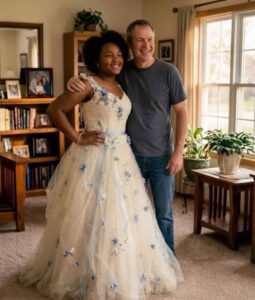
The night he gave it to me is a moment that lives in my memory with a kind of clarity that time hasn’t softened. He handed me the garment bag with a kind of nervous pride I had rarely seen in him, his usual composure replaced by something more vulnerable. There was hesitation in the way he held it, as if he wasn’t sure how it would be received, as if this act—so different from anything he had done before—carried a risk he wasn’t used to taking. As I unzipped it, I felt something shift inside me even before I saw the dress fully, like the air itself had changed. When I pulled it out, everything else seemed to fade. It wasn’t just beautiful—it was alive with meaning in a way I hadn’t expected. The fabric of my mother’s gown had been transformed into something entirely new, shaped to fit me, yet still holding echoes of where it came from. The design wasn’t perfect in a technical sense, but it was thoughtful, intentional, and deeply personal. Small details stood out the most—tiny blue flowers stitched carefully into the fabric, each one slightly different, each one carrying the unmistakable mark of someone learning as they went. I could tell he had taught himself how to do this, likely sitting for hours, making mistakes, undoing them, trying again until it felt right. Those imperfections weren’t flaws. They were proof. Proof of time invested, of patience stretched, of love expressed in the only way he knew how. In that moment, I didn’t just feel like I had a dress. I felt like I was being given something far more significant—a piece of my mother’s presence, reimagined through my father’s effort, brought together in a way that made me feel whole rather than incomplete.
When I walked into prom, I carried more than just fabric on my shoulders. I carried intention, memory, and a quiet strength that came from understanding—even if only partially—what that dress represented. For a while, everything felt exactly as it should. The lights reflected softly against the fabric, the music filled the room with a rhythm that made it easy to forget everything outside of that moment, and laughter moved freely through the space. I felt present in a way I hadn’t expected, as though the weight I had anticipated wasn’t there at all. But moments like that can be fragile, especially when someone chooses to disrupt them. My English teacher approached me with a smile that didn’t quite reach her eyes, her gaze lingering on my dress with a kind of judgment she didn’t bother to disguise. Her words came out sharper than necessary, loud enough to draw attention, framed as an observation but delivered as something else entirely. She commented on the dress looking outdated, like something pulled from another time, something that didn’t belong in the present. The impact was immediate and deeper than I wanted it to be. It wasn’t just about the dress—it felt like everything it represented had been reduced to something insignificant, something worthy of dismissal. My father’s effort, my mother’s memory, the quiet meaning I carried into that room—it all felt suddenly exposed. For a moment, I didn’t know how to respond. The confidence I had built so carefully began to crack, not because I believed her entirely, but because the vulnerability of the situation made it hard to separate her words from my own insecurities. It’s strange how quickly doubt can find its way in, even when something feels deeply right.
But before that moment could settle into something permanent, something unexpected shifted the direction of the night. Another voice entered the space—calm, measured, and firm in a way that carried authority without needing to raise itself. It cut through the tension not with aggression, but with clarity, reframing what had just happened in a way that made it impossible to ignore. What had felt like a personal attack was suddenly seen in a broader context, one that revealed it wasn’t isolated or accidental. There was a history behind it, a pattern that others had noticed and quietly acknowledged until it reached a point where silence was no longer acceptable. Watching the situation unfold, I felt something I hadn’t anticipated: relief. Not just because someone had intervened, but because it confirmed something I hadn’t fully allowed myself to believe—that the discomfort I had felt wasn’t something I had imagined, and it wasn’t something I deserved. That realization didn’t erase the hurt instantly, but it created space for something else to grow in its place. It allowed me to step back into the moment without carrying the full weight of what had been said. It reminded me that perception isn’t always truth, and that sometimes the most important thing isn’t avoiding judgment, but understanding where it comes from and choosing not to let it define you.
Afterward, the atmosphere shifted in a way that felt almost tangible. The tension that had briefly taken hold dissolved, replaced by something softer, more genuine, as if the night had been given permission to return to itself. People approached me differently—not with curiosity tinged by uncertainty, but with genuine interest and appreciation. When I explained the story behind the dress, their reactions changed in a way that felt honest and unforced. What had once been misunderstood became something people could connect to, something they could see beyond its surface. My best friend pulled me back into the rhythm of the night, refusing to let that earlier moment linger longer than it deserved. And as I moved, laughed, and allowed myself to be fully present again, I realized something important. The dress had become more than what anyone could say about it. It had outgrown that moment entirely. It carried meaning that existed independently of perception, something grounded in effort, memory, and love rather than opinion. When I returned home later that night, my father was waiting, just as I knew he would be. The quiet of the house felt different, filled with a kind of anticipation that didn’t need to be spoken. He looked at me carefully, searching my expression for something he couldn’t quite ask directly. “Did the dress hold up?” he said, trying to sound casual, though there was a vulnerability in the question he couldn’t hide. I smiled—not because the night had been perfect, but because it had been real in a way that mattered more. “It did more than that,” I told him. And I meant it. The dress had carried me through doubt, through hurt, and into something stronger. It reminded me that love doesn’t need to be flawless to be powerful. It just needs to be real, consistent, and brave enough to show itself in unexpected ways. And no matter what anyone else sees, those are the things that endure, long after the moment has passed.