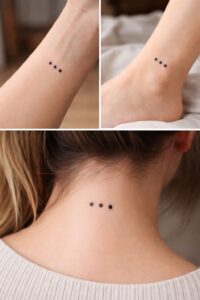
The three-dot tattoo (•••) is one of the most deceptively simple forms of body art, yet it carries a surprising depth of meaning that shifts depending on culture, context, and personal history. At first glance, it may appear as nothing more than a minimalist design—three small inked dots placed in a straight or triangular formation, often on the hand, fingers, or sometimes near the eyes or wrist. However, beneath its understated appearance lies a wide spectrum of interpretations, ranging from philosophical symbolism to lived experience, from cultural identity to misunderstood social labeling.
What makes the three-dot tattoo particularly fascinating is that it does not belong to a single tradition or meaning system. Unlike symbols that have fixed definitions, its significance is fluid. It changes depending on who wears it, where it is seen, and the cultural lens through which it is interpreted. This flexibility is part of what gives it both power and controversy.
One of the most widely recognized interpretations of the three-dot tattoo is its connection to the phrase “see no evil, hear no evil, speak no evil.” This concept originates from an ancient philosophical idea often represented by three wise monkeys covering their eyes, ears, and mouth. In this context, the three dots symbolize restraint, self-control, and a deliberate choice to avoid engaging in harmful behavior or speech. For some wearers, this meaning is deeply personal, reflecting a commitment to mindfulness, silence in conflict, or moral discipline.
However, in other environments, particularly within prison culture in certain regions, this philosophical interpretation evolves into something more complex. The three dots can become a symbol associated with loyalty, silence, and an unspoken code of conduct. In these contexts, it may represent the idea of not speaking to authorities or not revealing internal group matters. This does not necessarily mean the wearer is currently involved in criminal activity; rather, it may reflect past experiences or associations with environments where trust and silence were essential for survival.
It is important to understand that even within prison-related interpretations, the meaning of the tattoo is not uniform. In some cases, it is not tied to any organized group at all but instead represents a general mindset shaped by hardship. People who have experienced incarceration or difficult life circumstances may adopt the symbol as a reminder of what they have endured and how they have adapted.
Beyond institutional or subcultural meanings, the three-dot tattoo also carries interpretations rooted in personal identity and storytelling. For some individuals, the dots function as markers of time—representing phases of life, struggles overcome, or chapters that have shaped who they are. In certain variations, additional dots may be added over time, creating a visual timeline on the skin. Each dot can symbolize a significant event, such as years spent in confinement, periods of hardship, or milestones of personal transformation.
In this sense, the tattoo becomes less about external perception and more about internal narrative. It serves as a permanent reminder of resilience, survival, or change. The simplicity of the design contrasts sharply with the complexity of the experiences it may represent.
In Latin American and Chicano cultural contexts, the three-dot tattoo is often associated with the phrase “Mi Vida Loca,” meaning “My Crazy Life.” In this interpretation, the symbol reflects a lifestyle characterized by unpredictability, intensity, or rebellion. It does not necessarily point to a specific event or group affiliation but rather to a broader expression of lived experience. For some, it is a form of identity expression—acknowledging a life shaped by challenges, risk, or nonconformity.
This version of the meaning is especially common in youth subcultures, where tattoos often serve as visual language for belonging and identity. The three dots in this context can represent acceptance of one’s past, pride in survival, or simply acknowledgment of a life lived outside conventional expectations.
At the same time, the tattoo’s simplicity is part of what makes it so widely adopted. Because it is small, discreet, and easy to place, it can be worn in visible or hidden locations depending on personal preference. This has contributed to its spread across different communities and social groups, each attaching their own meaning to it.
However, the wide range of interpretations also creates misunderstandings. In some social or professional environments, the three-dot tattoo may be incorrectly assumed to signal criminal involvement or gang affiliation. This assumption is not always accurate, but it persists due to cultural associations formed through media, law enforcement training, or localized histories.
As a result, individuals with this tattoo may sometimes face unfair judgment or stereotyping. A symbol that holds personal or philosophical meaning for one person may be interpreted very differently by another, depending on their background or awareness of its varied uses. This tension between personal expression and public perception is one of the defining features of the three-dot tattoo.
The issue of misinterpretation highlights a broader reality about body art in general: tattoos are rarely universal in meaning. Unlike written language, which tends to have more standardized definitions, visual symbols are open to interpretation. A design that represents peace, struggle, identity, or memory for one person may be read as something entirely different by someone else.
In the case of the three-dot tattoo, this ambiguity is especially pronounced because of its minimalism. With no additional imagery or context, the meaning relies almost entirely on external assumptions. This makes it both powerful and vulnerable as a symbol.
From a psychological perspective, minimalist tattoos like the three dots often appeal to individuals who prefer subtle forms of expression. Instead of large, elaborate designs, they choose symbols that are quiet but meaningful to them personally. The simplicity of three dots allows for flexibility—it can be hidden in plain sight or displayed openly without drawing immediate attention.
In some philosophical interpretations, the number three itself carries symbolic weight. Across many traditions, the number three represents balance, harmony, or progression. It can signify past, present, and future; beginning, middle, and end; or mind, body, and spirit. While not always explicitly connected to the tattoo, these associations sometimes influence how individuals interpret or choose the design.
This layered symbolism allows the tattoo to function almost like a blank canvas. Each wearer adds their own meaning, whether rooted in philosophy, experience, or identity. Over time, the collective interpretations accumulate, giving the symbol a complex cultural footprint.
Despite its varied meanings, one consistent theme emerges across most interpretations: the three-dot tattoo is deeply personal. Whether it represents silence, survival, rebellion, memory, or philosophy, it is rarely chosen without significance to the wearer. Even when misunderstood by others, it often holds a private meaning that is not immediately visible.
This disconnect between internal meaning and external perception is central to the tattoo’s cultural complexity. It demonstrates how symbols evolve once they enter public space. A design that begins with one meaning can gradually take on many others as it spreads across different communities and contexts.
In modern society, where tattoos are increasingly common and widely accepted, the three-dot design continues to exist at the intersection of simplicity and depth. It remains small enough to be discreet but meaningful enough to provoke curiosity. Its ambiguity invites questions, interpretation, and sometimes misinterpretation.
Ultimately, understanding the three-dot tattoo requires moving beyond assumptions and recognizing the diversity of human experience it can represent. It is not a fixed symbol with a single definition, but a flexible expression shaped by individual stories and cultural environments.
For some, it is a reminder of restraint and personal discipline. For others, it is a reflection of hardship or survival. For others still, it is a statement of identity, belonging, or lived experience. And in some cases, it may simply be chosen for its aesthetic simplicity without any deeper symbolic intent.
What remains constant is that the three-dot tattoo reflects the human tendency to assign meaning to even the smallest forms of expression. Three dots, minimal and quiet, become a canvas for complex narratives that span philosophy, culture, and personal history.