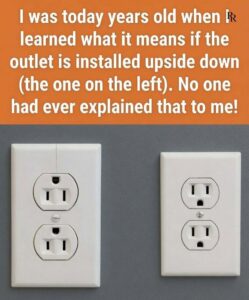
If you have ever looked at a wall outlet and noticed that the small round ground opening is positioned above the two vertical slots, you may have wondered whether someone installed it incorrectly.
At first glance, it appears backwards.
Most people are familiar with outlets installed with the ground hole facing downward. That orientation is so common that anything different immediately stands out. Many homeowners assume an upside-down outlet is the result of a careless installation or a simple mistake.
However, that is not always true.
In many homes, an outlet installed with the ground opening at the top was placed there intentionally. The reason can involve electrical practices, safety considerations, local habits, or simply the preference of the electrician who completed the installation.
The small change in appearance can reveal interesting details about how electrical systems have evolved over time.
To understand why some outlets are installed this way, it helps to look at how standard electrical receptacles work.
A typical household outlet has three openings.
The two vertical slots provide the electrical connection for hot and neutral wires.
The rounded opening connects to the grounding system.
The ground connection exists as an important safety feature. If a fault occurs and electricity reaches a metal part of an appliance, the grounding path helps direct excess current safely away, reducing the risk of electric shock.
Because the ground opening is physically different from the other two slots, the orientation of the outlet can change how certain plugs sit when connected.
For decades, most residential outlets were installed with the ground hole at the bottom. This became the familiar arrangement that most people expect.
But some electricians choose the opposite position.
One of the most common reasons involves safety.
Imagine a plug connected to a heavy device, such as a power strip or large appliance. Over time, a plug can loosen slightly from the outlet. If the plug begins pulling away from the wall, the ground pin is designed to remain connected longer than the electrical blades.
With the ground opening facing upward, some electricians believe that if a metal object accidentally falls behind a partially disconnected plug, it is less likely to make contact with the energized slots first.
This is one reason some professionals prefer the upside-down orientation.
Another important reason comes from switched outlets.
In many older homes, a wall outlet was designed so that a wall switch could control a lamp plugged into it.
Before modern lighting designs became common, many rooms did not have permanent ceiling lights. Instead, builders provided a switched receptacle so homeowners could turn a floor lamp or table lamp on and off from a wall switch.
Electricians sometimes installed these outlets upside down as a visual reminder.
The unusual orientation could indicate that the outlet had special wiring.
For example, one half of the receptacle might be controlled by a wall switch while the other half remained continuously powered.
A homeowner or future electrician looking at the outlet could recognize that something was different.
However, there is an important detail many people misunderstand.
The direction of the outlet alone does not prove anything about its wiring.
An upside-down outlet does not automatically mean it is switched.
A standard outlet can be installed upside down simply because the electrician preferred that position.
Likewise, a switched outlet can be installed in the traditional orientation.
The only way to know how an outlet functions is to test it or examine the wiring.
This is one of the biggest myths surrounding upside-down outlets.
People often assume there is always a hidden meaning behind the orientation.
Sometimes there is.
Sometimes there is not.
Electrical work has always included regional habits and individual preferences. Different electricians develop different installation styles based on training, experience, and workplace traditions.
One electrician may install every outlet with the ground opening downward.
Another may install them upward throughout an entire project.
Both may be following accepted practices.
Building codes generally focus on electrical safety requirements rather than requiring one specific outlet orientation.
The important factors include proper wiring, grounding, installation methods, and protection devices.
The physical direction of the receptacle is usually not the primary concern.
This explains why homeowners may find different outlet orientations throughout the same neighborhood or even within the same house.
A home renovated in different decades may contain several styles.
One room may have traditional outlets.
Another may have upside-down outlets installed during an electrical upgrade.
A basement finished years later may have yet another arrangement.
The differences often tell a story about when and how the work was completed.
Older homes especially reveal interesting electrical history.
Before modern building practices became standardized, electricians used various methods to solve everyday problems.
A switched outlet was once a common feature because many homes relied heavily on lamps for room lighting.
A homeowner might walk into a living room, flip a wall switch, and activate a lamp plugged into a nearby receptacle.
Today, many people use ceiling fixtures, smart lighting, and advanced controls, but the older approach remains in countless houses.
In those homes, an unusual outlet orientation may reflect the practical needs of another era.
The design was not about appearance.
It was about function.
The same principle applies to commercial buildings, workshops, and specialty spaces.
Electricians sometimes use orientation differences to help identify circuits or special-purpose outlets.
A maintenance worker entering a building may immediately notice that certain outlets are installed differently.
This can provide a quick visual clue, although it should never replace proper electrical testing.
Safety professionals emphasize that assumptions can be dangerous.
An outlet that looks different may still function normally.
An outlet that looks normal may still have wiring problems.
The appearance alone cannot tell the complete story.
Homeowners who are curious about an unusual outlet should avoid opening the receptacle cover or touching wiring unless they have the proper training.
Electrical systems can contain dangerous voltages even when everything appears normal.
Instead, simple observations are safer.
A homeowner can check whether a wall switch controls the outlet.
They can see whether the outlet works normally with different devices.
They can look for warning signs such as loose connections, discoloration, buzzing sounds, or unusual heat.
Those signs matter much more than whether the ground hole faces upward or downward.
Another reason upside-down outlets appear is related to installation convenience.
When electricians install large numbers of outlets during construction, they often develop a consistent method that feels efficient.
Some find it easier to align outlets in a particular direction.
Some follow the preference of a contractor.
Some follow the habits they learned early in their careers.
A small design choice can continue through generations of electrical work.
This is why the same style may appear throughout an entire house.
The mystery of the upside-down outlet demonstrates something interesting about everyday objects.
Many things people see in their homes have a hidden history.
A door hinge.
A window design.
A plumbing fixture.
An electrical outlet.
Each feature may reflect decades of engineering decisions and changing lifestyles.
The next time you notice an outlet that appears backward, it may not be a mistake.
It may be a clue.
It could represent an older lighting system.
It could reflect a safety preference.
It could show a professional’s installation style.
Or it could simply be the way someone chose to mount it.
The surprising truth is that the orientation itself is only one small part of the story.
The real information is behind the wall.
The wiring, the purpose, and the decisions made during installation are what determine how an outlet actually works.
That small upside-down outlet is a reminder that homes are full of details most people never notice until they stop and look closely.