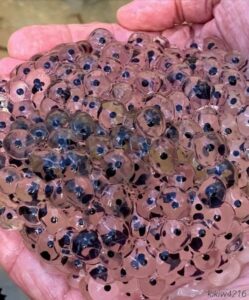
At first glance, they hardly look real. A cluster of glistening, translucent spheres sits in the palm of a hand, each orb containing a dark center that appears uncannily like a tiny, staring eye. The effect is both mesmerizing and slightly unsettling, as though dozens—or even hundreds—of miniature pupils are gazing outward in silent unison. It’s no surprise that images like these often go viral online, earning nicknames such as “eyeball eggs” or “alien jelly clusters.”
Yet despite their otherworldly appearance, these structures are entirely natural. They are amphibian egg masses—one of the most fascinating and visually striking reproductive strategies in the animal kingdom. Far from being strange anomalies, they represent a finely tuned evolutionary solution to the challenges of survival in aquatic environments.
Understanding these “eyeball eggs” requires looking beyond their eerie beauty and into the biology, ecology, and life cycle they represent.
What Are “Eyeball Eggs”?
The so-called “eyeball eggs” are clusters of fertilized eggs produced by amphibians, particularly frogs. A commonly associated species is the Southern leopard frog, though similar egg masses are produced by many related species.
Each individual sphere within the cluster is a single egg. The clear, jelly-like outer layer surrounds a developing embryo, which appears as a dark spot in the center. This dark pigmentation is what gives the illusion of a pupil or eye.
When grouped together in large numbers, these eggs create a striking visual pattern—hundreds of “eyes” suspended in transparent gel.
Why Do They Look Like Eyes?
The eye-like appearance is not intentional, of course, but it is the result of biological function.
The dark center is the embryo itself, which contains concentrated pigment. This pigmentation serves a purpose:
- It helps absorb heat from sunlight
- It provides a degree of camouflage
- It protects sensitive developing tissues
This feature is an example of countershading, where darker coloration appears on one side of the organism for adaptive reasons.
When viewed through the transparent jelly, the contrast between the dark embryo and the clear outer layer creates the illusion of a pupil inside an eyeball.
The Protective Jelly Matrix
One of the most remarkable aspects of these egg masses is the gelatinous substance that surrounds them.
This jelly is not just a passive coating—it performs several critical functions:
- Retains moisture and prevents drying
- Allows oxygen to diffuse into the egg
- Cushions against physical damage
- Provides some protection against microbes
- Makes the eggs slippery and harder for predators to consume
The jelly is composed primarily of water, along with proteins and complex carbohydrates. When first laid, it may be relatively compact, but it quickly absorbs water and expands into the familiar soft, bouncy structure.
This expansion increases the spacing between eggs, improving oxygen flow and reducing the risk of suffocation.
Reproductive Strategy: Strength in Numbers
Amphibians often rely on quantity rather than parental care. A single egg mass can contain hundreds or even thousands of eggs.
This strategy is based on probability:
- Many eggs will be eaten by predators
- Some will fail to develop
- A fraction will survive to adulthood
By producing large numbers, the species ensures that at least some offspring make it through the early stages of life.
This approach reflects a broader biological concept known as r/K selection theory, where organisms prioritize either high reproduction or high parental investment.
Frogs clearly fall on the high-reproduction side.
Where Are These Egg Masses Found?
These clusters are typically found in:
- Shallow ponds
- Seasonal wetlands
- Vernal pools
- Marshy edges of lakes
These environments are ideal because they often lack fish, which are major predators of eggs and tadpoles.
Many amphibians time their reproduction with seasonal rains, ensuring that temporary bodies of water are available for egg-laying.
The Role of Amplexus
Fertilization in frogs occurs externally through a process called Amplexus.
During this process:
- The male grasps the female
- The female releases eggs into the water
- The male releases sperm simultaneously
This synchronized release allows fertilization to occur outside the body.
The result is the formation of the jelly-coated egg mass.
Inside the Egg: A Rapid Transformation
What looks like a simple black dot is actually the beginning of a complex developmental journey.
Inside each egg:
- The fertilized cell begins dividing
- Basic body structures start to form
- The neural system begins developing
- The tail and gills emerge
- The embryo becomes a tadpole
This entire process can take anywhere from a few days to several weeks, depending on environmental conditions such as temperature.
Eventually, the embryo hatches into a tadpole, entering the next stage of its life cycle.
From Egg to Tadpole to Frog
The life cycle of amphibians is one of the most dramatic transformations in nature.
After hatching:
- Tadpoles live entirely in water
- They breathe through gills
- They feed on algae and organic material
Over time, they undergo metamorphosis:
- Legs develop
- Gills are replaced by lungs
- The tail shrinks
- The body reshapes into an adult frog
This transformation is a hallmark of metamorphosis.
It allows amphibians to transition from aquatic to terrestrial life.
Environmental Sensitivity
Amphibian eggs are highly sensitive to environmental conditions.
Factors that influence survival include:
- Water temperature
- Oxygen levels
- Pollution
- Presence of predators
- UV radiation
Because of this sensitivity, amphibians are often considered bioindicators—organisms that reflect the health of their environment.
Declines in egg mass populations can signal ecological problems.
Ecological Importance
These egg masses play a significant role in ecosystems.
They:
- Provide food for fish, insects, and birds
- Contribute to nutrient cycles
- Support biodiversity
- Help control insect populations (once frogs mature)
Frogs themselves are both predators and prey, making them essential components of food webs.
Why They Go Viral Online
The visual impact of “eyeball eggs” is hard to ignore.
Their popularity online stems from:
- Their unusual appearance
- The contrast between beauty and eeriness
- The curiosity they provoke
- Their resemblance to science fiction imagery
People often react with fascination, confusion, or even discomfort—an example of how unfamiliar natural forms can challenge our expectations.
Common Misconceptions
Because of their strange appearance, these egg masses are often misunderstood.
Some common myths include:
- They are alien organisms
- They are harmful or toxic
- They should not be touched
In reality, they are harmless and delicate. If handled, they should be returned to their original location quickly to avoid disrupting development.
Human Interaction and Responsibility
While it’s tempting to pick up and examine these clusters, it’s important to minimize disturbance.
Best practices include:
- Observing without handling when possible
- Keeping them submerged in water
- Avoiding prolonged exposure to air
- Not relocating them
Respecting these guidelines helps ensure the survival of developing embryos.
A Window Into Evolution
These egg masses are more than just visually striking—they are a window into millions of years of evolutionary adaptation.
Their design reflects:
- The challenges of aquatic reproduction
- The absence of parental care
- The need for protection and efficiency
Every detail, from the jelly coating to the pigmentation, serves a purpose.
Cultural and Emotional Impact
Interestingly, these “eyeball eggs” evoke strong emotional responses.
Some people find them:
- Beautiful
- Hypnotic
- Intriguing
Others find them:
- Creepy
- Unsettling
- Alien-like
This dual reaction highlights how human perception is shaped by familiarity and expectation.
Conservation Concerns
Amphibians worldwide face significant threats, including:
- Habitat destruction
- Pollution
- Climate change
- Disease
One major disease affecting amphibians is chytridiomycosis, which has caused widespread declines.
Protecting breeding habitats is crucial for maintaining healthy populations.
Why These Eggs Matter
At a glance, they may seem like small, insignificant clusters in a pond.
But they represent:
- The beginning of new life
- A critical stage in the ecosystem
- A delicate balance of environmental conditions
Each egg has the potential to become a fully grown frog, contributing to the cycle of life.
Seeing Nature Differently
Moments like encountering these egg masses can shift how we see the natural world.
What initially appears strange or unsettling often reveals:
- Complexity
- Purpose
- Beauty
It reminds us that nature does not conform to human expectations—and that’s part of what makes it so compelling.
Conclusion
The so-called “eyeball eggs” are a striking example of how nature can be both beautiful and bizarre at the same time. Beneath their surreal appearance lies a sophisticated biological system designed for survival, growth, and continuation of life.
From the protective jelly to the developing embryos within, every aspect of these amphibian egg masses reflects adaptation shaped over millions of years. They are not just curiosities—they are essential components of ecosystems and powerful reminders of the intricate processes unfolding all around us.
The next time you encounter a cluster of these translucent spheres, take a moment to look closer. What may seem strange at first glance is, in reality, a quiet miracle—hundreds of tiny lives beginning their journey in a fragile, shimmering world.
And in that moment, the eerie illusion of “staring eyes” transforms into something far more meaningful: a glimpse into the hidden wonders of life itself.