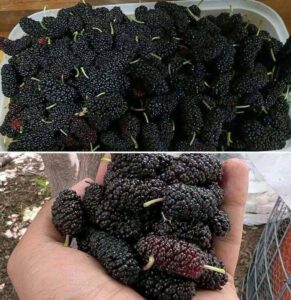
At first glance, a cluster of dark berries can be surprisingly difficult to identify.
Their deep purple or almost black color may immediately make you think of blackberries. But look a little closer and you may notice something different.
The fruits are elongated rather than round, their surfaces are made up of many tiny rounded sections, and each cluster is attached to a small stem.
These are characteristics commonly associated with mulberries.
Mulberries are the edible fruits produced by trees in the Morus genus. They can look quite different depending on the species and stage of ripeness, ranging from pale or pinkish colors to red, purple, and almost black.
Their appearance is one reason they are sometimes confused with other small fruits.
But the plants themselves are quite different.
Blackberries grow on brambles and produce fruit along trailing or upright canes. Mulberries grow on trees, where the fruit develops among the leaves and branches.
That difference is one of the easiest ways to distinguish the two.
If you see what appears to be a blackberry growing from a tree, there is a good chance you are actually looking at a mulberry.
The shape provides another useful clue.
A blackberry is generally made up of numerous small drupelets arranged into a rounded or slightly elongated berry.
A mulberry also consists of multiple tiny fruit sections, but the overall fruit is typically longer and more cylindrical.
The stem and structure of the fruit can therefore help identify it.
When mulberries are fully ripe, they can become extremely soft.
In fact, their delicate texture is one of the things that makes fresh mulberries so enjoyable and so difficult to transport.
A ripe fruit can be juicy enough to fall apart when handled.
That softness also explains why fresh mulberries often have a relatively short shelf life compared with firmer fruits.
If you have access to a mulberry tree, you may notice that the ripening process can happen quickly.
One day, the fruit may look bright and immature.
Soon afterward, some berries can become dark, soft, and ready to eat.
The deep color of many ripe mulberries comes from natural plant pigments called anthocyanins.
These compounds are responsible for the red, purple, and blue colors found in many fruits and vegetables.
Anthocyanins belong to a larger group of plant compounds called polyphenols.
They have attracted considerable scientific interest because of their antioxidant activity and their role in plant biology.
However, it is important to keep health claims in perspective.
The presence of anthocyanins does not mean that eating mulberries can cure a disease, “detox” the body, or produce dramatic weight loss.
Mulberries are nutritious food, but they are not a miracle remedy.
Their value comes from the combination of nutrients and plant compounds they naturally contain.
One of their useful nutritional features is dietary fiber.
Fiber plays an important role in normal digestion and can contribute to feelings of fullness after eating.
Whole fruits generally provide more fiber than fruit juices because the edible plant material remains intact.
That is one reason eating fresh or frozen mulberries can be a better way to enjoy them than relying on sweetened fruit drinks.
Mulberries also provide vitamin C and minerals such as potassium.
The exact nutritional composition can vary depending on the variety, growing conditions, ripeness, and serving size.
Like other fruits, they can fit naturally into a varied and balanced diet.
And they don’t have to be complicated.
Fresh mulberries can be eaten on their own as a snack.
Their natural sweetness also works well with foods that provide contrasting textures and flavors.
Try adding them to plain yogurt for a simple breakfast.
They can also be mixed into oatmeal, cereal, or a fruit bowl.
A handful of nuts or seeds can provide additional texture, while other fruits can create a colorful mixture.
Because ripe mulberries are so soft, they can also be used in desserts, sauces, baked goods, and smoothies.
Freezing is another practical option.
If you have access to a tree producing more fruit than you can eat immediately, freezing can help preserve the harvest.
One simple method is to gently remove damaged fruit, arrange the remaining berries in a single layer on a tray, and freeze them.
Once frozen, they can be transferred to a suitable freezer container or bag.
This prevents the berries from freezing into one large mass and makes it easier to remove individual portions later.
Fresh storage requires a little care.
Because ripe mulberries are delicate, rough handling can quickly damage them.
Refrigeration can help slow spoilage.
It is generally sensible to avoid washing them until you are ready to eat them, because excess moisture can encourage deterioration.
Inspect the fruit and remove berries that are visibly damaged or spoiled.
Dried mulberries are another option.
They can be convenient because removing water makes the fruit much easier to store and transport.
However, there is an important difference between fresh and dried fruit.
Once water has been removed, the natural sugars and calories are concentrated into a smaller portion.
That means it can be easy to eat more dried fruit than you intended.
Some packaged dried mulberries may also contain added sugar, so checking the ingredient list can be useful.
Mulberry leaves have also attracted attention beyond the fruit itself.
In various traditions, the leaves have been used to prepare tea and other preparations.
Researchers have studied compounds found in mulberry leaves, including their potential relationship with carbohydrate metabolism.
But scientific interest should not be confused with proof that a product can treat a medical condition.
People taking medication, particularly medication that affects blood sugar, should not replace prescribed treatment with mulberry leaf products without speaking with a qualified healthcare professional.
The same principle applies to many foods and herbal products.
A food can be nutritious without being medicine.
That distinction is especially important because attractive fruits often become the subject of exaggerated health claims online.
You may encounter statements suggesting that dark-colored fruits can “cleanse” the body, melt fat, reverse disease, or provide extraordinary health benefits.
Such claims usually go far beyond what the available evidence can establish.
There is no need to exaggerate the benefits of mulberries.
They are interesting and nutritious enough on their own.
Their fiber, vitamin C, potassium, and naturally occurring plant compounds make them a worthwhile addition to a varied diet.
Their flavor is another reason they deserve attention.
Ripe mulberries can have a mild sweetness with a slightly tart or earthy quality, depending on the variety.
The darkest fruits are often particularly juicy.
Eating them straight from a tree can be an enjoyable seasonal experience, although fruit picked from any tree should only be eaten when the plant and fruit have been correctly identified and the fruit is suitable for consumption.
The tree itself can also be interesting.
Mulberry trees have been cultivated in many parts of the world and have a long association with human agriculture.
Some species have also been important in silk production because their leaves provide food for silkworms.
That means the mulberry is not simply a fruit-producing plant.
It has played a role in agriculture, traditional food systems, and textile production.
So the next time you see a collection of dark berries, don’t assume they are blackberries.
Look at the plant.
Are the fruits growing on a tree rather than a thorny bramble?
Look at their shape.
Are they elongated and composed of many tiny rounded sections?
Check the color.
Are they changing from lighter shades toward red, purple, or nearly black as they ripen?
Those clues can help you recognize a mulberry.
And once you know what you’re looking at, the fruit becomes even more interesting.
What first appeared to be an ordinary cluster of black berries turns out to be a delicate tree fruit with a distinctive structure, a colorful history, and a useful nutritional profile.
Mulberries don’t need extraordinary claims to be worth appreciating.
They can simply be enjoyed as fruit.
Eat them fresh when they’re available.
Add them to yogurt or oatmeal.
Freeze extras for later.
Use dried versions in moderation.
And most importantly, remember that healthy eating is about the overall pattern of your diet rather than one particular fruit.
The next time you see these tiny dark fruits hanging from a tree, take a closer look.
They may not be blackberries at all.
They may be mulberries—soft, colorful, naturally sweet fruits that have been growing quietly on trees for generations.