The Meaning Behind Purple Porch Lights
If you’ve ever walked through a neighborhood at night and noticed a soft purple glow coming from someone’s porch, it can feel unexpectedly striking. It’s not the standard white or warm yellow most people use for outdoor lighting. Instead, it stands out quietly—noticeable without being loud.
That contrast is exactly why it matters.
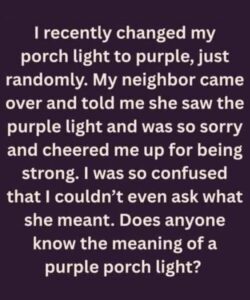
Purple porch lights are not just decorative choices. In many cases, they represent awareness, solidarity, and silent support for causes that are often hidden from public view.
Domestic Violence Awareness and the Color Purple
One of the most widely recognized meanings behind purple porch lights is related to domestic violence awareness, particularly during Domestic Violence Awareness Month in October.
During this time, individuals and organizations use purple lighting as a symbolic gesture to:
- Show support for survivors
- Raise awareness about abuse
- Encourage conversation about a topic often kept private
- Signal that help and understanding exist within the community
Domestic violence is often invisible to outsiders. It happens behind closed doors, making awareness especially important. Because of this, visible symbols like purple lights serve as a gentle public acknowledgment that the issue exists—even when it cannot always be seen.
A single porch light may seem small, but it can represent something much larger: recognition of suffering and a willingness to stand in solidarity with those affected.
Why Visibility Matters for Hidden Struggles
One of the most powerful aspects of purple porch lights is that they create visibility for issues that are otherwise silent.
Many survivors of domestic violence experience isolation. Fear, stigma, or safety concerns can prevent them from speaking openly about their situation. In such cases, awareness does not just inform—it validates.
A purple light in a neighborhood can quietly communicate:
- “You are not alone”
- “We see you”
- “Support exists here”
This kind of symbolism can be especially meaningful because it does not require direct confrontation or explanation. It exists in the background of everyday life, gently signaling empathy without forcing attention.
Even small interactions can grow from it. A neighbor might ask about the light. A conversation may begin. Awareness spreads naturally, without pressure.
Beyond October: A Year-Round Message
Although purple lights are often associated with awareness campaigns in October, many people choose to keep them year-round.
For these households, the meaning becomes ongoing rather than seasonal.
A continuous purple light can represent:
- Personal experience with domestic violence
- Support for a loved one or survivor
- Commitment to awareness and advocacy
- A general value of compassion and community safety
In these cases, the light becomes part of a household’s identity. It is no longer tied to a campaign—it becomes a quiet, permanent statement.
This ongoing visibility reflects an important truth: social issues do not disappear when awareness months end. Support and recognition are needed every day.
Other Causes Connected to Purple Lighting
While domestic violence awareness is the most recognized association, purple lighting has also been used in connection with other causes, including:
- Epilepsy awareness
- Alzheimer’s and dementia awareness
- General mental health advocacy
- Recognition of veterans, including those honored with the Purple Heart
Because of these overlapping meanings, purple lighting does not always point to a single cause. Instead, it often represents broader themes such as:
- Memory
- Healing
- Strength
- Awareness
- Transformation
The meaning depends on context, intention, and the story behind the choice.
The Psychology of the Color Purple
Color psychology helps explain why purple is often chosen for these types of awareness symbols.
Purple is commonly associated with:
- Calm reflection
- Emotional depth
- Spiritual awareness
- Balance between strength and sensitivity
Historically, purple was rare and expensive to produce, which led to its association with royalty and importance. Over time, it also became linked with introspection and emotional complexity.
This makes it especially fitting for causes involving:
- Trauma and recovery
- Mental health
- Memory and identity
- Compassion and empathy
It is a color that feels both soft and powerful at the same time—an ideal combination for quiet awareness.
Why Small Symbols Have Big Impact
At first glance, a single purple porch light may not seem significant. It does not announce itself loudly or demand attention. It simply exists within the landscape of ordinary life.
But meaning changes when multiple homes participate.
When entire streets begin to glow purple, something subtle but powerful happens:
- A sense of unity forms
- Awareness becomes visible without words
- Communities signal shared values
- Silence around difficult topics begins to soften
This is how symbolic change often works. It does not begin with large-scale action. It begins with repetition of small, intentional choices.
Silent Communication in Everyday Spaces
One of the most interesting aspects of purple porch lights is that they function as a form of silent communication.
They do not require explanation. They do not depend on language. Instead, they rely on recognition.
People passing by may not immediately understand the meaning, but curiosity often leads to learning. In that way, the symbol becomes educational without being forceful.
It transforms ordinary spaces into subtle reminders that:
- People around us may be facing unseen struggles
- Awareness can exist in everyday environments
- Compassion can be expressed without words
This quiet form of communication is part of what makes the symbol so powerful.
The Role of Community Awareness
Community involvement is essential to the meaning of purple porch lights.
When individuals adopt the symbol, it becomes personal. When neighborhoods adopt it collectively, it becomes cultural.
This shift turns private awareness into shared understanding.
It encourages:
- Conversations between neighbors
- Educational awareness
- Emotional support networks
- A stronger sense of belonging
Even if people interpret the symbol differently, the shared visibility creates connection.
More Than a Trend: A Form of Expression
While some may initially view purple porch lights as a trend, their continued use suggests something deeper.
Trends fade quickly. Meaningful symbols persist.
Purple lighting has remained relevant because it represents real experiences and real causes. It is not just aesthetic—it is expressive.
It allows people to:
- Honor personal experiences
- Show support without public declaration
- Participate in awareness efforts quietly
- Communicate values through environment
In many ways, it reflects a modern form of expression that blends personal space with social awareness.
Conclusion: What the Purple Glow Really Represents
The growing presence of purple porch lights across neighborhoods is not about decoration alone. It is about meaning made visible in a subtle form.
Behind each glow may be:
- A message of support for survivors
- A reminder of struggles that are often unseen
- A commitment to awareness and compassion
- A personal story of resilience or remembrance
Together, these lights form something larger than themselves—a quiet network of empathy spread across streets and homes.
They show that awareness does not always need to be loud to be powerful.
Sometimes, it is enough for a light to simply stay on.