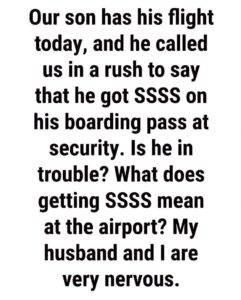
Seeing the letters “SSSS” printed on your boarding pass can feel unsettling, especially if you notice it for the first time at an airport counter or during online check-in. For many travelers, those four letters immediately raise questions: Did I do something wrong? Am I being flagged? Will I miss my flight?
Despite how it may appear, SSSS—short for Secondary Security Screening Selection—is not a punishment, accusation, or indication of suspicious behavior. It is a standard part of aviation security procedures used to enhance safety across commercial air travel systems worldwide.
Understanding what it actually means can quickly replace anxiety with clarity.
What “SSSS” Actually Means
SSSS stands for Secondary Security Screening Selection, a designation used to identify passengers who must undergo additional screening before boarding.
This extra screening is conducted by airport security authorities (such as the Transportation Security Administration in the United States) and is part of layered security systems designed to ensure aviation safety.
Importantly:
- It does not mean you are suspected of wrongdoing
- It does not mean you are on a watchlist
- It does not indicate a problem with your ticket or identity
- It does not prevent you from boarding your flight
It simply means your boarding process will include an additional step before you proceed to the gate.
Why SSSS Happens
One of the most confusing aspects of SSSS is that there is rarely a clear explanation for why a specific passenger is selected.
In most cases, selection occurs through automated systems that rely on a combination of:
- Random selection
- Security algorithms
- Travel pattern analysis
- Ticketing variables
- Route-based screening protocols
Certain travel behaviors may increase the likelihood of selection, such as:
- One-way international tickets
- Last-minute bookings
- Cash purchases (in some cases)
- Travel through higher-risk or heavily screened routes
However, none of these factors automatically indicate suspicion. Many travelers who are selected have completely ordinary travel histories and no identifiable reason for additional screening.
The randomness is intentional. Security systems often incorporate unpredictability to prevent patterns from being exploited.
This is why SSSS can feel frustrating—it removes transparency in exchange for security effectiveness.
What Happens During SSSS Screening
If your boarding pass is marked with SSSS, you will typically be directed to a separate screening area before reaching the gate.
While procedures may vary slightly by airport, additional screening usually includes:
1. Identity Verification
You may be asked to present:
- Passport or ID
- Boarding pass
- Travel documentation
2. Hand or Item Swabbing
Security officers may swab:
- Your hands
- Electronic devices
- Luggage surfaces
These tests check for trace substances as part of standard screening protocols.
3. Manual Bag Inspection
Your carry-on luggage may be:
- Opened
- Inspected item by item
- Rescreened through scanners
4. Additional Questions
You may be asked routine questions such as:
- Where are you traveling?
- Did you pack your own bags?
- What is the purpose of your trip?
These questions are procedural and not investigative in nature.
5. Physical Screening
In some cases, a more detailed pat-down may be performed according to standard security procedures.
How Long It Takes
Most SSSS screenings are relatively brief.
On average, the process takes:
- 5 to 15 minutes in normal conditions
- Longer during peak travel times or crowded airports
After completion, you continue through security as usual. There are no lasting consequences attached to the designation for that flight.
How to Stay Calm and Prepared
The emotional reaction to SSSS is often stronger than the actual process itself. Feeling singled out is natural, but reframing the situation helps significantly.
Arrive Early
Give yourself extra time at the airport. Even an additional 30–60 minutes can eliminate stress if screening takes longer than expected.
Keep Items Accessible
Organizing your bag helps speed up inspection:
- Electronics easy to remove
- Liquids properly packed
- Documents within reach
Stay Cooperative and Calm
Security staff are trained for these situations. A calm, respectful attitude generally leads to a smoother experience.
Avoid Overinterpreting the Situation
SSSS is not personal. It is procedural. Thinking otherwise often increases unnecessary stress.
Common Misconceptions About SSSS
Many travelers misunderstand what SSSS represents.
“I’m being targeted.”
Not true. Most selections are random or system-generated.
“Something is wrong with my ticket.”
Incorrect. Your booking remains valid.
“I’m on a list.”
SSSS is not equivalent to being on a security watchlist.
“It will delay my trip significantly.”
Usually false. Most delays are minimal.
Emotional Impact and Why It Feels Worse Than It Is
The discomfort of SSSS often comes from uncertainty, not inconvenience.
Being pulled aside can feel:
- Public
- Unexpected
- Disruptive
- Personal
But in reality, thousands of passengers experience it daily without issue.
Frequent travelers, airline employees, and business passengers encounter SSSS from time to time without any pattern or long-term consequence.
The experience is temporary and procedural, not evaluative.
Does It Happen Again?
For most travelers, SSSS:
- Appears occasionally
- Does not repeat consistently
- Cannot be permanently “fixed” or removed by the traveler
It is part of a dynamic system that changes frequently.
Even if you receive it once, it does not define future travel experiences.
The Bigger Picture
SSSS exists within a broader aviation security framework designed to maintain safety in an environment where millions of passengers travel daily.
While it may feel inconvenient at the individual level, it contributes to:
- Airport safety protocols
- Risk-based screening systems
- Adaptive security measures
- Global aviation protection standards
In most cases, the impact on the traveler is minimal compared to the scale of the system it supports.
Final Perspective
Seeing “SSSS” on your boarding pass can feel alarming at first, but its meaning is far more routine than it appears.
It is not a warning.
It is not a judgment.
It is not a problem with your travel.
It is simply an additional checkpoint within a system designed to keep air travel secure.
Once you understand that, the experience shifts from stressful uncertainty to manageable routine.
And after it is over, your journey continues exactly as planned—without consequence, without restriction, and usually without even leaving a lasting memory.
In the end, SSSS is not about who you are.
It is about how modern air travel maintains safety for everyone who steps onto a plane.