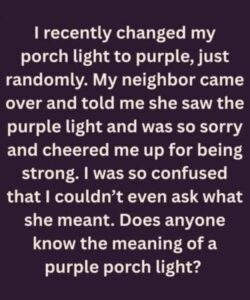
As evening settles across neighborhoods and streets begin to glow under porch lamps and streetlights, one color has quietly started standing out from the rest. Amid the familiar warm whites and soft yellow lights outside homes, an unexpected purple glow has become increasingly common. At first glance, it may seem like nothing more than a decorative choice or seasonal lighting trend. Yet for many people, that gentle purple light carries a far deeper meaning — one connected to awareness, empathy, support, and solidarity for struggles that often remain hidden behind closed doors.
Over the past several years, purple porch lights have appeared in neighborhoods across cities, suburbs, and rural communities alike. Some shine softly year-round, while others emerge during specific months tied to awareness campaigns and causes. Although many passersby may not immediately understand the significance, those who do often recognize the lights as quiet but powerful symbols of compassion and public support.
Unlike loud signs, banners, or public demonstrations, purple porch lights communicate something more subtle. They do not demand attention aggressively. Instead, they invite reflection. Their message is silent but intentional, offering reassurance to some and sparking curiosity in others.
For survivors of domestic violence, individuals struggling with mental health challenges, families facing illness, or communities raising awareness for difficult issues, that soft purple glow can represent far more than decoration. It can symbolize safety, acknowledgment, understanding, and the reminder that people care — even if no words are spoken.
The Connection Between Purple Porch Lights and Domestic Violence Awareness
The meaning most commonly associated with purple porch lights is support for survivors of domestic violence and recognition of Domestic Violence Awareness Month, observed every October.
Domestic violence remains one of the most widespread yet hidden social issues in the world. Unlike many public crises, abuse often happens privately, concealed behind the walls of homes and protected by fear, shame, manipulation, or silence. Victims frequently struggle to speak openly due to emotional trauma, financial dependence, safety concerns, or social stigma.
Because of this invisibility, awareness plays a crucial role.
Purple porch lights emerged as a symbolic way for individuals and communities to acknowledge domestic violence publicly while offering support to survivors in a non-invasive and approachable way. During October, many homeowners replace standard porch bulbs with purple lights to show solidarity and help spark conversations about abuse prevention and survivor support.
What makes this gesture especially meaningful is its simplicity.
Changing a light bulb requires little effort, yet the emotional impact can be profound. For survivors, seeing visible signs of awareness within their own neighborhoods can reduce feelings of isolation and invisibility. It serves as a reminder that others recognize the issue and care enough to show support publicly.
The color purple itself was chosen intentionally.
Purple has long been associated with courage, survival, dignity, and resilience — qualities deeply connected to the experiences of domestic violence survivors. It also symbolizes transformation and healing, making it especially fitting for awareness efforts centered on recovery and empowerment.
Why Visibility Matters for Hidden Struggles
One reason purple porch lights resonate so strongly is because they make invisible struggles visible in a gentle and accessible way.
Domestic violence, mental health challenges, trauma, and emotional suffering often remain hidden precisely because they occur privately. Many people experiencing abuse or emotional pain become isolated, believing nobody understands or cares about what they are going through.
Visible symbols of support can quietly challenge that isolation.
A purple porch light may seem small, but symbols matter deeply in human psychology. They create emotional signals within communities. They tell people they are seen, even when their experiences are difficult to discuss openly.
For some individuals, seeing a purple light outside a neighbor’s home can create a sense of comfort and connection. It may communicate:
“You are not alone.”
“People care.”
“This issue matters.”
“Support exists.”
These silent messages carry emotional weight precisely because they are understated. They do not force disclosure or demand conversation, yet they create openings where dialogue can happen naturally.
A child may ask why a porch light is purple.
A visitor may become curious.
Neighbors may begin discussing the meaning behind the lights.
In this way, awareness grows quietly through ordinary interaction.
Purple Lights and Mental Health Awareness
Although domestic violence awareness remains the most recognized meaning, purple porch lights are also connected to broader mental health awareness efforts.
Mental health struggles often remain hidden in much the same way emotional abuse does. Anxiety, depression, trauma, grief, and emotional exhaustion frequently exist beneath the surface of everyday life, unnoticed by others.
Purple has increasingly become associated with compassion for those facing emotional and psychological challenges. In some communities, homeowners use purple lighting to support mental health advocacy, suicide prevention efforts, and emotional wellness campaigns.
The symbolism works because purple psychologically represents a balance between calmness and emotional strength. It carries both softness and depth, making it a fitting color for conversations surrounding healing and emotional resilience.
In a world where many people silently battle stress, loneliness, burnout, or trauma, small visible gestures of support can feel surprisingly meaningful.
Other Causes Associated With Purple Porch Lights
Over time, purple lighting has become linked with several additional awareness movements and causes.
In November, purple is commonly used to support epilepsy awareness initiatives. Campaigns encouraging people to “light up purple” help raise visibility for those living with seizure disorders while promoting education and understanding.
Purple also appears in Alzheimer’s and dementia awareness efforts. Families and advocacy groups use the color to honor loved ones affected by memory-related illnesses and encourage support for research and caregiving resources.
Some communities connect purple lights with support for military veterans, particularly recipients of the Purple Heart, recognizing sacrifice, injury, and service.
Because the color has multiple associations, the exact meaning behind a purple porch light may vary depending on timing, context, or personal experience. Yet across these different causes, a common theme remains consistent: compassion for struggles that are often unseen.
Whether related to violence, illness, trauma, grief, or emotional hardship, purple lights frequently symbolize solidarity with people carrying invisible burdens.
Why Purple Feels Emotionally Powerful
Color psychology plays an important role in why purple porch lights attract attention and evoke emotion so effectively.
Historically, purple carried associations with royalty, spirituality, wisdom, and transformation because purple dye was once rare and expensive. Over time, the color also became connected to introspection, creativity, healing, and emotional depth.
Unlike bright red or aggressive neon tones, purple creates a softer emotional atmosphere. It feels reflective rather than confrontational. The glow appears calm, mysterious, and emotionally layered all at once.
Psychologically, purple sits between the energy of red and the calmness of blue, combining emotional intensity with quiet stability. This balance makes it especially effective for causes centered on resilience, awareness, compassion, and healing.
There is also something uniquely noticeable about purple lighting at night.
Because it remains relatively uncommon compared to traditional porch colors, it naturally catches attention without appearing harsh or alarming. People notice it precisely because it feels different from ordinary exterior lighting.
Small Actions Can Create Collective Impact
One of the most powerful aspects of purple porch lights is how small individual actions become meaningful when repeated collectively.
A single purple light may seem easy to overlook. But when entire neighborhoods begin glowing purple during awareness campaigns, the visual effect becomes striking. Streets transform into shared displays of support and solidarity.
This reflects an important truth about social awareness movements: collective visibility matters.
Large-scale change often begins through simple symbolic gestures that encourage conversation, normalize difficult topics, and create emotional connection within communities.
Not everyone can organize major campaigns or advocacy events. But many people can change a porch light.
That accessibility makes participation possible for individuals who want to express support quietly but meaningfully.
The Emotional Impact on Survivors
For survivors of domestic violence or individuals facing emotional hardship, visible signs of support can have a surprisingly deep psychological effect.
Trauma often creates feelings of invisibility and isolation. Many survivors feel disconnected from their communities, uncertain whether others understand their experiences or would believe them if they spoke openly.
Public symbols of compassion challenge that isolation.
Even if no direct conversation occurs, seeing awareness reflected within everyday spaces can help survivors feel acknowledged rather than ignored. It creates a subtle sense of belonging and recognition.
Importantly, purple porch lights do not require survivors to disclose personal experiences publicly. The support remains available without pressure or exposure.
That quiet nature is part of what makes the gesture emotionally effective.
The Difference Between Awareness and Performance
Another reason purple porch lights resonate with many people is because they feel less performative than some forms of public activism.
The lights exist quietly in the background of daily life. They are not designed primarily for attention or social media visibility. Instead, they function more like ongoing reminders embedded into ordinary environments.
This subtlety allows the gesture to feel sincere rather than self-promotional.
The message becomes less about announcing personal virtue and more about creating shared awareness and emotional presence within communities.
Why Some People Keep Purple Lights Year-Round
While many people install purple porch lights during awareness months, others choose to keep them glowing throughout the year.
For these individuals, the light often becomes deeply personal.
Some families have direct experiences with domestic violence, mental illness, addiction, grief, trauma, or caregiving. The purple glow may serve as a tribute to survivors, a memorial for loved ones, or a symbol of ongoing healing.
Others maintain purple lighting as a reflection of their values and commitment to compassion, advocacy, and emotional support for vulnerable people.
Keeping the light on year-round also reflects an important reality: struggles like domestic violence and mental health challenges do not disappear when awareness campaigns end.
The need for empathy and support exists continuously.
How Ordinary Spaces Become Meaningful
Perhaps the most fascinating aspect of purple porch lights is how they transform ordinary spaces into meaningful forms of communication.
Porches are everyday parts of domestic life. They are transitional spaces between private homes and public streets. By changing something as simple as a light bulb, homeowners quietly turn those familiar spaces into symbols carrying emotional and social meaning.
The gesture demonstrates how environments shape emotional experience.
A neighborhood filled with purple lights feels different psychologically than one without them. The lights create an atmosphere of reflection, awareness, and quiet unity.
They remind people that communities are not only collections of houses but networks of human experiences, struggles, and support systems.
The Bottom Line
Purple porch lights are far more than decorative lighting trends. For many people and communities, they symbolize awareness, compassion, healing, and solidarity with individuals facing struggles that often remain hidden behind closed doors.
Most commonly associated with Domestic Violence Awareness Month, purple lights also represent support for mental health awareness, epilepsy advocacy, Alzheimer’s awareness, veterans, and other causes connected to resilience and invisible hardship.
Their power lies not in grand gestures but in quiet visibility.
A simple purple glow outside a home may not solve complex social problems on its own. But it can start conversations, reduce isolation, spark curiosity, and remind struggling individuals that they are not alone.
In a world filled with noise, conflict, and distraction, these lights offer something quieter yet deeply meaningful: a silent message of empathy shining steadily through the darkness.