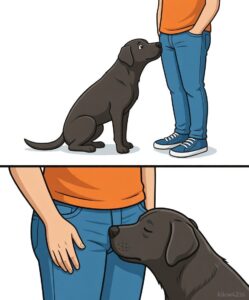
 Dogs experience the world in a way that is fundamentally different from humans. What may appear strange, awkward, or even inappropriate to us is often a deeply instinctive, biologically driven behavior that serves an important purpose in canine communication. One of the most misunderstood examples of this is when a dog sniffs a human’s private or intimate areas.
While many people interpret this as rude or embarrassing, for dogs it is simply information gathering. To understand this behavior properly, we need to explore how a dog’s sense of smell works, what pheromones are, and how canine biology transforms scent into a detailed map of identity, emotion, and health.
The Extraordinary Power of a Dog’s Nose
A dog’s sense of smell is one of the most advanced sensory systems in the animal kingdom. Humans rely primarily on vision, but dogs rely overwhelmingly on scent to interpret their environment.
To put this into perspective, humans have roughly 5 to 6 million olfactory receptors in their noses. Dogs, depending on the breed, have between 100 million and 300 million olfactory receptors. This means their sense of smell is estimated to be 10,000 to 100,000 times more sensitive than ours.
But it is not just the number of receptors that matters. The structure of a dog’s nose is highly specialized. Airflow in a dog’s nasal cavity is divided into separate pathways: one for breathing and one for scent detection. This allows dogs to continuously analyze smells even while exhaling.
Inside their nasal system is a specialized organ called the vomeronasal organ (or Jacobson’s organ), which detects pheromones—chemical signals that carry biological and social information.
What Are Pheromones?
Pheromones are chemical messengers released by living organisms to communicate with others of the same species. In animals, pheromones play a critical role in reproduction, territorial marking, emotional signaling, and social interaction.
Dogs rely heavily on pheromones. They use them to identify each other, determine reproductive status, recognize emotional states, and establish social hierarchies.
Humans also produce pheromone-like chemicals, although our communication system relies far more on speech and visual cues. Still, our bodies continuously release chemical signals through sweat, skin oils, and breath.
Dogs are extremely sensitive to these signals.
Why Certain Body Areas Attract Canine Attention
Human bodies produce scent chemicals through specialized glands called apocrine glands. These glands are concentrated in areas such as the armpits and groin. Unlike regular sweat glands, apocrine glands produce thicker secretions that interact with skin bacteria, creating stronger and more distinctive odors.
To a dog, these areas contain some of the richest sources of biological information.
When a dog sniffs these regions, it is not acting inappropriately. Instead, it is collecting detailed chemical data, including:
- Hormonal status
- Emotional state
- Stress levels
- Identity recognition
- Reproductive signals
- Health-related changes
From a canine perspective, this is equivalent to reading a highly detailed biological profile.
How Dogs Interpret Human Chemistry
A dog does not experience smell as a single sensation. Instead, it processes scent as layered information. Each person has a unique “scent signature” influenced by:
- Genetics
- Diet
- Hormones
- Stress levels
- Medical conditions
- Medication use
- Environmental exposure
When a dog sniffs a person, it is updating its internal “scent database” about who that person is at that moment.
Even subtle changes—such as anxiety, illness, or hormonal fluctuations—can alter a person’s scent profile significantly enough for a dog to notice.
Emotional States and Stress Detection
One of the most remarkable abilities dogs possess is detecting human emotional states through scent.
When humans experience stress, fear, or excitement, their bodies release hormones such as cortisol and adrenaline. These hormones alter body chemistry, which changes scent composition.
Dogs can detect these changes instantly.
This is why dogs often behave differently around people who are anxious or upset. They are not reacting to behavior alone—they are responding to chemical changes in the body.
Health Detection Abilities in Dogs
Scientific research has shown that dogs can detect certain diseases in humans through scent alone. This includes:
- Cancer (including breast, lung, and prostate cancers)
- Diabetes (especially blood sugar changes)
- Epileptic seizure warnings
- Bacterial infections
- Viral infections in controlled studies
These abilities are currently being studied in medical science, and trained detection dogs are already used in some healthcare settings.
The same biological sensitivity that allows dogs to detect illness is what also drives their curiosity toward different parts of the human body.
Why Dogs Sniff Private Areas Specifically
From a human perspective, the behavior feels awkward because of social norms. But dogs do not understand human privacy conventions.
In canine communication, sniffing is the primary method of greeting and gathering information. Dogs naturally sniff each other’s rear areas because that is where the most concentrated scent glands are located.
When a dog interacts with a human, it applies the same logic.
The groin area, like the armpits, contains a high concentration of apocrine glands. This makes it one of the strongest sources of chemical information on the human body.
To a dog, sniffing is not invasive—it is communication.
Differences in Scent Between Individuals
Not all humans smell the same to dogs. Certain factors increase scent changes and make some individuals more interesting to dogs, including:
- Hormonal cycles (menstruation, pregnancy, menopause)
- Stress or anxiety levels
- Recent physical activity
- Changes in diet
- Use of medications
- New hygiene products
Dogs are especially sensitive to change. A person whose scent suddenly differs from their usual profile may attract more attention.
Social Behavior and Canine Communication
Dogs use sniffing as a social tool. In canine interactions, sniffing is equivalent to greeting, checking identity, and confirming emotional status.
It is not considered aggressive or sexual behavior in dog communication.
When dogs sniff humans, they are simply applying the same communication method to a different species.
However, because humans assign social meaning and privacy rules to certain body areas, the behavior becomes socially uncomfortable in human contexts.
Training and Managing the Behavior
While this behavior is natural, it can be managed through training if it becomes uncomfortable in social settings.
Effective methods include:
- Redirecting the dog’s attention to hands or toys
- Teaching commands like “sit” or “leave it”
- Rewarding calm greeting behavior
- Avoiding punishment or negative reinforcement
- Socializing dogs early with structured greetings
Dogs respond best to consistency and positive reinforcement. They can learn boundaries specific to human social environments.
Dogs and Human Emotional Bonding
Beyond biology, this behavior also highlights the deep emotional bond between dogs and humans.
Dogs do not simply smell humans—they recognize them, track their emotional states, and respond accordingly.
This sensitivity is part of why dogs are such effective companions, service animals, and emotional support partners.
They are constantly gathering information about the people they care for.
Misconceptions About the Behavior
There are several common misunderstandings about why dogs sniff humans:
Myth: It is disrespectful behavior
Fact: It is instinctive communication, not social disrespect.
Myth: Only poorly trained dogs do it
Fact: All dogs use scent to gather information, regardless of training.
Myth: It is sexual behavior
Fact: Dogs are not interpreting humans sexually; they are analyzing chemical signals.
Myth: It indicates dominance
Fact: Sniffing is informational, not a dominance display.
The Science Behind Canine Perception
A dog’s world is built on scent. While humans construct reality primarily through vision, dogs construct it through olfactory information.
Every interaction they have with a human is enriched by scent-based interpretation. This includes:
- Emotional recognition
- Health awareness
- Memory formation
- Social bonding
To a dog, smell is not just information—it is identity.
Understanding the Behavior from a New Perspective
When viewed scientifically, what seems awkward to humans is actually an advanced sensory evaluation.
A dog sniffing a human is performing a detailed biological assessment of identity, emotional state, and health status in seconds.
It is not random behavior—it is structured perception.
Final Thoughts
Although it may feel uncomfortable from a human social perspective, this behavior is a natural expression of canine biology. Dogs rely on scent the way humans rely on sight and speech.
Understanding this difference helps reframe the behavior not as inappropriate, but as informational.
When a dog sniffs a person, it is not crossing a boundary—it is reading a biological story written in scent.
And in that sense, every human becomes something far more complex in a dog’s world: a constantly changing landscape of emotional and chemical signals that tells a story only they can fully read.