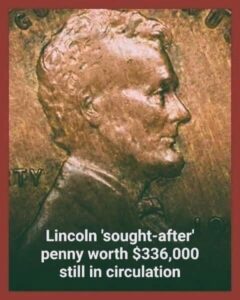
Few objects capture the imagination of collectors and ordinary Americans quite like the legendary 1943 bronze Lincoln penny. Small enough to fit unnoticed in a pocket, jar, or dusty coin collection, this rare coin has become one of the most famous minting errors in United States history. What makes the story so compelling is not simply the coin’s extraordinary value, but the fact that it was never supposed to exist at all. Created accidentally during the height of World War II, the 1943 bronze cent emerged from a unique moment in American history when even the materials used for everyday coins were affected by wartime demands. Today, surviving examples are worth hundreds of thousands—and in some cases millions—of dollars, transforming what appears to be an ordinary penny into one of the most sought-after treasures in the world of coin collecting.
To understand why the coin is so significant, it is important to look back at the historical circumstances surrounding its creation. During World War II, the United States government redirected massive amounts of industrial resources toward the war effort. Copper was considered strategically important because it was needed for ammunition, electrical wiring, military communications equipment, and countless other wartime applications. In response to material shortages, the United States Mint made a major change in 1943 by replacing the traditional bronze composition of the Lincoln cent with zinc-coated steel. The new steel pennies had a silvery appearance unlike the familiar copper-colored cents Americans had used for decades.
The transition was intended to conserve copper for military production, and billions of steel cents were successfully produced that year. However, amid the enormous scale of mint operations, a small number of bronze planchets—blank metal discs left over from the previous year’s production—remained inside the coin presses or feeding equipment. When these leftover bronze blanks accidentally entered the presses alongside the new steel planchets, a handful of 1943 pennies were struck using the wrong metal composition. These accidental coins became the famous 1943 bronze Lincoln cents.
At the time, nobody immediately realized what had happened. The coins quietly entered circulation among ordinary change, mixed alongside standard steel cents. Because the difference was subtle to casual observers, many people likely spent the coins without recognizing their significance. It was only several years later, beginning around 1947, that stories about unusual copper-colored 1943 pennies started attracting widespread attention. Coin collectors and hobbyists became fascinated by reports of pennies dated 1943 that appeared bronze instead of steel.
Initially, many experts and officials expressed skepticism. The United States Mint reportedly denied that bronze versions had been produced intentionally, leading many people to suspect the coins were counterfeits or altered pieces. Over time, however, professional numismatists conducted metallurgical tests and verified that genuine bronze 1943 cents did indeed exist. The realization transformed the coins into legends almost overnight.
Part of the fascination surrounding the 1943 bronze cent comes from its extreme rarity. Experts believe that only a tiny number were accidentally produced across all three U.S. Mint facilities operating that year: Philadelphia, Denver, and San Francisco. The Philadelphia coins carry no mintmark, while Denver and San Francisco examples include small “D” or “S” mintmarks beneath the date. Estimates vary, but many specialists believe fewer than twenty authentic bronze 1943 cents survive today.
This rarity has driven values to astonishing levels. Over the decades, authenticated examples have sold for hundreds of thousands of dollars at major auctions, with particularly well-preserved specimens reaching into the millions. One of the most famous sales occurred when a 1943 bronze cent sold for more than $1.7 million, cementing its reputation as one of the “holy grails” of American coin collecting. Even lower-grade examples can command extraordinary prices because demand far exceeds supply.
Stories surrounding the discovery of these coins have also fueled public fascination for generations. Perhaps the most famous involves a teenager named Don Lutes Jr., who reportedly found a 1943 bronze cent in his school cafeteria change during the late 1940s. Rather than selling it immediately, he kept the coin for decades. After his death, the penny was authenticated and eventually sold at auction for more than $200,000, with proceeds benefiting charity. Stories like this reinforce the romantic idea that extraordinary treasures can still hide in ordinary places, waiting for someone observant enough to recognize them.
The coin’s appeal also reflects something deeply human: the excitement of unexpected discovery. Most valuable collectibles require expertise, wealth, or specialized access, but the legend of the 1943 bronze penny suggests that fortune could appear in something as ordinary as pocket change. For decades, children and adults alike searched through coin jars, piggy banks, and rolls of pennies hoping to find one of these elusive rarities. The treasure-hunt quality of the story helped transform the coin into a piece of American folklore as much as a collectible artifact.
The physical characteristics of the coin further add to its mystique. Genuine bronze 1943 cents have the familiar reddish-brown appearance associated with older copper pennies, sharply contrasting with the gray or silver tone of standard steel cents from that year. Because steel pennies are magnetic and bronze ones are not, collectors often use a simple magnet test as an initial screening method. If a 1943 penny sticks to a magnet, it is almost certainly a common steel cent. If it does not, further examination may be warranted.
However, the fame of the coin has also attracted countless counterfeiters and altered coins. Many fake examples exist, often created by copper-plating ordinary steel pennies or modifying the date on 1948 copper cents so that the “8” resembles a “3.” As a result, authentication by reputable grading services and numismatic experts is essential before any supposed discovery is considered genuine. The overwhelming majority of “rare” 1943 copper pennies found by hopeful individuals turn out to be altered or counterfeit pieces rather than authentic mint errors.
Beyond monetary value, the 1943 bronze cent holds powerful historical significance. It represents a direct connection to World War II and the ways the conflict affected even the smallest aspects of American life. During wartime, sacrifice and resource conservation became national priorities. Families rationed gasoline, food, and household materials. Factories shifted toward military production. The replacement of copper pennies with steel reflected how deeply wartime needs shaped everyday objects and routines.
The accidental creation of bronze 1943 cents symbolizes the unpredictability of large-scale industrial systems operating during periods of rapid change. A few leftover planchets stuck in machinery may seem insignificant, yet those tiny oversights created some of the most valuable coins in American history. In this sense, the coins embody a fascinating blend of historical necessity, human error, and chance.
Collectors often describe the 1943 bronze cent as one of the greatest U.S. coin rarities ever produced. It is frequently mentioned alongside other legendary American coins such as the 1913 Liberty Head nickel and the 1804 silver dollar. Museums, private collectors, and auction houses treat authenticated examples with extraordinary care because each surviving coin represents both historical artifact and numismatic masterpiece.
The enduring popularity of the coin also reveals something broader about American culture. People are naturally drawn to stories where ordinary life intersects unexpectedly with hidden value. The idea that a simple penny could transform someone’s financial future appeals to the imagination because it turns something familiar into something extraordinary. It suggests that history, luck, and opportunity sometimes hide in plain sight.
Modern media has helped sustain this fascination. Articles, television programs, online videos, and social media posts frequently revive interest in the 1943 bronze cent whenever a major sale occurs or a rumored discovery surfaces. Headlines announcing six-figure or million-dollar auction results continue encouraging people to examine old coin collections and spare change more carefully. Even individuals with little interest in coin collecting often recognize the legendary status of the rare 1943 penny.
At the same time, serious numismatists emphasize that the true value of the coin extends beyond price alone. Each surviving specimen tells a story about wartime America, industrial adaptation, minting technology, and the enduring appeal of rarity. Coins are historical documents as much as collectibles, preserving evidence of the periods in which they were created. The 1943 bronze cent captures a unique moment when national priorities reshaped even the composition of everyday currency.
Today, authenticated examples remain carefully tracked and documented. Ownership histories are often recorded in detail because the coins are so valuable and rare. Some reside in prestigious private collections, while others appear occasionally at auction, where they continue attracting intense interest from collectors around the world. Whenever one surfaces publicly, it renews public excitement and reminds people why the coin has maintained legendary status for so long.
For ordinary Americans, the story carries an irresistible possibility: somewhere, perhaps forgotten in an old jar or hidden in inherited coins, another genuine 1943 bronze cent could still exist undiscovered. While the odds are extremely small, the possibility itself keeps the legend alive. Every handful of pennies becomes, in theory, a chance encounter with history and fortune.
Ultimately, the 1943 bronze Lincoln cent endures because it combines so many powerful elements into one tiny object: wartime history, accidental creation, rarity, mystery, extraordinary value, and the dream of unexpected discovery. It reminds people that even the most ordinary items can carry remarkable stories beneath their surface. A single penny, overlooked by most, became one of the greatest treasures in American numismatic history—not because it was planned carefully, but because chance and circumstance created something unique.