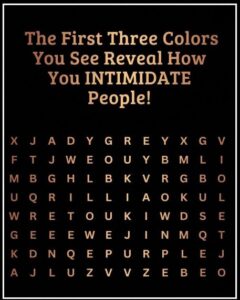
Across social media, personality quizzes and visual “tests” continue attracting enormous attention, especially those claiming to reveal hidden truths based on simple choices. Among the most popular are color perception trends that suggest the first color you notice in an image can uncover important details about your personality, emotional state, confidence level, or even how intimidating others find you.
The appeal is immediate.
You glance at an image filled with overlapping shades, identify the first color that catches your eye, and suddenly a description appears that seems oddly personal. Perhaps it says you are calm but intimidating, creative yet misunderstood, emotionally guarded, or naturally optimistic. Even when people know these tests are not scientifically rigorous, they often feel surprisingly accurate.
That reaction is not accidental.
Color-based personality content combines psychology, self-reflection, suggestion, and emotional curiosity in a way that feels personal and engaging. While these interpretations should not be treated as clinical assessments or scientific diagnoses, they can still provide an interesting lens through which people explore mood, identity, and social perception.
The key is understanding what these tests actually reveal—and what they do not.
Color psychology itself is a real field of study, though it is often oversimplified online.
Researchers have long examined how colors influence emotion, perception, attention, and behavior. Certain colors are commonly associated with specific feelings or symbolic meanings across many cultures. Blue is often linked to calmness and trust, red to intensity or passion, yellow to energy and optimism, green to balance or growth, and black to power or sophistication.
These associations can affect everything from marketing and branding to interior design and emotional responses.
However, there is an important difference between studying how colors influence people generally and claiming that a single color preference can definitively reveal someone’s entire personality.
Human personality is far too complex for that.
Still, the reason these tests resonate emotionally is because they rely on broad psychological patterns that many people recognize in themselves.
For example, if gray is the first color someone notices, online interpretations often describe that person as logical, composed, emotionally controlled, and reserved. Such descriptions appeal because many people want to see themselves as thoughtful and dependable.
At the same time, the interpretation may add that others perceive this calmness as intimidating or difficult to read.
This idea feels psychologically believable because emotional contrast strongly shapes social perception.
Someone who remains calm under pressure may indeed appear intimidating to individuals who are anxious or emotionally expressive. The “intimidation” comes less from aggression and more from contrast between personalities.
Similarly, people drawn first to purple are often described as creative, unconventional, and imaginative.
Purple historically carries associations with individuality, mystery, artistry, and independence. Individuals who identify with those traits may naturally connect with descriptions emphasizing originality and unconventional thinking.
For others, highly creative personalities can seem unpredictable or difficult to categorize, which may create feelings of uncertainty or intimidation in structured social environments.
Yellow tends to generate interpretations involving energy, positivity, warmth, and enthusiasm.
People who identify strongly with optimism often recognize themselves in these descriptions. Yet the interpretation may also suggest that intense positivity can overwhelm emotionally exhausted or pessimistic individuals.
Again, the logic feels emotionally realistic because highly energetic personalities genuinely affect social dynamics differently depending on the emotional state of those around them.
This is part of why these tests seem convincing.
They use emotionally flexible descriptions broad enough to fit many individuals while still feeling specific enough to feel personal.
Psychologists sometimes refer to this tendency as the Barnum effect, where people perceive vague or general personality descriptions as uniquely accurate for themselves.
Horoscopes, personality quizzes, and many viral online tests rely heavily on this psychological phenomenon.
But color-based reflection exercises are not necessarily meaningless simply because they are not scientifically precise.
In some ways, they function similarly to journaling prompts or creative self-reflection tools. The value comes less from objective truth and more from the introspection they encourage.
When someone reads that blue represents calmness, trust, and reliability, they may begin thinking more deeply about whether those qualities describe how they interact with others.
When a test suggests green reflects balance and emotional growth, people may reflect on their current emotional state or personal goals.
This reflective process itself can be valuable.
Colors also carry deeply personal associations shaped by culture, memory, environment, and experience.
A color associated with comfort in one culture may represent mourning or caution in another. Childhood experiences, favorite environments, family memories, fashion preferences, and even seasonal changes can influence emotional responses to color.
For example, someone may feel drawn to warm earthy colors because they associate them with safety and home. Another person may prefer bright tones because they connect them with creativity, excitement, or optimism.
Mood can affect color perception too.
People experiencing stress, sadness, exhaustion, or emotional excitement may respond differently to colors depending on their psychological state at that moment. This means the “first color you see” may sometimes reflect temporary emotion more than stable personality.
That fluidity is important.
Online personality tests often present traits as fixed identities, but real human personality is dynamic and context-dependent. Confidence, emotional openness, creativity, and social comfort all shift over time and across situations.
No single image or color preference can fully define someone.
Still, the popularity of these trends reveals something meaningful about modern psychology and social behavior.
People naturally seek frameworks for understanding themselves and others.
Humans are deeply curious about identity, perception, and emotional connection. Personality quizzes, zodiac signs, color tests, and similar systems offer simple narratives that help organize complex emotions and social experiences into understandable categories.
They also provide reassurance.
Many people find comfort in feeling “seen” by descriptions that capture emotions or traits they struggle to articulate themselves. Even loosely accurate interpretations can create a sense of recognition and emotional validation.
Social media amplifies this effect dramatically.
Quick visual tests are easy to share, emotionally engaging, and highly interactive. People enjoy comparing results with friends, discussing similarities, and interpreting what certain choices “mean.”
The experience becomes social as much as psychological.
In many cases, these trends function less like scientific assessments and more like conversation starters.
The concept of being perceived as intimidating is especially interesting in these color interpretations because intimidation often has less to do with hostility and more to do with psychological contrast.
A highly composed person may intimidate someone emotionally reactive.
A confident person may intimidate someone insecure.
A creative thinker may intimidate someone who values predictability.
A socially outgoing person may overwhelm someone introverted.
This dynamic reflects emotional comparison more than objective personality hierarchy.
What feels intimidating to one person may feel inspiring, comforting, or attractive to another.
Understanding this can help people avoid internalizing negative assumptions about themselves based on others’ reactions.
The goal of self-reflection should not be to reshape personality completely to satisfy everyone around us.
Instead, it can help individuals better understand how their natural tendencies interact with different personalities and emotional environments.
That awareness can improve communication and empathy without sacrificing authenticity.
Scientific personality psychology takes a far more rigorous approach than viral color tests.
Researchers studying personality typically rely on validated frameworks such as the Five-Factor Model, which examines traits like openness, conscientiousness, extraversion, agreeableness, and neuroticism through extensive data analysis and repeated testing.
Even these established models acknowledge that personality is nuanced and influenced by genetics, environment, development, relationships, and life experiences.
Compared to such research, internet color tests are clearly simplified entertainment.
But entertainment and reflection are not inherently useless.
In fact, playful self-analysis can sometimes encourage deeper emotional awareness in accessible ways. A person reflecting on why certain colors feel comforting, energizing, or emotionally significant may gain insight into their mood, stress levels, social identity, or personal preferences.
The danger arises only when people mistake symbolic exercises for objective psychological truth.
No color can determine intelligence, emotional worth, compatibility, morality, or destiny.
No viral image can accurately diagnose mental health, relationship success, or hidden personality traits.
And no personality interpretation should replace genuine self-awareness, communication, or professional guidance when needed.
Still, there is something undeniably human about wanting meaning in small details.
Colors influence atmosphere, emotion, memory, and expression in subtle but powerful ways. Artists, designers, marketers, and psychologists all recognize that color affects perception more deeply than many people consciously realize.
This is why certain rooms feel calming while others feel stimulating.
Why some brands feel trustworthy while others feel exciting.
Why clothing colors can alter confidence and mood.
And why visual personality trends continue capturing attention online.
At their best, these exercises remind people to pause briefly and consider themselves more thoughtfully.
Not to define themselves permanently by a single color—but to reflect on emotions, strengths, insecurities, social dynamics, and identity with curiosity rather than judgment.
Ultimately, the colors that catch your attention may not scientifically reveal who you are.
But they can still reveal something meaningful about what resonates with you emotionally in that moment.
And sometimes, even small moments of reflection can help people understand themselves a little more clearly.