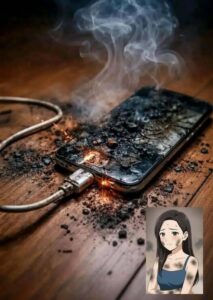
NEVER PUT THE CHARGER LIKE THIS: THE HIDDEN DANGERS OF IMPROPER PHONE CHARGING THAT CAN TURN YOUR DEVICE INTO A FIRE HAZARD OVERNIGHT
Charging a phone is something most people do without thinking. It has become a background habit of modern life—plug it in before bed, disconnect it in the morning, repeat every day. But behind this simple routine lies a serious and often underestimated safety risk. The phrase “never put the charger like this” is not just dramatic wording—it reflects real-world incidents where small charging mistakes have led to overheating, device failure, property damage, and in rare but documented cases, house fires.
To understand why this happens, it’s important to look beyond the surface convenience of charging and examine what is actually happening inside your device while it is plugged in.
THE SCIENCE INSIDE YOUR PHONE: WHY HEAT IS THE REAL ENEMY
Modern smartphones rely on lithium-ion batteries. These batteries are powerful, lightweight, and rechargeable, making them ideal for portable electronics. However, they are also chemically sensitive.
Inside a lithium-ion battery, energy is stored through controlled chemical reactions. During charging, lithium ions move between the positive and negative electrodes. This process generates heat naturally. Under normal conditions, your phone manages this heat using built-in safety systems.
The problem begins when that heat cannot escape efficiently—or when the battery is stressed beyond safe limits.
When temperature rises too high, a dangerous chain reaction can occur called thermal runaway. This is a condition where increasing heat causes the battery to generate even more heat, leading to rapid overheating. In severe cases, this can result in smoke, fire, or even small explosions.
This is why charging habits matter far more than most users realize.
THE MOST COMMON CHARGING MISTAKES PEOPLE MAKE EVERY DAY
Many charging risks come not from rare accidents but from everyday behavior that feels completely harmless.
1. Charging on soft surfaces
Placing a phone on a bed, pillow, or couch while charging is one of the most dangerous habits. Soft materials trap heat around the device, preventing proper ventilation. Even a small increase in temperature can build up over hours.
2. Using damaged cables
Frayed wires, bent connectors, or exposed internal wiring can disrupt the electrical flow. This may lead to inconsistent charging, overheating, or electrical sparks.
3. Cheap or unverified chargers
Low-quality chargers often lack proper voltage regulation. Without safety controls, they may deliver unstable current that stresses the battery.
4. Overcharging overnight
While most modern phones stop charging when full, they still cycle power to maintain 100%. This creates continuous heat generation over long periods, especially in warm environments.
5. Covering the phone while charging
Charging under clothing, blankets, or inside bags prevents heat from escaping and significantly increases risk.
6. Charging in extreme temperatures
Leaving a phone in direct sunlight or near heat sources while charging multiplies thermal stress on the battery.
WHAT ACTUALLY HAPPENS WHEN A BATTERY FAILS
Battery failure does not usually happen instantly. It is often a gradual process caused by repeated stress.
First, the battery begins to degrade internally. Its ability to regulate charge weakens. Heat builds up faster than before. Charging becomes less efficient.
Then micro-damage accumulates inside the cells. The protective layers inside the battery start breaking down. Gas can form within the battery casing, causing swelling.
Eventually, if the stress continues, internal short circuits may occur. At this stage, the battery can rapidly overheat.
In extreme cases, the battery casing ruptures, releasing toxic fumes and flammable material.
While modern phones are designed with multiple safety layers, no system can fully protect against repeated misuse or defective accessories.
WHY NIGHT CHARGING IS PARTICULARLY RISKY
Many people prefer charging their phones overnight for convenience. While this is not inherently dangerous when done correctly, it increases exposure time to potential risks.
The longer a device remains connected to power, the longer it generates low-level heat. If the phone is placed on an insulating surface, this heat accumulates.
Additionally, people are less likely to notice warning signs at night—such as overheating, unusual smells, or battery swelling.
Night charging also increases dependence on inexpensive third-party chargers, which are often left unattended for hours.
The risk is not that every phone will fail—it is that when failure happens, no one is there to react quickly.
WARNING SIGNS YOUR PHONE CHARGING SETUP IS UNSAFE
Your device often gives subtle warnings before a serious problem develops:
- The phone becomes unusually hot during charging
- Charging speed becomes inconsistent
- The battery drains unusually fast after charging
- The device feels swollen or the screen lifts slightly
- A burning smell or chemical odor appears
- The charging cable becomes warm or discolored
These signs should never be ignored. They indicate that the battery or charging system is under stress.
REAL-WORLD CONSEQUENCES OF BAD CHARGING HABITS
While dramatic incidents are rare, they do occur. Fire departments around the world regularly report fires linked to charging devices left on beds or sofas. In most cases, the root cause is not the phone itself, but unsafe charging conditions.
Beyond fire risk, there are other consequences:
- Permanent battery damage requiring replacement
- Loss of personal data from sudden device failure
- Electrical damage to outlets or adapters
- Reduced device lifespan
- Potential injury from burns or smoke inhalation
Even minor overheating over time can shorten battery life significantly, forcing users to replace phones earlier than necessary.
MYTHS ABOUT PHONE CHARGING THAT CREATE FALSE SECURITY
Many people rely on assumptions that are not fully accurate.
“My phone stops charging at 100%, so it is safe”
While charging does slow at full capacity, the device still manages power cycles that generate heat.
“Only cheap phones overheat”
Even high-end devices can overheat if misused or exposed to poor charging conditions.
“Fast chargers are unsafe”
Fast charging is safe when using certified equipment. The danger comes from heat buildup, not speed itself.
“It’s safe as long as I’m not using the phone”
Unused phones can still overheat if placed in poor environments while charging.
SAFE CHARGING HABITS THAT ACTUALLY PREVENT DANGER
Preventing charging hazards does not require complicated steps. It requires consistency.
Use certified chargers only
Always choose chargers approved by the device manufacturer or certified safety standards.
Charge on hard surfaces
Place your phone on wood, metal, or stone surfaces that allow airflow.
Keep it uncovered
Never charge under pillows, blankets, or clothing.
Monitor temperature
If your phone feels hot, unplug it immediately and let it cool.
Avoid long-term overnight charging when possible
Short charging sessions reduce heat exposure.
Replace damaged cables immediately
Even minor cable damage can escalate into electrical failure.
WHAT TO DO IF YOUR PHONE OVERHEATS WHILE CHARGING
If you notice overheating:
- Unplug the charger immediately
- Move the device to a cool, ventilated area
- Do not place it in a refrigerator or freezer (rapid cooling can damage components)
- Remove any protective case to allow heat to dissipate
- Avoid using the phone until it returns to normal temperature
If overheating happens repeatedly, the battery or charger should be inspected or replaced.
THE BIGGER PICTURE: WHY THIS MATTERS MORE THAN EVER
Phones are no longer just communication tools—they are central to work, identity, finances, and memory. That makes charging safety more important than ever.
A single device failure can mean loss of access to critical data, disruption of work, and in rare cases, physical danger.
The irony is that the most dangerous risks often come from the most routine behaviors. Plugging in a phone feels harmless, but when done carelessly or repeatedly in unsafe conditions, it becomes a hidden hazard.
FINAL THOUGHT
“Never put the charger like this” is not about fear—it is about awareness. Modern batteries are safe when respected, but fragile when ignored. The difference between safe charging and dangerous charging is often just a few small habits: where you place your phone, what charger you use, and how long you leave it plugged in.
By treating charging as a small but important safety practice rather than an afterthought, you protect not only your device but your home, your data, and your personal safety.
Because in most cases, accidents are not caused by technology failing—they are caused by everyday habits that no one thought twice about.