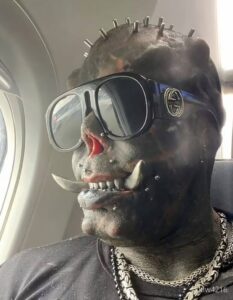
In a world increasingly shaped by self-expression, cosmetic enhancement, and online identity, few individuals have pushed the boundaries of physical transformation as far as Brazilian body modification enthusiast Michel Praddo, now legally known as Diabão Faro do Prado. To millions around the globe, however, he is better recognized by a far more dramatic name: “Diabão,” or the Human Satan.
Covered almost entirely in black tattoos, adorned with horn implants, surgically altered facial features, sharpened teeth, removed ears, tattooed eyeballs, and claw-like hands formed through finger amputations, Diabão has become one of the most visually shocking and controversial figures in modern body modification culture. His appearance evokes reactions ranging from fascination and admiration to fear, disgust, and concern. Yet behind the viral photographs and sensational headlines exists a far more complex story about identity, pain, rebellion, freedom, trauma, and the deeply human desire to become something entirely self-defined.
Now fifty years old in 2025, Diabão continues to evolve both physically and psychologically, remaining one of the most recognized extreme modification figures in the world. To some, he represents dangerous self-destruction. To others, he is a living work of art and a symbol of radical bodily autonomy. Regardless of perspective, his transformation forces society to confront uncomfortable questions about appearance, personal freedom, and the limits of human reinvention.
Born in 1975 in Santos, São Paulo, Brazil, Michel Praddo grew up far removed from the image that would later make him internationally famous. Before becoming the Human Satan, he worked as a tattoo artist and lived a life that, by many accounts, was relatively ordinary. Yet beneath the surface, he struggled with feelings of alienation, instability, and emotional pain that would eventually shape the direction of his life.
In interviews over the years, Diabão has spoken openly about periods of homelessness, addiction, and personal hardship during his younger years. He has described feeling disconnected from society and dissatisfied with conventional expectations surrounding appearance, work, and identity. Tattooing initially became more than just a profession—it became a form of emotional release and self-definition.
What began as artistic experimentation gradually transformed into obsession.
During the early 2000s, he started covering increasingly large portions of his body with black ink, eventually creating a nearly complete blackwork aesthetic that became the foundation for his later modifications. Unlike decorative tattoos designed simply for beauty or symbolism, his approach aimed at total transformation. He wasn’t trying to accessorize his appearance; he was trying to reconstruct it entirely.
Over time, tattoos alone no longer felt sufficient.
The modifications became more extreme.
More permanent.
More physically demanding.
And far more controversial.
One of the most recognizable features of Diabão’s appearance is the collection of silicone horn implants protruding from his scalp. These subdermal implants, placed beneath the skin to create raised protrusions, dramatically altered the silhouette of his head and contributed heavily to his demonic image.
Eventually, he accumulated enough horn implants to earn a Guinness World Record for the most horn implants on a human head.
But the horns represented only the beginning.
As the years passed, Diabão underwent a staggering number of body modification procedures, many of them involving significant pain, surgical risk, and irreversible consequences. He tattooed the whites of his eyes black through scleral tattooing, an extremely dangerous procedure that can potentially lead to blindness, infection, or chronic complications. He split his tongue down the middle into a forked shape resembling a serpent’s tongue. He altered the corners of his mouth through bifurcation procedures, giving his smile a wider and more sinister appearance.
His teeth were reshaped into fang-like structures with chrome dental implants, further reinforcing the demonic aesthetic he had carefully cultivated over decades.
Perhaps most shocking to many observers was the removal of both external ears in 2022. Diabão explained publicly that he chose to remove them partly to symbolize liberation after the COVID-19 pandemic and the end of mandatory mask usage. To critics, the procedure seemed incomprehensible. To him, it represented another deliberate step toward becoming something beyond ordinary human form.
Then came one of his most controversial procedures yet.
In early 2025, Diabão revealed that he had surgically amputated multiple fingers on both hands, removing ring and pinky fingers to create claw-like appendages he referred to as “Las Garras,” or “The Claws.” Graphic images documenting the healing process quickly spread across social media platforms, attracting millions of views and intense global debate.
For many viewers, this marked the moment where fascination shifted fully into horror.
Yet Diabão himself remained calm and unapologetic throughout the backlash.
Pain, he insisted repeatedly, was temporary.
Transformation was permanent.
That philosophy appears central to understanding his worldview. While most people instinctively avoid pain or bodily risk, Diabão treats physical suffering as part of a larger artistic and psychological process. Every scar, implant, amputation, and tattoo contributes to what he views as a complete reconstruction of self.
To him, the body is not fixed.
It is material.
Canvas.
Architecture.
Identity made visible.
Of course, critics argue that such thinking crosses dangerous lines.
Medical professionals and mental health experts have frequently expressed concern about the psychological dimensions of extreme body modification. Some question whether individuals pursuing radical transformations may suffer from body dysmorphia, trauma-related conditions, addiction to modification itself, or other underlying mental health struggles.
Others raise ethical concerns regarding surgeons and body modification practitioners willing to perform procedures involving amputations, eye tattooing, or extensive tissue removal.
Where should personal freedom end?
Should there be legal limits on elective body modification?
At what point does self-expression become self-harm?
These debates intensify whenever Diabão shares new procedures online.
Yet supporters strongly reject the idea that his appearance automatically signals mental illness. Within body modification communities, he is often viewed as a pioneer who simply embraces bodily autonomy more radically than most people are willing to. Supporters argue that society already accepts many forms of physical alteration—cosmetic surgery, fillers, implants, tattoos, and aesthetic procedures—while judging only those modifications that fall outside mainstream beauty standards.
From this perspective, Diabão merely exposes the arbitrary boundaries society creates around “acceptable” appearance.
After all, modern culture routinely encourages transformation.
Fitness culture reshapes bodies.
Cosmetic surgery reshapes faces.
Fashion reshapes identity.
Social media reshapes self-image constantly.
Diabão simply pushes these impulses to an extreme conclusion few people feel comfortable confronting directly.
Another significant aspect of his story is his relationship with his wife, Carol Praddo, widely known online as Mulher Demônia, or Demon Woman.
Carol has undergone extensive modifications herself, including heavy blackwork tattoos, facial procedures, implants, and aesthetic changes designed to complement Diabão’s appearance. Together, they present themselves almost as a unified artistic project—two individuals fully committed to a shared vision that rejects conventional standards of beauty and identity.
Their relationship fascinates people partly because it appears deeply supportive despite the extremity of their lifestyle.
Diabão frequently describes Carol as his closest emotional ally, someone who understands the physical pain, public scrutiny, and psychological commitment required for such transformation. In interviews and social media posts, the couple often appears affectionate, relaxed, and surprisingly ordinary despite their shocking appearances.
They cook meals together.
Relax at home.
Spend time at beaches in coastal Brazil.
Laugh during livestreams.
These glimpses into everyday life humanize them in ways many viewers do not expect. Behind the dramatic modifications are still two people navigating love, companionship, financial stress, aging, and ordinary domestic routines.
That contrast may be part of why the public remains so fascinated by them.
They look almost mythological, yet live deeply human lives.
Social media has played a massive role in Diabão’s rise to international fame. Platforms like Instagram, TikTok, and YouTube transformed him from a niche body modification enthusiast into a global viral figure. Every new procedure generates headlines, reaction videos, and debates across online communities.
Some viewers admire his confidence and commitment.
Others react with revulsion or concern.
Comment sections often become battlegrounds between supporters celebrating bodily freedom and critics condemning what they view as glorified mutilation.
Despite the hostility he regularly receives, Diabão appears remarkably composed publicly. Rather than responding aggressively to criticism, he often answers philosophical questions calmly, emphasizing that appearance should not determine human worth and that people should have the freedom to shape their bodies according to their own desires.
His resilience under constant public judgment has become part of his identity as well.
Living with such an appearance comes with obvious challenges.
Diabão and Carol frequently attract stares, ridicule, fear, and discrimination in public spaces. Employment opportunities outside body modification culture are naturally limited. Family relationships have reportedly become strained at times due to the severity of his transformation.
Yet he insists the sacrifices are worth it.
For Diabão, authenticity matters more than acceptance.
That mindset became symbolically complete in 2024 when he legally changed his name to Diabão Faro do Prado, formally distancing himself from the identity he was born into and embracing fully the persona he had spent decades constructing.
Names carry power.
And for him, the legal change represented more than branding—it marked rebirth.
The psychological complexity of his transformation continues to fascinate researchers, journalists, and documentary creators worldwide. Some view his modifications as a reaction against trauma and instability from earlier periods of life. Others interpret them as performance art exploring themes of fear, taboo, religion, and identity.
His demonic aesthetic holds particular cultural significance in Brazil, a country with strong Catholic influences and deep religious traditions. By intentionally embodying satanic imagery through horns, black eyes, fangs, and ritualistic appearance, Diabão challenges powerful social and spiritual symbols embedded within mainstream culture.
For religious critics, his appearance feels intentionally provocative or blasphemous.
For supporters, it represents liberation from restrictive norms and moral expectations.
In many ways, he has become a modern symbol of confrontation itself—a figure forcing society to examine why certain appearances inspire such intense emotional reactions.
What exactly makes people uncomfortable?
The pain involved?
The rejection of beauty standards?
The destruction of recognizable humanity?
Or the unsettling realization that identity may be more fluid and self-created than society prefers to admit?
These questions help explain why Diabão’s story resonates far beyond tattoo culture alone.
Historically, body modification has existed in countless societies for spiritual, cultural, social, and artistic reasons. Scarification, ritual tattooing, piercings, stretched skin, dental modifications, and bodily alterations have appeared across civilizations for centuries.
Yet modern Western society often treats extreme modification differently because it prioritizes individual aesthetics tied to conventional attractiveness and functionality.
Diabão intentionally disrupts those expectations.
He does not seek approval.
He seeks transformation.
And perhaps that distinction unsettles people more than the modifications themselves.
Financially, Diabão and Carol sustain their lifestyle largely through online audiences, merchandise sales, appearances, and custom artwork. Their fame has created opportunities within alternative culture while simultaneously limiting integration into conventional social systems.
They exist partially outside mainstream society while remaining constantly observed by it.
This paradox defines much of modern internet fame.
Visibility creates income.
But also scrutiny.
Isolation.
Objectification.
Everything becomes content—including pain.
Diabão regularly documents healing processes after surgeries and modifications in graphic detail. Millions watch images of swollen flesh, stitched wounds, implants, and recovery stages with equal parts fascination and horror.
The internet rewards spectacle.
And few spectacles are more visually extreme than someone deliberately transforming into a demonic figure over decades.
Yet reducing his story entirely to shock value misses its deeper emotional layers.
At its core, Diabão’s journey appears rooted in profound dissatisfaction with limitation—social limitation, aesthetic limitation, psychological limitation, even biological limitation.
Most people spend life adapting themselves to fit society.
He chose instead to reshape himself until society no longer knew where to place him.
Whether that decision represents empowerment or tragedy depends largely on individual perspective.
Some view him as courageous.
Others see profound suffering hidden beneath performance.
Perhaps both interpretations contain truth simultaneously.
As of 2025, Diabão continues hinting at future procedures and refinements, showing no intention of slowing his transformation despite advancing age and growing medical risks. Each new modification pushes his body further from conventional human appearance and deeper into the symbolic persona he has spent decades constructing.
He has effectively turned himself into living mythology.
Not merely a tattooed man.
Not merely an internet celebrity.
But a figure representing the extreme edge of bodily freedom in the modern era.
And that legacy will likely endure long after social media trends fade.
Because ultimately, Diabão’s story is not just about tattoos, horns, amputations, or shock.
It is about the ancient human desire to control identity completely.
To reject imposed definitions.
To become outwardly what one feels inwardly.
Most people pursue that desire carefully, within socially acceptable boundaries.
Diabão pursued it without compromise.
The result is both disturbing and fascinating—a man who transformed himself so radically that he became impossible to ignore.
Whether viewed as a cautionary tale, performance art, psychological struggle, or radical act of self-ownership, his journey forces difficult conversations about freedom, beauty, mental health, and the evolving relationship between humans and their bodies.
In a world increasingly obsessed with curated identity and physical perfection, Diabão stands apart not because he sought perfection—
but because he abandoned the idea entirely.
Instead, he chose transformation.
Permanent.
Painful.
Unapologetic.
And through decades of sacrifice, surgeries, and relentless reinvention, the Brazilian Human Satan created something very few people ever truly achieve:
a life entirely shaped according to his own vision, regardless of the world’s reaction.