Why the Famous Store Theft Puzzle Confuses Almost Everyone Until They Track Every Dollar Carefully
Introduction: A Puzzle That Feels Harder Than It Really Is
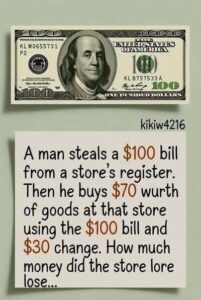
At first glance, the famous store theft puzzle seems like it should be simple. A thief steals a one hundred dollar bill from a store, later returns to the same store, and uses that same bill to buy seventy dollars worth of goods, receiving thirty dollars in change.
Most people hear this story and immediately feel something is wrong, as if the store must have lost more than one hundred dollars. Some say one hundred seventy. Others say two hundred. A few even feel the loss is “greater than the sum of its parts” because the money was stolen first and then used again.
But the puzzle is not difficult because of mathematics.
It is difficult because of how humans think.
The moment the word “theft” appears, the brain switches from logical accounting to emotional storytelling. And once that happens, people begin counting the same money twice without realizing it.
The solution becomes obvious only when the entire situation is stripped of emotion and treated like a simple financial ledger: what went out, what came back, and what remained missing at the end.
Step One: The Moment of Theft
The story begins with a single clear action: the thief takes one hundred dollars from the cash register.
At that moment, the store has lost one hundred dollars in cash. There is no confusion here. The register is short by one bill, and the store is down one hundred dollars.
If the story ended at this point, the answer would be simple: the store loses one hundred dollars.
But the story does not end there, and that is where confusion begins.
The human mind tends to “lock in” that initial loss. Once people hear “stolen one hundred dollars,” they mentally record it as a permanent loss and carry that assumption forward even when the situation changes.
This is the first cognitive trap.
Step Two: The Return of the Same Bill
Later in the story, the thief returns to the store as a customer. Crucially, the thief still has the same one hundred dollar bill that was stolen earlier.
This detail is the key to the entire puzzle.
The thief uses that same bill to purchase seventy dollars worth of merchandise. The cashier accepts the payment and gives the thief thirty dollars in change.
Now something important happens: the original one hundred dollar bill goes back into the register.
This means the store is no longer missing that original cash. It has been restored.
At this point, the initial “theft” is no longer an ongoing loss. The money has moved in a circle and returned to the store’s possession.
This is where many people begin to go wrong. They continue counting the stolen one hundred dollars as a separate loss even though it has already come back.
Step Three: What Actually Left the Store
Now we must stop and ask a very simple question:
What did the store permanently lose?
Not what was stolen.
Not what was temporarily missing.
Not what changed hands during the story.
Only what did not come back.
When we apply that standard, two things remain:
The store gave away seventy dollars worth of merchandise. Those goods are gone forever. They cannot be returned simply by the thief handing back the bill.
The store also gave away thirty dollars in cash as change. That money also left permanently.
So the total permanent loss is:
Seventy dollars in goods
Thirty dollars in cash
Together, that equals one hundred dollars.
That is the entire loss.
Nothing more.
Step Four: The Double Counting Trap
The reason so many people get the puzzle wrong is because they accidentally count the same money twice.
The most common incorrect reasoning goes like this:
First, the thief steals one hundred dollars.
Then the thief buys seventy dollars of goods.
Then the thief receives thirty dollars in change.
Adding these together produces two hundred dollars.
But this is incorrect because it treats the same one hundred dollar bill as both:
- stolen cash
- and later returned cash
In reality, once the bill returns to the register, it cancels out the original theft.
The store is no longer missing that money.
It is like temporarily borrowing something and then giving it back before the final accounting is done.
Accounting does not care about emotional sequences. It only cares about final balances.
Step Five: Why the Brain Gets It Wrong
This puzzle is not really about math. It is about perception.
Human beings are not naturally trained to think in ledger form. Instead, we think in stories.
Stories have:
- beginnings
- dramatic events
- emotional moments
- sequences of actions
So when people hear the puzzle, they break it into narrative parts:
First: theft
Then: return
Then: purchase
Then: change
Because these events feel separate, the brain treats them as separate losses.
But financially, that is incorrect.
The store’s balance sheet does not care about storytelling order. It only tracks net outcome.
Step Six: Emotional Framing Distorts Logic
The word “theft” carries strong emotional weight. It signals wrongdoing, loss, and violation.
Once the brain registers that emotion, it becomes difficult to “undo” it later when the money returns.
Even when logically explained, people often feel like the store “still lost” the stolen hundred dollars in addition to everything else.
This is a psychological illusion.
The brain prefers to preserve emotional consistency rather than update its calculation.
So even after the money returns, the feeling of loss remains.
This is the core reason the puzzle is so effective.
It exposes how emotion interferes with accounting logic.
Step Seven: A Clean Accounting Version
To remove confusion, we can rewrite the entire scenario in pure financial terms:
A store temporarily loses one hundred dollars in cash due to theft.
The same one hundred dollars is later returned to the register through a purchase.
During that purchase, the store exchanges seventy dollars in goods and thirty dollars in cash for the returned bill.
Now the situation is clear.
There is no emotional framing.
No storytelling confusion.
No double meaning.
Just transactions.
And the result is simple:
The store loses exactly one hundred dollars.
Step Eight: What Actually Happened Financially
If we strip away narrative and track only value flow, we see:
- Cash leaves temporarily, then returns
- Inventory leaves permanently (70 dollars)
- Cash change leaves permanently (30 dollars)
Net loss = 100 dollars
The original stolen bill is not a separate loss because it is no longer missing.
This is the most important insight of the puzzle.
Step Nine: Why People Still Argue About It
Even after understanding the correct answer, many people still feel unsure. This is because intuition resists abstraction.
We are used to thinking:
“If something is stolen, it is lost.”
But in this case, that assumption is incomplete. The money is only temporarily missing.
The correct way to think about it is:
Loss only counts when value does not return.
Once people accept that principle, the confusion disappears.
Step Ten: Real-Life Parallels
This mistake is not limited to puzzles. It appears in real life constantly.
People often:
- panic over temporary financial losses
- double count expenses in emotional situations
- misinterpret refunds or returns
- overestimate damage from reversible events
For example, investors sometimes react strongly to short-term market drops even when recovery occurs later. The emotional impact of the drop feels permanent, even when it is not.
The same cognitive bias is at work.
Step Eleven: The Core Lesson of the Puzzle
The real lesson is not about money.
It is about clarity.
To solve the puzzle correctly, you must:
- ignore emotional storytelling
- track only final outcomes
- avoid double counting
- separate temporary movement from permanent loss
Once you do that, the answer becomes obvious.
The store loses one hundred dollars.
Nothing more.
Conclusion: Why the Puzzle Feels Hard but Isn’t
The famous store theft puzzle is not a test of intelligence or arithmetic skill. It is a test of mental discipline.
It reveals how easily human thinking becomes distorted when emotion enters a financial situation.
At every stage, the math is simple. The confusion comes from the story surrounding the math.
Once you remove narrative bias and track each dollar step by step like an accountant, the illusion disappears completely.
The store does not lose one hundred seventy dollars.
It does not lose two hundred dollars.
It loses exactly one hundred dollars:
Seventy in merchandise
Thirty in cash
And the stolen bill?
It returns, and cancels itself out.
That is the entire answer.
Simple, clean, and often missed the first time because the mind prefers stories over ledgers.