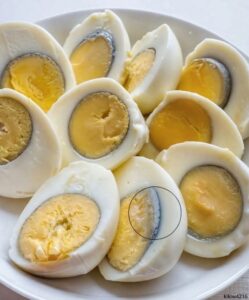
Hard-boiled eggs are among the simplest foods to prepare, yet they often create unexpected frustration in the kitchen. Most people assume that cooking an egg requires little more than placing it in boiling water and waiting. However, anyone who has sliced into a hard-boiled egg and discovered a green or gray ring surrounding the yolk knows that achieving perfect results is not always as effortless as it seems.
The appearance of a green ring around the yolk can be disappointing. Although the egg remains safe to eat, the discoloration often makes it look overcooked and less appetizing. Many home cooks immediately assume they have used poor-quality eggs or made a serious mistake during preparation. Fortunately, the truth is much simpler. The green ring is not a sign of spoilage, contamination, or low quality. Instead, it is the result of a harmless chemical reaction that occurs when eggs are exposed to excessive heat for too long.
Understanding why this discoloration occurs can help anyone consistently produce hard-boiled eggs with bright yellow yolks, smooth texture, and excellent flavor. Once the science behind the process becomes clear, preventing the problem becomes remarkably easy.
At first glance, an egg appears to be a simple food. Yet beneath the shell lies a surprisingly complex structure made up of proteins, minerals, water, and nutrients that respond differently to heat. The white and yolk each contain unique compounds, and when temperatures become too high or cooking times become too long, these compounds begin interacting in ways that affect both appearance and texture.
The green ring develops because of a reaction between sulfur found in the egg white and iron found in the yolk. Egg whites contain sulfur-rich amino acids that naturally release small amounts of hydrogen sulfide gas during cooking. Under normal cooking conditions, this process is minimal and causes no visible changes. However, when eggs are exposed to prolonged heat, significantly more hydrogen sulfide is produced.
As the gas moves inward from the egg white toward the yolk, it reacts with iron naturally present in the yolk. This reaction creates a compound called iron sulfide. Iron sulfide appears as a greenish-gray layer around the outer edge of the yolk, creating the familiar ring that many people find unattractive.
While the appearance may be disappointing, it is important to understand that iron sulfide is completely harmless. The egg remains safe to eat and retains most of its nutritional value. The discoloration is purely cosmetic. Nevertheless, because the reaction typically occurs when eggs are overcooked, it often coincides with texture changes that affect overall quality.
Overcooked yolks tend to become dry, crumbly, and chalky. Instead of maintaining a creamy, tender consistency, they develop a powdery texture that many people find less enjoyable. Egg whites can also become tougher and more rubbery when exposed to excessive heat. For this reason, preventing the green ring improves not only appearance but also taste and texture.
One of the most common mistakes people make when preparing hard-boiled eggs is assuming that vigorous boiling produces better results. In reality, aggressive boiling often creates the very conditions that lead to discoloration. Rolling boils expose eggs to unnecessary heat stress, increasing sulfur production and encouraging the formation of iron sulfide.
A gentler cooking approach typically produces superior results. Many cooking experts recommend placing eggs in a pot, covering them with water, and bringing the water to a boil gradually. Once boiling begins, reducing the heat to a gentle simmer allows the eggs to cook evenly without excessive temperature exposure.
For most large eggs, a cooking time between nine and twelve minutes is sufficient to fully cook both the white and yolk. Exact timing depends on factors such as egg size, starting temperature, and personal preference. Slightly shorter cooking times may produce creamier yolks, while slightly longer times result in firmer centers. The key is avoiding unnecessary overcooking.
Timing alone, however, is not enough. One of the most overlooked steps in the entire process occurs after the eggs leave the hot water. Many people remove the eggs from the pot and simply allow them to cool naturally. Unfortunately, this practice allows residual heat to continue cooking the eggs.
This phenomenon, often called carryover cooking, can significantly affect final results. Even though the eggs are no longer sitting in boiling water, their internal temperature remains high. As a result, sulfur production continues and the risk of discoloration increases.
The solution is immediate cooling. Transferring freshly cooked eggs into an ice bath or bowl of very cold water rapidly lowers their temperature and stops the cooking process. This simple step dramatically reduces the likelihood of a green ring forming around the yolk.
An ice bath offers additional benefits as well. Rapid cooling helps preserve texture, prevents overcooking, and often makes peeling easier. Allowing eggs to remain in ice water for at least five to ten minutes gives them enough time to cool thoroughly before handling.
Peeling is another area where many people encounter difficulties. Interestingly, egg freshness plays a role here. Contrary to what some might assume, the freshest eggs are not always the easiest to peel. Fresh eggs contain a lower internal pH, causing the egg white to adhere more tightly to the shell membrane.
As eggs age, carbon dioxide gradually escapes through microscopic pores in the shell. This process raises the pH level and weakens the bond between the white and shell membrane. As a result, slightly older eggs often peel much more cleanly than extremely fresh ones.
For those planning to make deviled eggs, egg salad, or decorative garnishes, using eggs that are approximately one week old can often improve peeling results significantly. While freshness remains important for food safety and flavor, slightly aged eggs frequently provide a smoother cooking experience.
Storage practices also influence quality. Once cooked, hard-boiled eggs should be refrigerated promptly if they are not eaten immediately. Proper refrigeration helps maintain freshness, preserve texture, and reduce the growth of harmful bacteria. Eggs stored in their shells generally retain moisture and quality better than peeled eggs.
Many people wonder whether green-ringed eggs contain fewer nutrients than properly cooked eggs. The answer is generally no. While prolonged heating may cause small losses of certain heat-sensitive nutrients, the overall nutritional profile remains largely intact. The egg still provides protein, vitamins, minerals, healthy fats, and other beneficial nutrients.
Eggs remain one of the most nutrient-dense foods available. They provide high-quality protein containing all essential amino acids required by the human body. They are also rich in vitamins such as B12, riboflavin, vitamin D, and choline, a nutrient important for brain health and cellular function.
Because eggs are affordable, versatile, and highly nutritious, they continue to play an important role in diets around the world. Whether eaten for breakfast, added to salads, used in sandwiches, or incorporated into recipes, eggs offer both convenience and nutritional value.
Understanding the science behind cooking also helps remove unnecessary anxiety from the process. Many people view kitchen mistakes as signs of failure. In reality, cooking is often a series of small experiments guided by observation and adjustment. The green ring is not evidence of incompetence. It is simply feedback indicating that temperature or timing can be improved.
Once cooks understand this relationship, they gain greater confidence in the kitchen. Instead of guessing why results vary, they can identify the specific factors responsible for changes in appearance and texture. This knowledge makes it easier to achieve consistent outcomes.
The same principle applies to many other cooking techniques. Heat influences proteins, starches, fats, and sugars in predictable ways. Learning how ingredients respond to temperature transforms cooking from a process of trial and error into a process of understanding.
Hard-boiled eggs provide an excellent example because the science is easy to observe. Small adjustments in temperature and cooling produce visible improvements. Bright yellow yolks, tender whites, and smooth texture become much easier to achieve when the cooking process is managed carefully.
For those seeking consistently perfect results, a simple routine often works best. Start with eggs placed in cold water. Bring the water to a gentle boil. Reduce the heat if necessary to maintain a mild simmer. Cook for the appropriate amount of time based on egg size. Immediately transfer the eggs to an ice bath. Allow them to cool thoroughly before peeling or storing.
These straightforward steps require no special equipment, expensive gadgets, or advanced culinary skills. They simply require attention to timing and temperature. Yet the difference in results can be remarkable.
Ultimately, the green ring around a hard-boiled egg is a reminder that even the simplest foods involve chemistry. Sulfur and iron interact in response to heat, creating a harmless but noticeable visual effect. By understanding this reaction and taking steps to control it, anyone can improve both the appearance and quality of their eggs.
Perfect hard-boiled eggs are not the result of luck. They are the result of gentle cooking, proper timing, and rapid cooling. Once these habits become routine, bright yellow yolks and tender textures become the norm rather than the exception.
The reward is a food that looks as good as it tastes—cleanly peeled, beautifully colored, nutritious, and versatile enough for countless meals. With just a little knowledge and attention, one of the simplest ingredients in the kitchen can consistently deliver excellent results, proving that sometimes the smallest adjustments make the biggest difference.