The Heinz 57 Mystery
Introduction: A Number That Became a Global Symbol
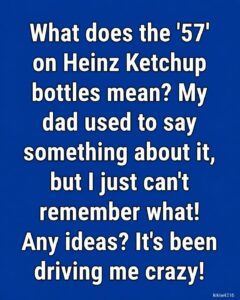
For more than a century, the number “57” printed on bottles of ketchup has puzzled consumers around the world. Most people recognize it instantly, yet few can confidently explain what it actually means. Is it the number of ingredients? A secret recipe code? A list of product varieties? Or something entirely different hidden in the history of food branding?
The truth is that the number has far less to do with chemistry or culinary secrets and much more to do with marketing creativity at the turn of the 20th century. It is tied to the early growth of one of the most recognizable food companies in the world, Heinz, and its ambitious founder Henry J. Heinz.
To understand the “57 mystery,” we need to go back to a time when branding was still evolving, packaged food was becoming mainstream, and companies were experimenting with ways to stand out in a crowded marketplace.
The World Before “57”
In the late 1800s, packaged food was still a relatively new concept. Most households made sauces, pickles, and condiments at home or bought them from local producers without standardized branding. Trust in packaged goods was not guaranteed, and companies had to work hard to convince consumers that their products were safe, consistent, and worth buying.
Henry J. Heinz was among the pioneers who believed that transparency and quality could build consumer trust. His company sold a growing range of products, including vinegar, pickles, sauces, and preserved foods. As the product line expanded, so did the challenge of making the brand memorable.
At the time, many businesses used long descriptive slogans, but few had simple, repeatable identities. Heinz wanted something different—something that would stick in people’s minds immediately.
Henry J. Heinz and the Search for a Slogan
According to widely shared company history, Henry J. Heinz was inspired by advertising he saw while traveling. One story suggests he noticed a shoe company promoting “21 styles” and was struck by how effective the number sounded in advertising.
Whether this moment happened exactly as described or evolved through company storytelling, the idea it sparked was clear: numbers are easy to remember. They are short, universal, and psychologically appealing.
Heinz began looking for a number that could represent the variety and richness of his company’s offerings. At that time, the company already sold far more than 57 products, but the number itself was not meant to be literal.
Instead, it was chosen for how it sounded and felt.
Why “57” Was Chosen
The choice of “57” is one of the most famous examples of branding psychology before the term even existed.
Henry J. Heinz reportedly believed that certain numbers simply “looked better” in advertising. The number 57 had a visual and auditory balance that felt memorable and distinctive. It was neither too small nor too large, and it had a unique rhythm when spoken.
Interestingly, the company was already producing far more than 57 products at the time the slogan was introduced. In fact, Heinz had dozens more varieties than the number suggested. But the goal was never mathematical accuracy—it was emotional impact.
The slogan “57 Varieties” became a simple way to communicate abundance, quality, and trust.
The Rise of “57 Varieties”
Once the slogan was adopted, it began appearing across packaging, advertisements, and promotional materials. “57 Varieties” quickly became synonymous with the brand itself.
Consumers began associating the number with reliability and consistency. Even if they did not know what it meant, they recognized it as a symbol of the company’s promise of variety and quality.
Over time, the phrase became so powerful that it outlived its original context. People began to assume it had a specific meaning tied to ingredients or product counts. This misunderstanding only strengthened the mystery.
The Expansion of the Myth
As decades passed, the meaning of “57” became increasingly unclear to the public. Many popular explanations emerged:
- It represented 57 ingredients in ketchup
- It referred to 57 product lines
- It was a secret recipe code
- It marked the founder’s favorite number
- It had symbolic or cultural meaning
None of these explanations are accurate.
Instead, the number was purely a branding choice designed to create recognition and memorability. The simplicity of the idea is what allowed it to survive for more than a century.
Ironically, the mystery surrounding the number became part of its marketing success.
How Marketing Psychology Played a Role
The success of “57” can be better understood through modern marketing principles. Today, brands use similar techniques:
- Short slogans for memorability
- Numbers for clarity and recall
- Emotional rather than literal messaging
- Repetition across packaging and advertising
Heinz was ahead of its time in using these strategies. The number “57” functioned as a cognitive shortcut. Instead of remembering dozens of product names, consumers remembered a single symbol.
This simplicity made the brand easier to recognize in stores, advertisements, and eventually international markets.
Why the Story Still Confuses People Today
Even in the modern era, many people still assume the number has a hidden meaning. This persistence is due to how human memory works. When we see repeated symbols over a lifetime without explanation, our minds naturally try to fill in the gaps.
The number “57” appears so consistently on bottles of ketchup that it feels intentional and precise. This leads people to assume it must be based on a formula or measurement.
In reality, it is one of the earliest examples of branding becoming more powerful than literal meaning.
The Role of Advertising in Building the Legend
As advertising evolved through the 20th century, Heinz continued to reinforce the “57 Varieties” message. The slogan appeared in print ads, television commercials, and packaging designs worldwide.
Even as the company expanded far beyond 57 products, it kept the number because it had become part of its identity. Changing it would have meant losing a century of brand recognition.
At this point, “57” was no longer just a marketing idea—it was cultural heritage.
The Expansion Beyond Ketchup
While many people associate “57” primarily with ketchup bottles, the slogan originally represented the entire product range of the company.
Over time, ketchup became the flagship product, and the number became closely tied to it. This association strengthened consumer recognition even further.
Today, when people think of “57,” they usually think of ketchup first, even though the origin of the number had nothing to do with that specific product.
The Power of Simplicity in Branding
The “57” story is often used in marketing discussions as a classic example of simplicity winning over complexity. Instead of trying to explain every product individually, Heinz created a single unifying symbol.
This approach has since been used by countless brands:
- Simple slogans
- Minimalist logos
- Numeric branding
- Repetition for recognition
The success of “57 Varieties” demonstrates how a simple idea can become more powerful than detailed explanation.
What the Number Means Today
In the modern context, “57” no longer has a literal meaning. It is a historical artifact that represents the early branding strategy of a company that helped shape the global food industry.
For many consumers, it is simply part of the visual identity of ketchup bottles. For marketers, it is a case study in how perception can override literal truth.
The number continues to appear not because it is meaningful in a mathematical sense, but because it is meaningful in a cultural and historical sense.
Why the Mystery Endures
The reason the “Heinz 57” mystery persists is simple: stories are more memorable than explanations.
A hidden meaning feels more interesting than a marketing decision. A secret recipe feels more exciting than a branding experiment. And a symbolic number feels more powerful than a random choice.
This is why myths often survive longer than facts in popular culture.
Conclusion: A Simple Idea That Became Legendary
The story of “57” is not one of hidden recipes or secret formulas. It is the story of a clever branding decision made during the early days of mass marketing.
Henry J. Heinz chose a number that sounded memorable, looked balanced, and helped unify a growing product line. That decision became one of the most recognizable branding elements in food history.
Today, the number remains printed on bottles around the world, a reminder that sometimes the simplest ideas create the most lasting impact.
What began as a marketing slogan became a global symbol—one that still sparks curiosity more than a century later.