Breakfast usually doesn’t come with surprises.
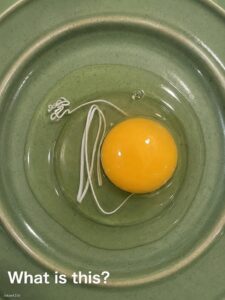
One morning, I reached into the refrigerator, took out a fresh egg, and cracked it into a bowl. Before I could whisk it for an omelet, something unusual caught my eye.
A thin, white, twisted strand stretched from the yolk into the egg white. It looked almost like a tiny cord or ribbon. Since I had never noticed one before, I wondered whether the egg had spoiled or contained some kind of foreign material.
As it turns out, what I saw was completely normal.
The mysterious white strand is called the chalaza (pronounced kuh-LAY-zuh). Every healthy egg contains one or two of these spiral-shaped cords. Their job is to anchor the yolk in the center of the egg, preventing it from moving too much inside the shell.
Think of the chalaza as a natural suspension system. Whenever an egg is turned or gently shaken, these protein-rich strands help keep the yolk centered, protecting it while the egg develops.
Interestingly, the chalaza is often easier to see in very fresh eggs. As an egg ages, the strands gradually become less firm and less noticeable. That means seeing a prominent chalaza is actually a sign that the egg is relatively fresh.
Many people mistake the chalaza for an embryo or an indication that the egg has begun developing into a chick. In grocery-store eggs, that isn’t the case. Commercial eggs sold for eating are generally unfertilized, so the white strand has nothing to do with a developing embryo.
Another common misconception is that the chalaza indicates spoilage. In reality, it is completely edible. Because it is made primarily of protein, it cooks along with the rest of the egg and usually becomes impossible to notice after frying, scrambling, boiling, or baking.
If you’re making custards or very smooth desserts, some recipes recommend straining the egg mixture to remove the chalaza simply for texture—not because it is unsafe.
So how can you tell if an egg has actually gone bad?
There are several better indicators than the presence of a chalaza:
- A strong sulfur-like or rotten odor after cracking the egg.
- Unusual discoloration such as pink, green, or black inside the egg.
- Visible mold on the shell or contents.
- Cracks that have allowed contamination to enter the egg.
One popular freshness test is the water test. Place an uncracked egg in a bowl of cold water. A very fresh egg usually sinks and lies flat. As the egg ages, an air pocket inside grows larger, causing it to stand upright or eventually float. While this test provides a general idea of freshness, cracking the egg and checking its smell remains the most reliable method.
Eggs are fascinating structures. The shell contains thousands of microscopic pores that allow gases to pass through while helping protect the contents inside. Beneath the shell are two membranes, followed by the egg white, the chalazae, and the nutrient-rich yolk.
Every part serves a purpose.
The next time you crack an egg and notice those white twisted strands, there’s no reason to worry. They aren’t worms, plastic fibers, or signs that something has gone wrong. They’re simply one of nature’s clever engineering features, quietly doing their job.
Sometimes the most surprising kitchen discoveries turn out to have the simplest scientific explanations. What first looks unusual is often just a reminder of how remarkably well-designed everyday foods really are.