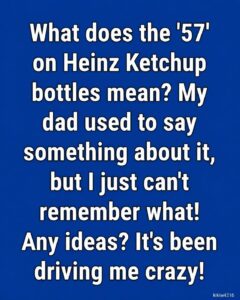
Walk down almost any grocery store aisle, and you’ll likely spot a familiar sight: a bottle of Heinz ketchup displaying the number 57. The figure has become so closely associated with the brand that many people assume it must represent something specific—perhaps the number of ingredients, a secret recipe, or the varieties of products the company originally sold.
Surprisingly, none of those explanations is correct.
The famous “57” is one of the most successful marketing symbols ever created, and its story begins with the company’s founder, Henry J. Heinz, whose simple branding idea became a lasting part of food history.
A Company Built on Quality
Henry J. Heinz believed consumers deserved food products that were consistent, safe, and honestly labeled. During the late nineteenth century, when packaged foods were becoming increasingly popular, his company stood out by emphasizing purity and transparency.
Heinz introduced products in clear glass containers whenever possible so customers could see exactly what they were buying. This approach helped build trust at a time when food manufacturing standards varied widely.
As the business expanded beyond pickles into sauces, condiments, vinegar, baked beans, and other pantry staples, Heinz looked for a memorable way to distinguish the growing brand from its competitors.
The Inspiration Behind the Number
According to company history, Henry Heinz noticed an advertisement promoting a business with a numbered slogan. The concept caught his attention because numbers are easy for people to remember.
Although Heinz was already producing well over 57 different products by that time, he decided that “57” sounded appealing. He reportedly chose the number because he found it distinctive, memorable, and pleasant to say.
Rather than reflecting an actual product count, the number became part of the company’s new slogan: “57 Varieties.”
Even though the business already offered many more than 57 products, the phrase stuck.
Why “57 Varieties” Worked
From a marketing perspective, the slogan accomplished several things.
First, it gave consumers a simple phrase they could easily remember.
Second, it suggested variety without overwhelming shoppers with long product lists.
Finally, it helped establish a recognizable identity that competitors found difficult to imitate.
More than a century later, many people still associate the number 57 with Heinz even if they don’t know the story behind it.
A Symbol Bigger Than Its Original Meaning
Over time, the number evolved beyond advertising.
It became part of the company’s logo, appeared on packaging around the world, and was incorporated into promotional campaigns, restaurant signs, and product displays.
Today, seeing “57” instantly reminds many consumers of Heinz ketchup, demonstrating the lasting power of consistent branding.
The Famous Bottle Trick
The number 57 is also connected with a well-known ketchup tip.
If ketchup is slow to pour from a glass bottle, many people instinctively hit the bottom. Heinz has long suggested tapping the bottle gently on the embossed “57” located near the neck instead.
This technique often encourages the ketchup to flow more smoothly by helping it move through the bottle’s narrow opening.
While modern squeeze bottles have reduced the need for this trick, it remains a fun piece of brand lore.
Why the Story Endures
The mystery surrounding the number has inspired countless theories over the years.
Some people believe it refers to ingredients.
Others think it represents recipes or manufacturing locations.
The actual explanation is much simpler: it was an inspired marketing decision made by a businessman who understood that memorable branding could be just as valuable as a quality product.
The Lasting Legacy of “57”
Few advertising slogans survive for generations, but “57 Varieties” has done exactly that.
The number no longer serves as a literal description of Heinz’s product lineup. Instead, it has become a symbol of the company’s long history, commitment to recognizable branding, and ability to create an identity that resonates with consumers around the world.
Sometimes the most enduring business ideas aren’t based on complicated strategies or hidden meanings. In the case of Heinz, a single number chosen for its memorability became one of the most recognizable symbols in the global food industry—a reminder that great branding can turn even the simplest idea into an enduring icon.