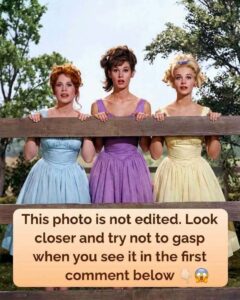
For generations of television fans, Petticoat Junction represented warmth, family, and the simple charm of life in Hooterville. The series offered a comforting mixture of homespun humor, eccentric neighbors, family disagreements, romance, and small-town adventures. Its relaxed pace made the show feel almost timeless, as though life in Hooterville existed outside the hurried world viewers knew in their own homes.
Yet even the most carefully produced television series has its share of mistakes. In Petticoat Junction, some were connected to casting changes, while others involved props, locations, costumes, vehicles, and the fictional world itself. Many were so subtle that audiences simply accepted them without question. Others were visible enough to become amusing discoveries for fans watching the episodes years later.
One of the most interesting examples involved Billie Jo Bradley, the eldest of Kate Bradley’s three daughters. The character was played by different actresses during the series, and those changes occasionally created small continuity problems. Meredith MacRae eventually became the actress most closely associated with Billie Jo, but Jeannine Riley and then Gunilla Hutton had previously played the role.
For viewers watching the series in its original run, the changes were simply part of television. Today, however, they can make certain episodes especially interesting to compare. Familiar promotional material, opening images, and established character details did not necessarily change as quickly as the cast did. As a result, fans can sometimes notice traces of an earlier version of the character after a new actress has taken over.
The changes also remind viewers how different television production was from the modern era. A successful television program could run for years, and replacing an actor was not necessarily treated as a reason to rebuild every piece of existing material. Publicity photographs, promotional artwork, footage, and other visual elements could remain in circulation even after the cast had changed.
That means some apparent inconsistencies were not mistakes in the story at all. They were artifacts of production.
The Hooterville Cannonball Was Not Always as Consistent as Fans Remember
Perhaps the most recognizable piece of Petticoat Junction machinery was the Hooterville Cannonball. The little train became almost a character in its own right, carrying passengers and helping establish the unusual personality of the Hooterville Valley.
Because the Cannonball appeared so often, however, it was also an obvious source of continuity quirks.
The train did not always appear exactly the same way. Details such as its numbering, equipment, positioning, and operation could vary depending on the episode and the requirements of a particular scene. Television productions frequently had to work around practical limitations, and a vehicle used repeatedly could be filmed from different angles or in different settings.
The Cannonball’s fictional railroad also operated according to sitcom logic rather than the rules of a real railroad. Characters could use the train in ways that served the comedy or advanced the story, even when the logistics might have raised questions for a railway enthusiast.
That was rarely important to the audience. The Cannonball was there to create atmosphere, provide transportation, and generate jokes. Viewers were not watching a documentary about railroad operations. They were watching a comedy about an unusual community where almost anything could happen.
The Bradley Sisters Changed, but Hooterville Stayed the Same
The Bradley daughters provide another fascinating example of how television continuity could become complicated.
Billie Jo was not the only Bradley daughter whose characterization evolved. Bobbie Jo and Betty Jo also underwent changes in presentation over the course of the series, although Linda Kaye Henning remained closely associated with Betty Jo and Lori Saunders became the familiar Bobbie Jo for much of the show’s run.
As actors changed or characters developed, the fictional family sometimes had to absorb those changes without lengthy explanations. Sitcoms traditionally depended on viewers accepting a certain amount of flexibility. A character could look different, behave somewhat differently, or suddenly have a revised history, and the story would simply continue.
This is one reason older television can be so much fun for modern audiences to revisit. Viewers accustomed to highly serialized programs may immediately notice inconsistencies that original audiences simply ignored.
In a show such as Petticoat Junction, the personalities mattered more than strict continuity. Kate Bradley remained the emotional center of the Shady Rest Hotel, and the daughters remained part of the family world regardless of occasional changes in casting or characterization.
Costumes Could Reveal the Production Schedule
Costume continuity is another area where sharp-eyed viewers can sometimes spot the realities of television production.
Characters might appear to be wearing the same clothing across scenes that were actually filmed at different times, or a costume might return in another episode without any particular explanation. This was not unusual for sitcoms, particularly when productions were working with recurring wardrobes.
For a modern audience, repeated clothing can seem like a continuity mistake. In reality, it was often simply practical.
Television productions had budgets, schedules, and costume departments that had to keep dozens of details organized. A favorite outfit could be reused because it worked well on camera, fit the performer, or had already become associated with the character.
In a world where fans can freeze a frame instantly and compare episodes online, such details are easier to notice than they were decades ago.
Props Sometimes Moved Between Scenes
The same principle applied to props.
Objects placed on tables, desks, counters, or inside the Shady Rest Hotel could occasionally change position between shots. A character might be holding an object in one camera angle and have it placed somewhere else in the next. Food could appear or disappear, furniture could shift, and small background details might not remain perfectly consistent.
These are classic sitcom continuity errors, and they are particularly easy to miss when a scene is driven by dialogue.
The audience naturally watches the actors. A joke, reaction, or dramatic moment draws attention away from a glass, plate, book, or piece of furniture in the background.
The imperfections become more obvious only when someone watches the scene specifically looking for them.
Hooterville Itself Operated by Its Own Rules
Perhaps the biggest continuity issue in Petticoat Junction was not a single object or actor but the geography of Hooterville.
The fictional community was designed to feel like a small, isolated place, yet its exact layout could change according to the needs of the story. Locations existed primarily as storytelling devices. The Shady Rest Hotel, railroad, stores, farms, and surrounding communities could be connected differently depending on what the episode required.
That kind of flexible geography was common in classic sitcoms.
A character could leave one location and arrive somewhere else with surprising speed. A journey that seemed as though it should take longer might be completed almost immediately. The audience rarely cared because the goal was not geographical realism.
Hooterville was less a carefully mapped town than a television universe.
Its purpose was to bring familiar characters together so that stories could happen.
Background Details Could Change Without Explanation
Long-running television programs often accumulate small changes simply because sets are modified, repaired, redecorated, or rebuilt.
The Shady Rest Hotel was especially important because it served as one of the show’s main gathering places. Any recurring set inevitably developed minor differences over time.
Furniture could be moved. Decorations could change. Background objects might appear in one episode and disappear in another.
For viewers, these details usually registered as part of the changing appearance of the house or hotel rather than as errors.
Today, however, fans frequently compare episodes side by side. A detail that went unnoticed for decades can suddenly become obvious.
The Opening Sequence Could Preserve the Past
Opening sequences are another fascinating window into television continuity.
Once an opening was created, it could remain in use for a considerable period. But casts, hairstyles, costumes, and visual styles could change while the opening remained largely familiar.
This could leave viewers with a curious mixture of old and new imagery.
For Petticoat Junction, the opening was particularly memorable because it helped establish the series’ rural atmosphere and its connection to the Hooterville community. Repeated every week, it became part of the show’s identity.
At the same time, any outdated footage could become a historical snapshot of an earlier period of the production.
Rather than seeing these differences purely as mistakes, fans can view them as evidence of how the show evolved.
Some “Mistakes” Were Actually Practical Television Tricks
Not every oddity was an error.
Classic sitcoms frequently used filmmaking techniques that modern audiences may interpret differently. Exterior shots, studio sets, rear projections, reused footage, and carefully framed camera angles allowed productions to create locations that would have been difficult or expensive to film continuously.
The result could occasionally look unusual when examined closely.
But these techniques were part of the craft.
Television producers had to make weekly episodes on demanding schedules. A production could not spend unlimited time establishing perfect continuity for every object in every shot. The priority was delivering an entertaining episode on time and within budget.
That context makes many of the show’s quirks more understandable.
Why Fans Still Love Finding the Mistakes
The fascinating thing about Petticoat Junction is that its imperfections have not diminished its appeal.
If anything, the little mistakes give longtime fans another reason to revisit the series.
Spotting a changing prop, an inconsistent costume, an unusual train detail, or evidence of an earlier cast member can feel like discovering a small piece of television history. These moments remind viewers that the program was created by real performers and production crews working under real-world conditions.
They also reveal how much television has changed.
Modern productions can maintain enormous databases of costumes, props, locations, scripts, and character histories. Editing software allows filmmakers to correct certain continuity problems after filming. Audiences can pause, rewind, screenshot, and share individual frames within seconds.
When Petticoat Junction was originally broadcast, viewers generally watched an episode once, at the scheduled time. If a prop moved or a costume changed, there was no easy way to stop the picture and investigate it.
The story simply continued.
And that may be one of the reasons the show’s mistakes remained so charming.
Hooterville Was Never Supposed to Be Perfect
Ultimately, Petticoat Junction worked because its characters were more important than its continuity.
Kate Bradley, her daughters, the residents of Hooterville, and the unforgettable Cannonball created a world that felt welcoming and familiar. The humor came from personalities and situations, not from technical perfection.
The little mistakes were therefore easy to overlook. A different actress might appear in a familiar role. A train might look slightly different. A prop could move between shots. A costume could return unexpectedly. The geography of Hooterville might not always make perfect sense.
None of it destroyed the illusion.
Instead, these quirks have become part of the show’s enduring legacy.
For fans returning to Petticoat Junction today, watching for mistakes can add another layer of enjoyment. The goal is not to criticize a beloved classic, but to appreciate the craftsmanship, limitations, and changing circumstances behind it.
After all, Hooterville was never meant to be a perfectly organized place.
It was meant to be fun.
And decades later, the occasional blooper only makes that world feel a little more human.