For many people, a trip to the nail salon is more than just a beauty appointment. It can be a chance to relax, slow down, and enjoy a little personal time away from the demands of everyday life. Whether you are getting a simple manicure, a pedicure, gel polish, or an elaborate nail-art design, the experience often involves more than the finished look. It is also about the time, attention, and skill provided by the technician.
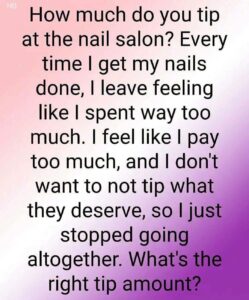
Yet when the appointment comes to an end, one question frequently creates uncertainty: How much should you tip?
Tipping at a nail salon is a common way to show appreciation for a technician’s work. There is no single amount that applies to every situation, and expectations can vary depending on the salon, location, service, and overall experience. However, many customers use 15% to 20% of the service price as a general starting point.
From there, the amount can be adjusted depending on the circumstances.
If the technician provided excellent service, spent extra time perfecting the shape, accommodated a complicated request, or created detailed nail art, a customer may decide to leave more. On the other hand, someone working with a strict budget may choose a smaller amount that still fits comfortably within their spending plan.
The most important thing is to approach tipping as an expression of appreciation rather than a source of anxiety.
Why Do People Tip Nail Technicians?
Nail technicians perform detailed work that requires patience, precision, and concentration.
Even a basic manicure involves several steps. Nails may need to be shaped, cuticles carefully managed, surfaces prepared, and polish applied evenly. More complicated services can require significantly more time and technical skill.
Nail art can add another layer of difficulty.
A design involving multiple colors, small details, patterns, decorations, or specialized techniques can require careful planning and steady hands. What may look simple when finished can take considerable effort to create.
A tip gives customers a way to recognize that effort.
It is not necessarily a payment for simply completing the service. Instead, it can communicate that the customer appreciated the technician’s care, professionalism, and attention to detail.
Is 15% to 20% a Good Starting Point?
For many customers, 15% to 20% provides a useful guideline.
For example, if a service costs $50, a 15% tip would be $7.50, while a 20% tip would be $10.
If the service costs $70, the same range would be $10.50 to $14.
For a $100 appointment, the range would be $15 to $20.
These calculations can make tipping easier because customers do not have to make up a number at the end of every appointment.
It is also worth remembering that the percentage is a guideline, not a mandatory fee.
A person’s financial circumstances matter. If the cost of the appointment has already stretched the budget, leaving a smaller tip may be more realistic than feeling obligated to spend beyond one’s means.
When Might You Tip More?
There are several situations in which a customer may decide to give more than the usual amount.
Exceptional service is one obvious example.
Perhaps the technician was especially attentive, took time to explain the process, helped choose a flattering color, or carefully corrected a problem. Maybe the appointment ran longer than expected because the technician wanted to make sure the final result was right.
Extra effort can also justify a larger tip.
Suppose you request a detailed design involving several colors, tiny patterns, gems, or other decorative elements. If the technician spends substantial additional time creating the look, you may want to recognize that work.
The same can apply when a technician accommodates a last-minute request or works carefully to achieve a particular result.
Of course, tipping more should remain a personal decision.
You do not have to increase the tip every time a service takes longer, particularly if the additional time was already included in the quoted price.
What About a Basic Manicure?
A basic manicure is generally straightforward, which can make tipping decisions feel easier.
If the service was professional and you were satisfied with the result, a tip within the usual range is a simple way to express appreciation.
The amount does not need to be dramatic.
A modest tip can still communicate that you valued the technician’s work.
This is especially important because tipping culture can sometimes create the impression that customers must constantly increase their spending to demonstrate gratitude.
That is not necessary.
A thoughtful tip that fits your circumstances can be perfectly appropriate.
What About Pedicures?
Pedicures can involve more time and physical effort than customers sometimes realize.
A technician may spend considerable time preparing the feet, shaping the toenails, caring for the cuticles, applying polish, and completing finishing touches.
Depending on the salon and service, there may also be soaking, exfoliation, massage, or other treatments.
Because the service can involve several stages, customers may want to calculate the tip based on the full service price.
If additional services are added during the appointment, it can be helpful to consider the final total when determining the tip.
Nail Art Can Change the Equation
Nail art is one of the clearest examples of a service that may deserve additional recognition.
A plain coat of polish can be relatively quick. A detailed design may require significantly more time and concentration.
Consider the difference between asking for a single color and requesting ten individually designed nails.
The second service may involve tiny brushes, multiple layers, careful positioning, and repeated corrections. Some designs require considerable artistic skill.
If you are particularly pleased with a complex design, adding a little extra to the tip can be a meaningful way to show appreciation.
You should also recognize that some salons charge separately for nail art. If that additional fee already reflects the technician’s work, you are not necessarily expected to provide a dramatically larger tip.
The important point is to recognize the overall service rather than feeling pressured by an arbitrary rule.
What If Several Technicians Work on Your Appointment?
Sometimes more than one person contributes to a salon service.
One technician might perform the manicure while another handles nail art or another part of the appointment. In other cases, a different person may assist with preparation or finishing.
When multiple people are directly involved, tipping can become confusing.
A practical approach is to ask the salon how tips are handled.
Some salons have systems for distributing tips among staff. Others may expect customers to tip individual technicians directly.
Asking beforehand can prevent an awkward moment at checkout.
There is nothing unusual about saying, “What’s the best way to handle tips here?” Staff members are generally familiar with the question.
What If the Service Was Not Good?
Tipping can become more complicated when you are dissatisfied.
If the technician made a small mistake but responded professionally and attempted to correct it, you might still choose to leave a tip, perhaps adjusting the amount based on the experience.
If there was a serious problem, however, you may want to speak with the technician or salon manager before deciding what to do.
Communication can sometimes resolve a misunderstanding.
For example, you may have expected a particular shape or color but not explained your preference clearly. In other cases, the technician may be able to fix an issue quickly.
A tip should not be viewed as a replacement for communicating about the service.
If something is wrong, it is reasonable to address the problem respectfully.
Should You Tip in Cash or by Card?
Many salons accept tips through credit or debit cards, while others may prefer cash.
If you have a regular technician or visit a smaller salon, carrying some cash can be convenient.
Cash may also make it easier to provide a tip directly to a specific technician when a salon’s payment system does not automatically distribute tips.
If you are unsure, simply ask when you arrive.
This is another small question that can eliminate uncertainty before the appointment begins.
Plan the Tip Before Your Appointment
One of the easiest ways to make tipping less stressful is to plan ahead.
Before your appointment, consider the expected service price and decide what percentage you are comfortable leaving.
If your manicure costs $40 and you want to tip 20%, you already know that you will leave $8.
If the service is expected to cost $75, a 15% to 20% range would be $11.25 to $15.
Having those numbers in mind prevents the checkout process from becoming a rushed calculation.
It also helps you establish a budget for the entire appointment.
Instead of thinking only about the advertised salon price, consider the service plus the tip when deciding whether the appointment fits comfortably within your spending plan.
Tipping Should Not Become a Financial Burden
Rising salon prices have made budgeting increasingly important for many customers.
A service that once felt inexpensive can become significantly more costly when several treatments, upgrades, and additional services are combined.
That is why it is perfectly reasonable to establish a personal spending limit.
If you know you can comfortably spend $60 total, for example, you may choose a service that leaves enough room for a tip.
Planning this way can actually make the appointment more enjoyable because you are not worrying about money at the end.
There is no benefit to spending more than you can comfortably afford simply because you feel pressured to meet an unwritten expectation.
A Tip Is About Appreciation
At its heart, tipping is a way to say thank you.
The technician has spent time working on your hands or feet, often performing highly detailed tasks that require concentration. A tip can acknowledge that effort.
But appreciation can also be expressed in other ways.
A sincere compliment can mean a great deal. Recommending a technician to a friend can help build their clientele. Leaving a thoughtful review can also support a salon or independent technician.
If you regularly visit the same person, becoming a reliable client may be one of the most valuable forms of support you can provide.
Tipping is only one part of the relationship.
Regular Customers May Have Different Considerations
If you visit the same technician regularly, consistency can make the experience easier.
You may already know the salon’s policies, typical service prices, and preferred payment methods. You may also have developed a relationship with the technician and understand the amount of time different services require.
Regular customers sometimes choose to tip consistently rather than changing the amount dramatically from visit to visit.
This can make budgeting easier and avoid overthinking each appointment.
During holidays or special occasions, some customers may choose to give an additional gift or larger tip as a gesture of appreciation. Again, this is optional rather than an obligation.
The Bottom Line
There is no universal tipping rule that every nail salon customer must follow.
For many people, 15% to 20% is a reasonable general guideline, with the possibility of tipping more when the service is exceptional or unusually detailed.
The final amount should take into account the quality of the service, the complexity of the work, the salon’s tipping practices, and your own budget.
Most importantly, tipping should not overshadow the reason you made the appointment in the first place.
A visit to the nail salon is supposed to be a chance to take care of yourself, relax, and leave feeling refreshed. Spending the entire appointment worrying about whether you will choose the “correct” tip defeats some of that purpose.
Plan ahead, know what you can comfortably afford, and use the standard percentage as a helpful starting point rather than an absolute rule.
Whether you leave a modest tip for a simple manicure or a more generous amount after an elaborate nail-art session, what matters most is that the gesture reflects genuine appreciation.