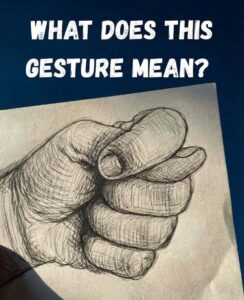
A clenched fist usually looks simple.
Close your fingers.
Fold your thumb.
The message seems straightforward.
But what if the thumb is positioned somewhere unusual?
Look closely at the hand gesture in this picture.
The fingers are curled into a fist, but the thumb isn’t resting on the outside.
Instead, it is tucked between the index and middle fingers.
That tiny difference transforms an ordinary-looking fist into a gesture with a remarkably long and complicated history.
Known in English as the fig gesture, the sign has appeared in different cultures and periods, carrying meanings that could range from rejection and defiance to protection, mockery, and playful teasing.
Its history is a fascinating reminder that humans have always communicated through body language.
Long before people could send text messages, add emojis to conversations, or react to social media posts, they relied on their hands, faces, posture, and movements to express ideas.
Sometimes a gesture could communicate something that would have taken an entire sentence to explain.
The fig gesture is one example of this ancient visual language.
What Is the Fig Gesture?
The basic gesture is formed by curling the fingers into a fist while placing the thumb between the index and middle fingers.
The exact meaning depends heavily on cultural and historical context.
That’s important because gestures don’t have universal meanings.
A hand movement that is harmless or humorous in one place can be insulting or meaningful somewhere else.
The fig gesture is particularly interesting because it has accumulated several interpretations over time.
Some traditions associated it with rejection.
Others connected it with protection.
In certain settings, it could be used in teasing or joking.
The same physical movement could therefore carry very different emotional meanings depending on who was making it, who was receiving it, and what cultural traditions surrounded the interaction.
Communication Before Words
Modern people often underestimate how important gestures were before widespread literacy and modern communication technology.
Imagine living in a world without smartphones.
There are no text messages.
No instant translations.
No emojis.
No social media.
Even written communication may be unavailable or impractical.
How do you quickly communicate disagreement?
How do you indicate that you don’t want something?
How do you signal that you’re joking?
How do you communicate an emotion without speaking?
The answer is often body language.
A raised hand can mean stop.
A nod can mean agreement.
A shake of the head can indicate rejection.
A wave can communicate greeting or farewell.
And more complicated gestures can develop within particular communities.
The fig gesture belongs to this broader history of human communication.
A Gesture of Rejection
One interpretation of the fig gesture involves refusal or rejection.
In situations where directly saying “no” could be uncomfortable, socially risky, or confrontational, a gesture could communicate resistance without requiring a verbal argument.
This made hand signs particularly useful in social environments where etiquette mattered.
Instead of openly challenging another person, someone could make a subtle gesture that conveyed their feelings.
Of course, whether the gesture was actually understood depended on the people involved.
A gesture only works as communication when the participants share some understanding of what it means.
That’s why body language is so closely connected to culture.
Quiet Defiance
The fig gesture can also be understood as a form of quiet defiance.
There is something interesting about communicating resistance without saying a word.
A person can remain outwardly calm while using a small physical movement to express disagreement.
This can be especially powerful in situations where speaking openly isn’t easy.
Imagine someone being pressured to agree with something they don’t accept.
They may not be able to start an argument.
They may not want to attract attention.
But a subtle hand gesture can communicate:
“I don’t accept this.”
“I disagree.”
“No.”
Or even:
“You can’t control me.”
That doesn’t mean every historical use of the gesture had exactly this meaning.
Rather, its association with refusal illustrates how gestures can become tools of social communication.
Protection and Symbolism
The history becomes even more interesting when we move beyond everyday communication.
Hand gestures have often been associated with symbolic or protective meanings.
Across cultures, people have used particular arrangements of the fingers as signs believed to protect against misfortune, unwanted influences, or harmful intentions.
The fig gesture became associated with some of these ideas in certain traditions.
A closed hand can naturally suggest strength.
The hidden thumb creates an unusual shape that may have contributed to its symbolic interpretation.
For people who believed strongly in protective signs, a gesture didn’t have to be dramatic to feel meaningful.
A person could make a small movement with their hand during a moment of uncertainty and feel reassured by it.
Whether or not such protection actually worked is a separate question.
The important point is that symbols can influence how people feel.
A physical gesture can become a reminder of confidence, safety, or control.
Why Was the Gesture Called a “Fig”?
The name itself is intriguing.
The term “fig” has been associated with the shape formed by the fingers and thumb.
The resemblance to a fig fruit may have influenced the terminology in some languages and traditions.
However, terminology and usage vary across cultures.
There isn’t necessarily one universal origin story explaining every version of the gesture.
Like many ancient customs, its history developed through different societies and periods.
That makes it difficult to reduce the gesture to one simple definition.
Its meaning evolved.
Its symbolism changed.
And its social role depended on where and when it was used.
From Serious Symbol to Playful Gesture
Not every use of the fig gesture was hostile or serious.
Over time, gestures can become detached from their original meanings.
A sign that once communicated something significant may eventually become a joke.
Children may learn it from parents or grandparents.
Friends may use it while teasing one another.
Families may turn it into an inside joke.
When that happens, the gesture becomes part of informal culture.
The meaning can become less about its historical symbolism and more about shared familiarity.
A child may have no idea that a hand gesture has existed for centuries.
They may simply know that an older relative makes the gesture when joking around.
This is one of the ways cultural traditions survive.
People don’t always preserve traditions by deliberately studying them.
Sometimes they preserve them simply by repeating them.
The Role of Childhood Games
Children have always created their own communication systems.
Secret gestures.
Codes.
Handshakes.
Signals.
Games.
Small movements can become meaningful within a group.
A gesture might indicate that someone has won.
Another might mean that a person is joking.
Another might be used to trick someone.
This playful environment can help old gestures survive even after their original social meaning fades.
A child may learn a hand sign from an older sibling.
That sibling may have learned it from a parent.
The parent may have learned it from a grandparent.
And suddenly a gesture with ancient roots remains alive in everyday behavior.
The people using it may never know its history.
Why Gestures Change Meaning
Language changes constantly.
Words gain new meanings.
Old expressions disappear.
New slang develops.
Gestures behave similarly.
A hand sign that was once considered serious may become humorous.
A gesture that was once harmless may become offensive in another era.
A sign can even mean completely different things in different countries at the same time.
This makes gestures fascinating but also potentially confusing.
Someone traveling to another culture might unknowingly make a movement that carries an unintended message.
That’s why cultural awareness matters.
Body language isn’t universal.
The Power of a Silent Message
One of the most interesting things about the fig gesture is that it demonstrates how powerful silence can be.
Imagine being in an argument.
Instead of responding verbally, you simply make a gesture.
The other person understands.
No explanation is necessary.
No long speech.
No written message.
Just movement.
Humans are exceptionally good at interpreting visual signals.
We can recognize emotion from facial expressions.
We can understand posture.
We can interpret movement.
And we can attach cultural meaning to specific gestures.
This is why body language remains important even in an age of digital communication.
What Happens to Gestures in the Digital Age?
Modern technology has created a new form of visual communication.
Instead of moving our hands, we often send emojis.
A thumbs-up.
A waving hand.
A raised fist.
A crossed fingers symbol.
A heart.
These tiny images function like miniature gestures.
They can communicate feelings without requiring a sentence.
In some ways, emojis are simply the digital descendants of an ancient human habit.
We still want to communicate visually.
We still want shortcuts.
We still want symbols that carry emotional meaning.
The technology changed.
The instinct didn’t.
The Importance of Context
If you encounter the fig gesture today, it’s important not to assume it has one fixed meaning.
Ask yourself where it is being used.
Who is making it?
What is happening around the gesture?
Is the person joking?
Are they communicating with someone from a particular cultural background?
Is the gesture being used as part of a historical or artistic reference?
Context can completely change interpretation.
This is true of nearly all body language.
A smile can indicate happiness.
It can also indicate embarrassment.
A crossed arm can mean defensiveness.
It can also simply mean someone is cold.
A gesture rarely exists independently from the situation surrounding it.
A Small Gesture With a Long History
Perhaps that’s what makes the fig gesture so fascinating.
It is physically tiny.
The difference between an ordinary fist and this particular hand position is just the location of one finger.
Yet that small change can carry centuries of cultural history.
It reminds us that communication doesn’t always require words.
Humans have always searched for ways to express ideas quickly.
Sometimes we use voices.
Sometimes we use facial expressions.
Sometimes we use objects.
And sometimes we simply move our hands.
The fig gesture has traveled through different cultures, generations, and interpretations.
Its meaning has never been completely fixed.
It has been used in serious situations and playful ones.
It has been connected with rejection, resistance, protection, symbolism, and humor.
That flexibility tells us something important about human communication.
Meaning isn’t always contained in the object itself.
Meaning is created by people.
Why We Should Pay Attention to Ancient Gestures
Learning about old gestures can help us understand how people communicated before modern technology.
It can also remind us that culture isn’t preserved only in books and museums.
Sometimes history survives in everyday habits.
A grandmother teaching a child a hand sign.
Friends joking with one another.
A traditional gesture used during a ceremony.
A familiar movement passed between generations.
These small actions can carry pieces of cultural history.
We may not recognize their origins, but they can still connect us with people who lived long before us.
More Than Just a Hand Sign
The next time you see a clenched fist with the thumb tucked between the fingers, look at it differently.
It may appear to be nothing more than an unusual arrangement of the hand.
But behind that small movement is a much larger story about communication, culture, symbolism, and human behavior.
The fig gesture reminds us that people have always found ways to speak without speaking.
Long before smartphones and emojis, our hands were already communicating.
A gesture could say no.
It could express defiance.
It could be used playfully.
It could symbolize protection.
And sometimes, it could simply create a shared understanding between two people.
Today, we may send a reaction with a single tap on a screen.
Our ancestors had their own shortcuts.
They used the tools they always carried with them.